
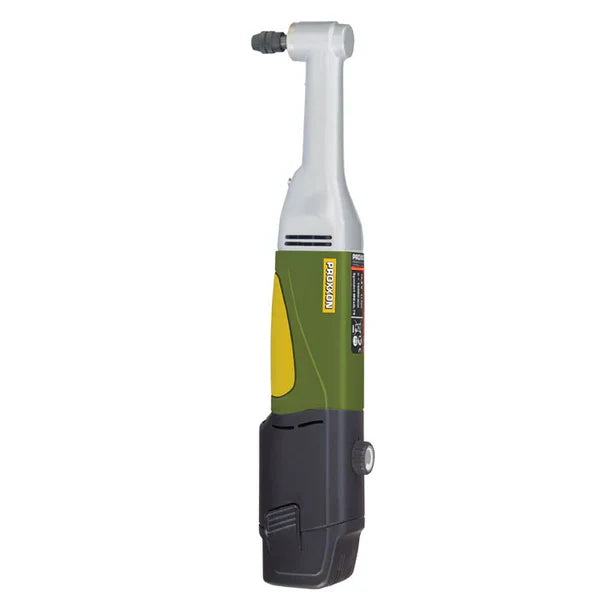
PrBoth the Proxxon LWB/A and LHW/A are 10.8V cordless long-neck tools on the same MICROMOT battery platform — same voltage, same long-neck form factor, same /A suffix meaning cordless lithium-ion. But they do completely different jobs, and the difference comes down to one thing: what mounts on the head.
Quick Reference
| LWB/A | LHW/A | |
|---|---|---|
| Mount type | Collet (shank grip) | Center bore disc mount |
| Accessories | Bits, burrs, cutters, mounted points | Cut-off wheels, grinding discs, sanding pads |
| Motion | Spins like a drill (point-end tools) | Spins like a saw blade (flat discs) |
| Speed | 5,000–16,000 RPM | 5,000–16,000 RPM |
| Disc/collet size | 1.0–3.2mm shanks (6 collets included) | 50mm (2") disc, 10mm bore |
| Best for | Drilling, milling, carving, polishing, detail work | Cutting, grinding, sanding, shaping |
| Primary customer | Restorers, jewelers, model makers, detail stone work | Stone fabricators — higher-volume SKU |
What Is a Collet?
A collet is a slotted metal sleeve that grips a tool’s shank — the smooth cylindrical shaft of a bit, burr, or cutter — by squeezing around its full circumference when a nut is tightened. The tool slides in from the end and gets clamped from all sides.
- Holds the tool by its shank, not through it
- Tool diameter must match the collet (1.0, 1.5, 2.0, 2.4, 3.0, 3.2mm on the LWB/A)
- Tool spins on its own axis, centered tight — minimal runout
- Used for: drill bits, router/milling bits, burrs, mounted points
Think Dremel-style — same principle, higher precision. The LWB/A ships with 6 MICROMOT hardened steel collets covering the full range.
What Is a Center Bore Disc Mount?
The center bore (disc mount) system works differently: the disc has a hole through the middle that drops over a threaded spindle on the tool. A nut or flange threads down on top to clamp the disc flat against the tool’s face.
- Holds the tool by its center hole, sandwiched between two flanges
- Disc spins flat, like a tiny circular saw blade or sanding pad
- Handles lateral force well — designed for material removal
- Used for: cut-off wheels, grinding discs, flap discs, sanding backers
Think 4" angle grinder — same principle, smaller (50mm) disc. The LHW/A uses a 50mm disc with a 10mm center bore.
The Practical Difference
Collet = grips a stick. The shank goes in, the tool sticks out the end. Spins like a drill. Used for point-end tools: bits, burrs, cutters.
Center bore = grips a donut. A flat disc is clamped on a post. Spins like a saw blade. Used for flat disc tools: cut-off wheels, grinding discs, sanding pads.
That’s why the LWB/A does drilling and milling (point-end tools) and the LHW/A does cutting and grinding (flat discs). Different mounting = different geometry of work.
Which One Should You Stock?
If you’re stocking for Tile Installers, the LWB/A is the higher-volume SKU by a wide margin. Fabricators reach for it for small cuts, grinding seams, and sanding tight inside corners that a standard 4" grinder can’t get into.
The LWH/A is more of a niche/specialty buy — restorers, jewelers, model makers, and the occasional stone fabricator doing inlay or fine detail work.
Battery Runtime Note
Both tools run on the Proxxon MICROMOT 10.8V platform. Proxxon rates the 2.5Ah battery at approximately 30 minutes at max power. For fabricators hitting it hard, pitch the spare battery SKU alongside either tool — or they’ll come back complaining about downtime.