
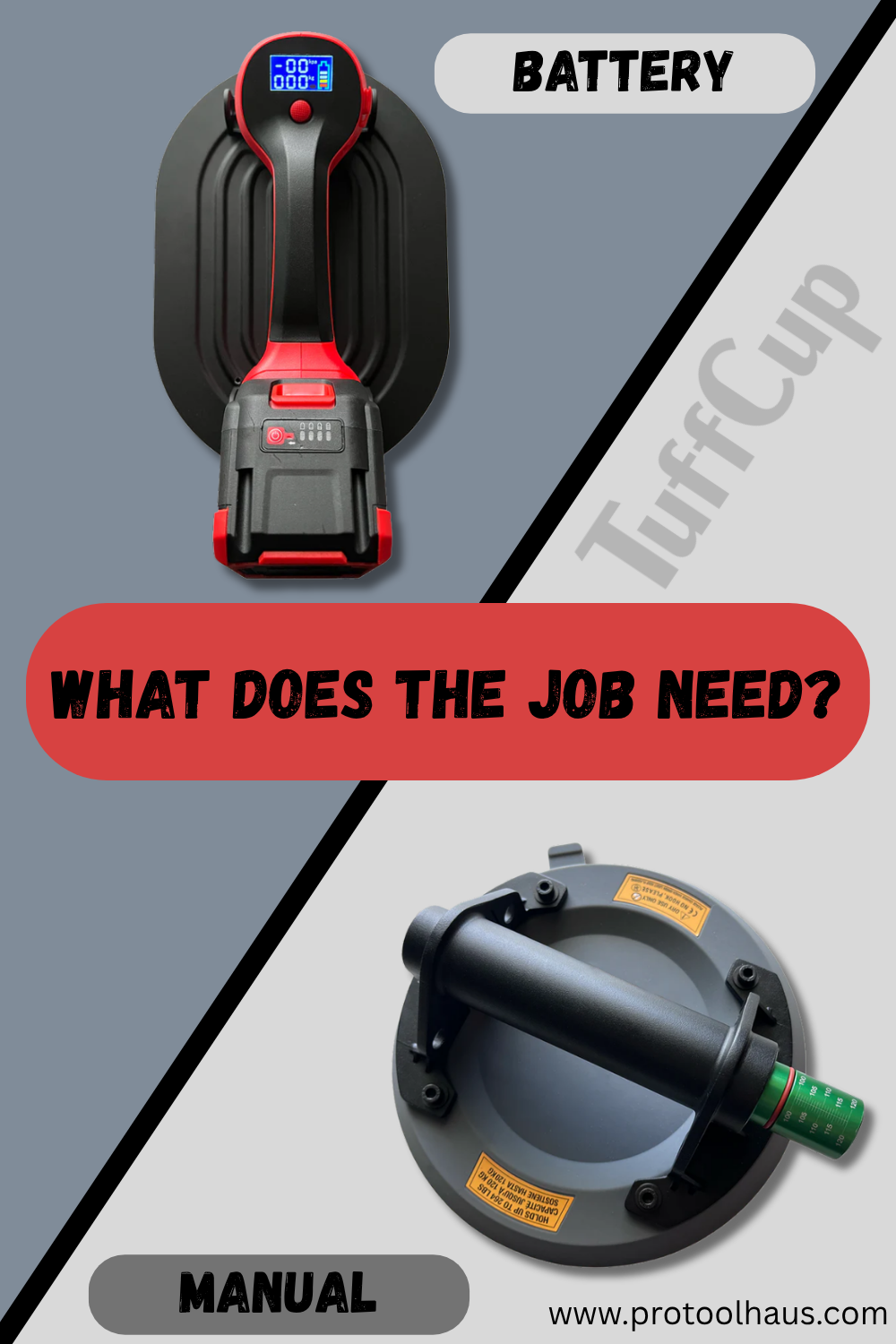
When it comes to lifting stone, glass, and tile on the job site, the tool you choose matters as much as the technique. Vacuum cups have become the standard for safe, mark-free material handling — but with battery-powered and manual options available, the choice isn't always obvious.
This guide breaks down the key differences between battery-powered and manual suction cups, and helps you decide which is right for your workflow, your surfaces, and your job site conditions.
How Vacuum Cups Work
All vacuum cups work on the same principle: a rubber or foam pad creates an airtight seal against a non-porous surface, and suction holds the material in place during lifting and placement. The difference between battery-powered and manual models is how that suction is generated and maintained.
- Manual vacuum cups use a hand pump or lever mechanism to create suction. Once pumped, the seal holds passively — no power required.
- Battery-powered vacuum cups use an electric motor to continuously generate and monitor suction pressure, with auto start/stop systems that maintain a consistent hold throughout the lift.
Battery-Powered Vacuum Cups: Pros & Cons
Advantages
- Consistent suction monitoring — Auto start/stop systems continuously adjust pressure. LED displays give real-time feedback on suction level and battery status.
- Higher sustained capacity — Electric motors maintain suction without degradation over time, even on longer lifts.
- Hands-free operation — No need to re-pump between lifts. Set it, lift it, place it.
- Longer practical hold time — Models like the TuffCup Eos and TuffCup Poseidon offer 48+ hours of continuous runtime per charge.
- Better for high-volume work — If you're setting dozens of tiles or slabs per day, electric cups reduce fatigue and speed up workflow.
Considerations
- Requires charging — USB-C on most TuffCup models (2.5–8 hours depending on model)
- Slightly heavier than comparable manual models
- Higher upfront cost
Best TuffCup Battery-Powered Models
- TuffCup Hermes Mini — 132 lb, 1.1 lbs, IP54, 24+ hr runtime. Best for precision work on smaller panels.
- TuffCup Poseidon 8" — 220 lb, 1.9 lbs, 48+ hr runtime. Lightweight electric for daily professional use.
- TuffCup Titan 8" LED — 264 lb, metal body, LED display, 48+ hr runtime. Mid-range workhorse.
- TuffCup Eos 9" LED — 330 lb, metal body, LED display, 48+ hr runtime. Heavy-duty smooth surface lifting.
- TuffCup Ares 9" x 5.5" LED — 308 lb, foam ring pad for rough surfaces up to 1/8" texture. USB-C, 24+ hr runtime.
- TuffCup Athena 11" LED — 440 lb, foam ring pad for rough surfaces up to 3/8" texture, waterproof, Handle Frame compatible.
- TuffCup Hades 13.3" x 8.7" LED — Largest pad in the lineup, dual 21V batteries, 200W motor, Handle Frame compatible.
Manual Vacuum Cups: Pros & Cons
Advantages
- No charging required — Ready to use anywhere, anytime. No downtime waiting for a battery.
- Lighter weight — Manual cups are typically lighter than their electric equivalents.
- Lower cost — Simpler mechanism means a lower price point.
- Reliable backup — Even if your electric cup runs low, a manual cup keeps you working.
- Long passive hold — The TuffCup Apollo holds suction for 24+ hours per pump on a properly sealed surface.
Considerations
- Requires re-pumping if suction drops — no auto monitoring
- No LED feedback on suction level
- Best suited for smooth, non-porous surfaces
- Less ideal for very high-volume repetitive lifting
Best TuffCup Manual Models
- TuffCup Apollo 8" — 264 lb horizontal / 165 lb vertical, 2.2 lbs, metal body, 24+ hr hold. The go-to manual single-pad cup.
- TuffCup Gemini Double — 176 lb, dual 5" plates, 1.4 lbs. Even load distribution for glass panels and thin stone slabs.
Which Should You Choose?
Use this quick decision guide:
- High-volume daily production shop → Battery-powered. Auto monitoring, consistent suction, and hands-free operation pay off at scale.
- Job site without reliable power access → Manual. The Apollo holds 24+ hours per pump — no outlet needed.
- Lifting glass panels or thin stone → Gemini Double for two-point load distribution, or Hermes Mini for compact electric precision.
- Mixed smooth and rough surfaces on the same job → Pair an electric smooth-surface cup (Eos or Titan) with a foam ring pad rough-surface cup (Ares or Athena).
- Backup tool for your electric cup → Apollo. Same 264 lb capacity as the Titan, no battery required.
- Large-format panels requiring two-handed control → Athena or Hades with the TuffCup Handle Frame.
The Bottom Line
Battery-powered cups are the right choice for most professional, high-volume applications — the auto monitoring, LED feedback, and consistent suction make them faster and safer for repetitive lifting. Manual cups earn their place as reliable backups, job-site-anywhere tools, and cost-effective options for lower-volume work.
The best shops carry both.
Browse the full TuffCup vacuum cup lineup at Pro Tool Haus, or start with the Apollo if you're looking for a dependable manual cup to add to your toolkit.