
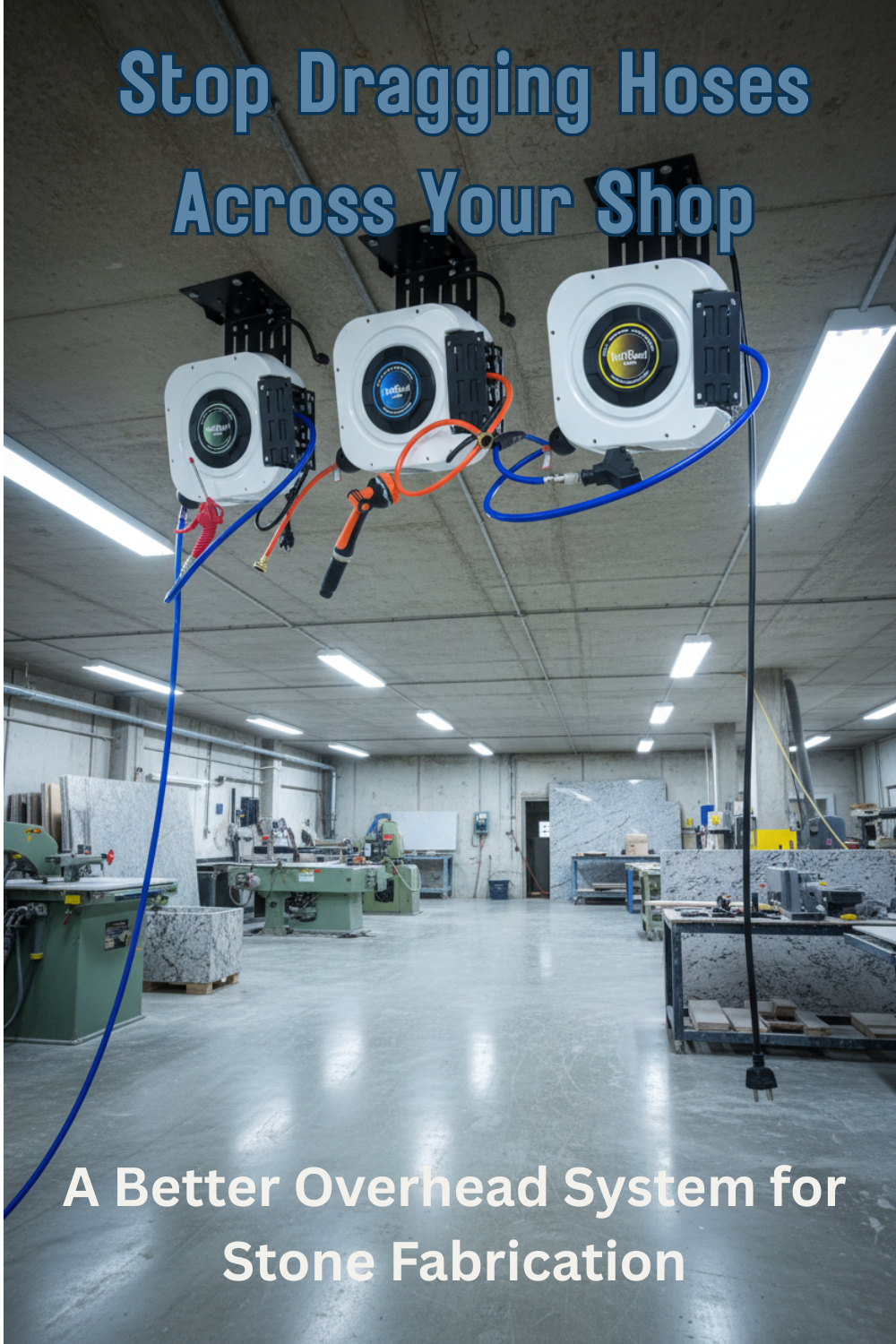
Walk into any well-run stone fabrication shop and you'll notice one thing immediately: the floor is clear. No air hoses snaking across wet concrete, no extension cords running under bridge saws, no water lines creating trip hazards between workstations. Everything runs overhead.
If your shop still has hoses and cords on the floor, this guide is for you. We'll cover how to plan and install a complete overhead retractable system for air, water, and power using the TuffReel line from Tenax USA — and why it's one of the highest-ROI shop upgrades you can make.
Why Overhead Reels Matter in a Stone Fabrication Shop
Safety
Stone fabrication is a wet environment. Water is constantly running — for blade cooling, slurry control, and surface rinsing. Hoses and cords on a wet floor are a serious slip and shock hazard. OSHA citations for trip hazards and electrical safety violations in fabrication shops are common and expensive. Overhead reels eliminate the hazard at the source.
Productivity
Every time a fabricator has to step over a hose, untangle a cord, or drag a line across the shop, that's lost time. Overhead reels deliver air, water, and power exactly where you need it — pull, lock, work, retract. No coiling, no dragging, no untangling.
Equipment Protection
Hoses and cords on the floor get run over by carts, stepped on, kinked, and abraded. Overhead storage extends the service life of your lines significantly and reduces the frequency of hose and cord replacement.
Shop Appearance
A clean, organized shop signals professionalism to customers, inspectors, and employees. If you run a showroom or have clients visit your shop, overhead utilities are a visible indicator of a well-run operation.
The Three Reels You Need
TuffReel Aero — 50 FT Retractable Air Hose Reel
The Aero handles your pneumatic tools — grinders, inflators, sprayers, and blow guns. Key specs for stone fabrication:
- 50 FT reinforced PU + mesh hose (4' lead-in, 46' output)
- 300 PSI maximum working pressure
- 3/8" ID x 1/2" OD hose — standard for most pneumatic tools
- Ratchet lock holds at any length; auto-retract with a forward tug
- Wall or ceiling mount with 180° swivel coverage
- Lead-free, safety-certified fittings
Best placement: Above your grinder station or anywhere pneumatic tools are used regularly.
TuffReel Hydro — 50 FT Retractable Water Hose Reel
The Hydro keeps your water line overhead and out of the work zone — critical for blade cooling, slurry rinsing, and surface cleaning. Key specs:
- 50 FT reinforced PU + mesh hose (4' lead-in, 46' output)
- 300 PSI maximum working pressure
- Brass fittings — leak-resistant and thread-seal compatible
- Weather-resistant housing — built for wet shop environments
- Ratchet lock + smooth auto-retract
- Wall or ceiling mount
Best placement: Above your bridge saw, wet polishing station, or sink area.
TuffReel Volt — 50 FT Retractable Electric Cord Reel
The Volt keeps power cords overhead and out of wet work zones — the most critical safety upgrade in a wet shop. Key specs:
- 50 FT 12 AWG grounded cable (4' lead-in, 46' output)
- 20 Amp / 2500W capacity
- Triple grounded outlets — power multiple tools simultaneously
- Thermal overload protection — automatically prevents overheating
- Impact-resistant polymer housing
- Wall or ceiling mount with 180° swivel coverage
Best placement: Above any workstation where electric tools are used — polishing stations, detail work areas, or anywhere you currently run extension cords.
Planning Your Overhead System
Step 1 — Map Your Workstations
Walk your shop and identify every workstation that uses air, water, or power. Common stations in a stone fabrication shop:
- Bridge saw — water (blade cooling) + power
- CNC machine — water + power
- Grinder/polisher station — air + power
- Wet polishing station — water + power
- Detail/edge work area — air + power
- Sink/cleanup area — water
Each station that uses two or more utilities is a candidate for a multi-reel overhead setup.
Step 2 — Identify Your Supply Points
Each TuffReel has a 4-foot lead-in hose or cable that connects to your supply source:
- Aero (air): connects to your compressed air line or compressor outlet
- Hydro (water): connects to your water supply line
- Volt (power): plugs into a standard grounded 110V / 20A outlet
Plan your reel mounting positions so the lead-in reaches your supply point comfortably. If your air and water supply lines run along the ceiling or upper wall, mounting the reels directly at the supply point is ideal.
Step 3 — Choose Wall vs. Ceiling Mount
All three TuffReels support both wall and ceiling mounting with 180° swivel coverage. General guidance:
- Ceiling mount: Best for central workstations where coverage is needed in multiple directions. The swivel allows the reel to serve a wider area.
- Wall mount: Best for workstations positioned against a wall. Easier to access the lead-in connection and keeps the reel out of overhead clearance zones.
Step 4 — Determine Reel Height
Mount reels high enough that the extended hose or cord clears your tallest equipment and doesn't create a new overhead hazard, but low enough that the lead-in connection is accessible for maintenance. A typical mounting height in a fabrication shop is 8–10 feet, depending on ceiling height and equipment clearance.
Step 5 — Install in Order: Water → Air → Power
If installing all three at a single station, install in this order:
- Hydro (water) first — water supply connections are the most involved and set the position anchor for the other reels
- Aero (air) second — connect to your air line once the Hydro position is confirmed
- Volt (power) last — electrical connections should always be made last, with power off at the breaker
Installation Tips
- Use lag bolts into studs or joists — all three reels are heavy when loaded (10–15 lbs empty; more with hose tension under load). Never mount into drywall alone.
- Check working pressure before connecting the Hydro — if your shop water pressure exceeds 300 PSI, install a pressure regulator upstream of the reel.
- Verify your outlet is 20A rated before connecting the Volt — the Volt draws up to 20A at full load. A 15A outlet will trip the breaker under load.
- Test the ratchet lock before use — pull the hose or cord to several lengths and confirm the lock engages cleanly before putting the reel into service.
- Label your reels — in a busy shop with multiple reels overhead, a simple label (AIR / WATER / POWER) prevents the wrong line from being pulled at the wrong station.
Maintenance
Aero (Air)
- Bleed air pressure from the hose after each use — do not store the reel under pressure
- Inspect fittings quarterly for leaks
- Check hose for abrasion or kinking annually
Hydro (Water)
- Drain the hose after each use, especially in cold climates where freezing is a risk
- Inspect brass fittings for mineral buildup or corrosion annually
- Store in a dry location if the shop is not climate-controlled
Volt (Power)
- Unplug the reel when not in use — do not leave energized overnight
- Inspect the cable for cuts, abrasion, or exposed wire quarterly
- Do not exceed 2500W combined load across all three outlets
- Test the thermal overload protection annually by running at near-full load and confirming the protection trips before the cable overheats
Shop All TuffReel Products
- TuffReel Aero — 50 FT Retractable Air Hose Reel →
- TuffReel Hydro — 50 FT Retractable Water Hose Reel →
- TuffReel Volt — 50 FT Retractable Electric Cord Reel →
- Shop All Hose Reels at Pro Tool Haus →
Pro Tool Haus is an authorized distributor of Tenax USA products, including the TuffReel line. Ships from Charlotte, NC. See all Tenax USA products →