
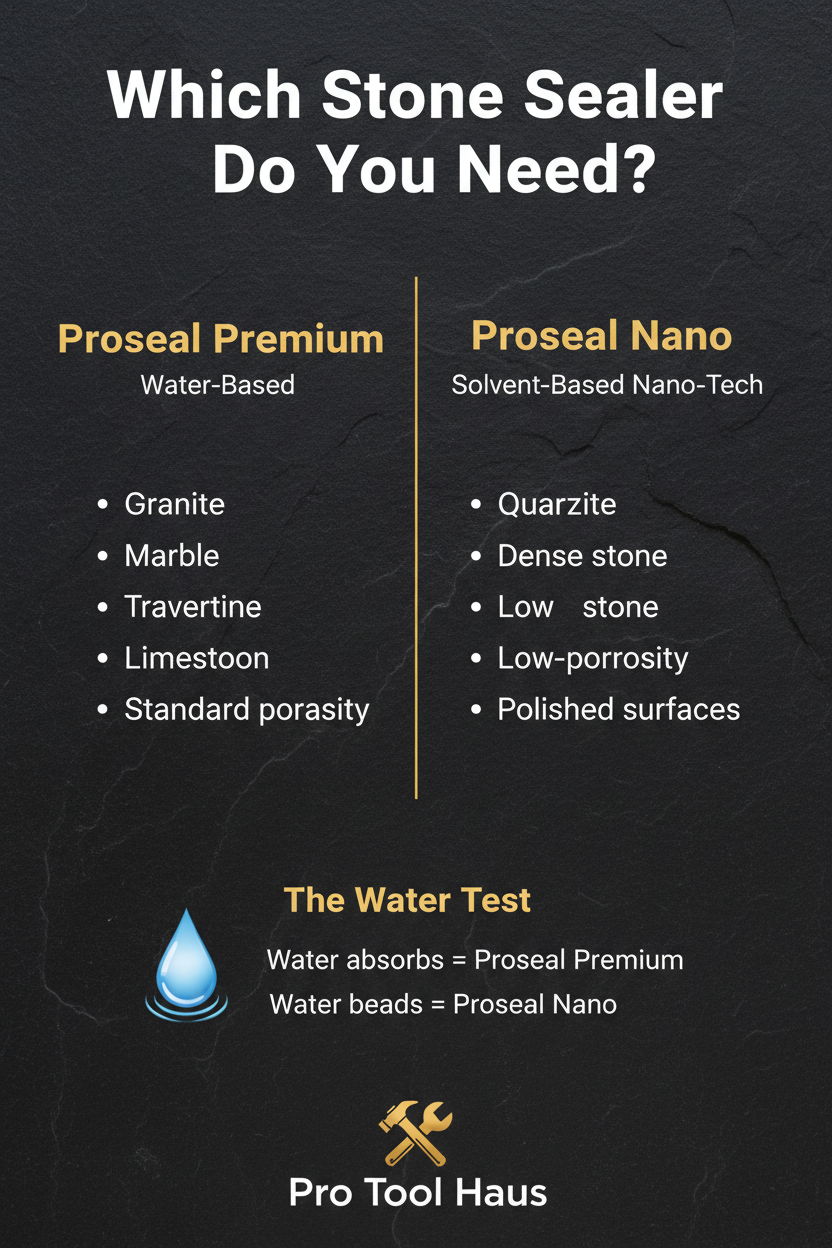
Sealing stone is one of the most important steps in any countertop installation or restoration project — but not all sealers work the same way on all stone. The two most common questions we get at Pro Tool Haus: "Which Tenax sealer should I use?" and "What's the difference between Proseal and Proseal Nano?"
This guide answers both.
What Is an Impregnating Sealer?
Both Proseal and Proseal Nano are impregnating sealers — meaning they penetrate into the pores of the stone rather than sitting on top as a surface coating. This is important because:
- They don’t change the appearance of the stone (no glossy film, no plastic look)
- The stone continues to breathe naturally
- Protection comes from within the stone, not from a surface layer that can wear off
- They last significantly longer than topical waxes or coatings
The difference between the two comes down to chemistry and stone type.
Tenax Proseal Premium — The Standard Choice
Tenax Proseal Premium Stone Sealer is a water-based impregnating sealer suitable for the widest range of natural and engineered stone surfaces. It’s the right choice for most standard stone sealing applications.
Best for:
- Granite countertops and floors
- Marble (stain protection only — does not prevent etching)
- Travertine, limestone, and sandstone
- Engineered quartz and concrete
- Onyx, slate, and terrazzo
Key specs:
- Up to 5-year protection on areas not under heavy wear
- Protects against oil and water-based stains (coffee, wine, oil, mustard, ketchup)
- Works on polished, honed, brushed, and matte finishes
- Indoor and outdoor use
- Coverage: 215–323 sq ft per liter depending on porosity
- Apply between 50°F–95°F; ideal at 68°F–77°F
When to choose Proseal: When you’re sealing granite, marble, travertine, limestone, or most standard natural stone and you want reliable, long-lasting stain protection without altering the stone’s appearance.
Tenax Proseal Nano — For Quartzite and Dense Stone
Tenax Quartzite Sealer Proseal Nano is a solvent-based impregnating sealer that uses nano-technology to penetrate the micro-pores of dense, low-porosity stone. It’s specifically formulated for quartzite — a stone that standard water-based sealers often struggle to penetrate adequately.
Best for:
- Quartzite (primary application)
- Dense, low-porosity stone where water-based sealers underperform
- Polished and glossy surfaces with higher absorption rates
- Marble, granite, limestone, travertine, concrete, and agglomerates (secondary applications)
Key specs:
- Nano-technology formula penetrates stone micro-pores
- Solvent-based for superior penetration on dense surfaces
- No hydrocarbons — safer formulation
- No surface film; stone breathes naturally
- Coverage: 215–323 sq ft per liter
- Indoor and outdoor use
When to choose Proseal Nano: When you’re sealing quartzite, or any dense stone where you’ve tried a water-based sealer and found it beading on the surface rather than absorbing. If the sealer won’t soak in, the stone needs a solvent-based formula.
Side-by-Side Comparison
| Proseal Premium | Proseal Nano | |
|---|---|---|
| Base | Water-based | Solvent-based |
| Technology | Standard impregnating | Nano-technology |
| Best for | Granite, marble, travertine, limestone | Quartzite, dense/low-porosity stone |
| Penetration | Standard | Deep micro-pore penetration |
| Surface film | None | None |
| Indoor/outdoor | ✅ | ✅ |
| Hydrocarbons | — | None |
| Shelf life | 1 year | 1 year |
How to Tell Which One You Need
Step 1: Identify your stone.
If it’s quartzite, start with Proseal Nano. If it’s granite, marble, travertine, or limestone, start with Proseal Premium.
Step 2: Do the water test.
Apply a few drops of water to the stone surface. If the water absorbs within a few minutes, the stone is porous and will accept a standard water-based sealer. If the water beads and sits on the surface for a long time, the stone is dense and low-porosity — use Proseal Nano.
Step 3: Test before committing.
Always test your sealer on an inconspicuous area first. Apply, wait 10 minutes, and check for absorption. If the sealer beads rather than soaks in, switch to Proseal Nano.
How to Apply Either Sealer
The application process is the same for both products:
- Clean the stone thoroughly with an approved stone cleaner and dry completely
- Apply the sealer evenly using a brush, sponge, cloth, or low-pressure sprayer
- Allow the stone to absorb the sealer — do not let it dry on the surface
- Buff with a clean cloth 4–5 minutes after application to remove excess
- Repeat the application after 10–15 minutes
- Allow 24 hours for full protection to develop — do not walk on treated floors during this time
Important: What Stone Sealers Don’t Do
Both Proseal and Proseal Nano protect against staining — they do not protect against etching.
Etching is a chemical reaction that occurs when acidic substances (wine, citrus, tomato, coffee, vinegar) contact calcium-based stone like marble and limestone. The acid reacts with the calcium carbonate in the stone, leaving a dull mark or ring that is not a stain — it’s physical damage to the stone surface. If you’re dealing with etch marks on marble, a sealer won’t help. You’ll need a polishing powder or etch remover to restore the surface.
Also Consider: Ager Stone Enhancing Sealer
If you want stain protection and a richer, deeper color on your stone, consider Tenax Ager Stone Enhancing Sealer. Ager is a solvent-based impregnating sealer that deepens and enriches the natural color and grain of stone while providing the same stain protection as Proseal. The color enhancement is permanent — test on an inconspicuous area first.
Download the Full Tenax Sealer Comparison Chart
Not sure which Tenax sealer is right for your specific stone? Download the Tenax Sealer Comparison Chart 2026 (PDF) for a complete side-by-side comparison of all Tenax sealer products.
Shop Tenax Sealers at Pro Tool Haus
- Tenax Proseal Premium Stone Sealer →
- Tenax Quartzite Sealer Proseal Nano →
- Tenax Ager Stone Enhancing Sealer →
Pro Tool Haus is a certified distributor of Tenax USA products.