
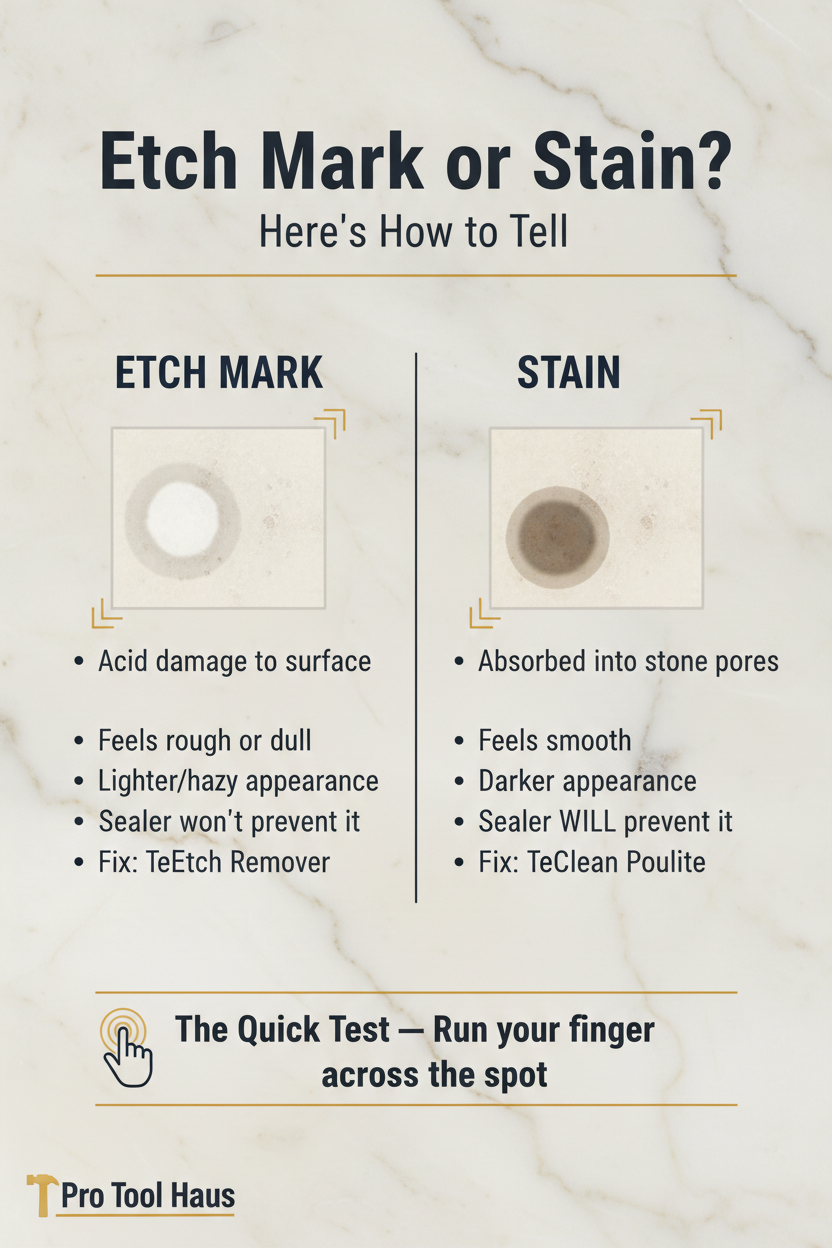
If you've ever noticed a dull ring on your marble countertop after setting down a wine glass, or a dark spot that won't wipe away, you've encountered one of the two most common stone surface problems: etching and staining. They look similar, they're often confused for each other — and they require completely different fixes.
Using the wrong treatment won't just fail to solve the problem. It can make it worse.
This guide will help you identify which one you're dealing with and walk you through exactly how to fix it.
What Is an Etch Mark?
An etch mark is physical damage to the stone surface — not a stain. It happens when an acidic substance comes into contact with calcium-based stone (marble, limestone, travertine, onyx, alabaster) and chemically reacts with the calcium carbonate in the stone, dissolving a thin layer of the polished surface.
Common causes of etching:
- Wine, citrus juice, tomato sauce
- Coffee, vinegar, salad dressing
- Cleaning products containing acids (bleach, bathroom cleaners)
- Carbonated beverages
What etching looks like:
- Dull, hazy, or lighter-colored spot or ring
- Rough or matte texture where the stone was previously polished
- Often appears immediately after contact with an acidic substance
- Does not wipe away — it's in the surface, not on it
Important: Sealers do not prevent etching. Etching is a chemical reaction with the stone itself — a sealer protects the pores from absorbing liquids, but it cannot stop acid from reacting with calcium carbonate on the surface.
What Is a Stain?
A stain is discoloration caused by a substance being absorbed into the pores of the stone. Unlike etching, staining is not surface damage — it's contamination inside the stone.
Common causes of staining:
- Cooking oil, grease, butter
- Coffee, tea, wine (absorbed rather than etched)
- Rust from metal objects left on stone
- Ink, dyes, or pigments
What staining looks like:
- Darker-colored spot, often matching the color of the substance that caused it
- May appear gradually as the substance soaks deeper into the stone
- Does not change the texture or finish of the stone
- May wipe away partially on the surface but the discoloration remains in the pores
Important: Staining primarily affects unsealed or under-sealed stone. A properly sealed stone surface will resist most common stains.
The Quick Test: Etch or Stain?
Run your finger across the spot.
- If the surface feels rough, dull, or different in texture compared to the surrounding stone → it's likely an etch mark
- If the surface feels smooth and normal but the color is different → it's likely a stain
Look at the color.
- Etch marks are typically lighter or hazy — the polished surface has been dulled
- Stains are typically darker — the pores have absorbed a colored substance
Consider what caused it.
- Acidic substance (wine, citrus, coffee, vinegar) on marble, limestone, or travertine → almost certainly an etch mark
- Oil, grease, or pigment on any stone → likely a stain
How to Fix an Etch Mark
Etch marks require mechanical re-polishing — you need to physically restore the surface that was dissolved by the acid.
For spot etch repair on marble, limestone, travertine, onyx, or alabaster:
Use Tenax TeEtch Etch Remover — a polishing compound specifically formulated for calcium-based stone.
How to use TeEtch:
- Apply a spoonful of TeEtch compound directly onto the etch mark
- Using a clean cloth, rub in a circular motion over the area
- After 2–3 minutes, the etch will be mechanically removed and the surface re-polished
- For larger or stubborn areas, use with a buffer
- Wipe clean and inspect; repeat if necessary
For larger areas or deeper etching: Use Tenax Marble Polishing Powder with a polishing machine for full surface restoration.
Do not use TeEtch on granite. Granite is not calcium-based and does not etch. If you have dull spots on granite, use Tenax Granite Polishing Powder.
How to Fix a Stain
Stains require drawing the contamination out of the stone pores — not scrubbing the surface.
For oil, grease, wine, coffee, and organic stains:
Use Tenax TeClean Stain Remover Poultice Powder — a blend of surfactants and diatomaceous earth that draws stains up and out of porous stone using stain reversal chemistry.
How to use TeClean:
- Mix TeClean powder with water to a toothpaste-like consistency
- Apply the poultice directly over the stained area
- Cover with plastic wrap and puncture several small holes to allow slow drying
- Leave in place for 24–48 hours until fully dried
- Remove the dried poultice — the stain will be drawn out with it
- Rinse clean and allow to dry completely; repeat if needed
For surface-level mold, algae, moss, or atmospheric buildup: Use Tenax BrioAction 3 Professional Stain Remover — a sanitizing, 90%+ biodegradable cleaner for heavy contamination on stone, masonry, and hard surfaces.
After the Fix: Seal Your Stone
Whether you've just removed an etch mark or a stain, the next step is the same: seal the stone.
- If your marble etched, a sealer won't prevent future etching — but it will protect against staining, which is the other half of the problem.
- If your stone stained, it almost certainly wasn't properly sealed. Sealing now will prevent the next stain from penetrating.
Choose the right sealer:
- Tenax Proseal Premium Stone Sealer — for granite, marble, travertine, limestone, and most natural stone
- Tenax Quartzite Sealer Proseal Nano — for quartzite and dense, low-porosity stone
Not sure which sealer to use? Read our full guide: Proseal vs. Proseal Nano — Which Tenax Stone Sealer Do You Need? →
Quick Reference Chart
| Etch Mark | Stain | |
|---|---|---|
| Cause | Acid reacting with calcium carbonate | Substance absorbed into stone pores |
| Stone types affected | Marble, limestone, travertine, onyx | Any porous stone |
| Appearance | Dull, hazy, lighter spot | Darker spot matching substance color |
| Texture change | Yes — rough or matte | No — surface feels normal |
| Sealer prevents it? | ❌ No | ✅ Yes |
| Fix | TeEtch or Marble Polishing Powder | TeClean Poultice Powder |
Shop Stone Stain & Etch Removal at Pro Tool Haus
- Tenax TeEtch Etch Remover →
- Tenax TeClean Stain Remover Poultice Powder →
- Tenax BrioAction 3 Professional Stain Remover →
- Tenax Marble Polishing Powder →
- Tenax Proseal Premium Stone Sealer →
Pro Tool Haus is a certified distributor of Tenax USA products.