
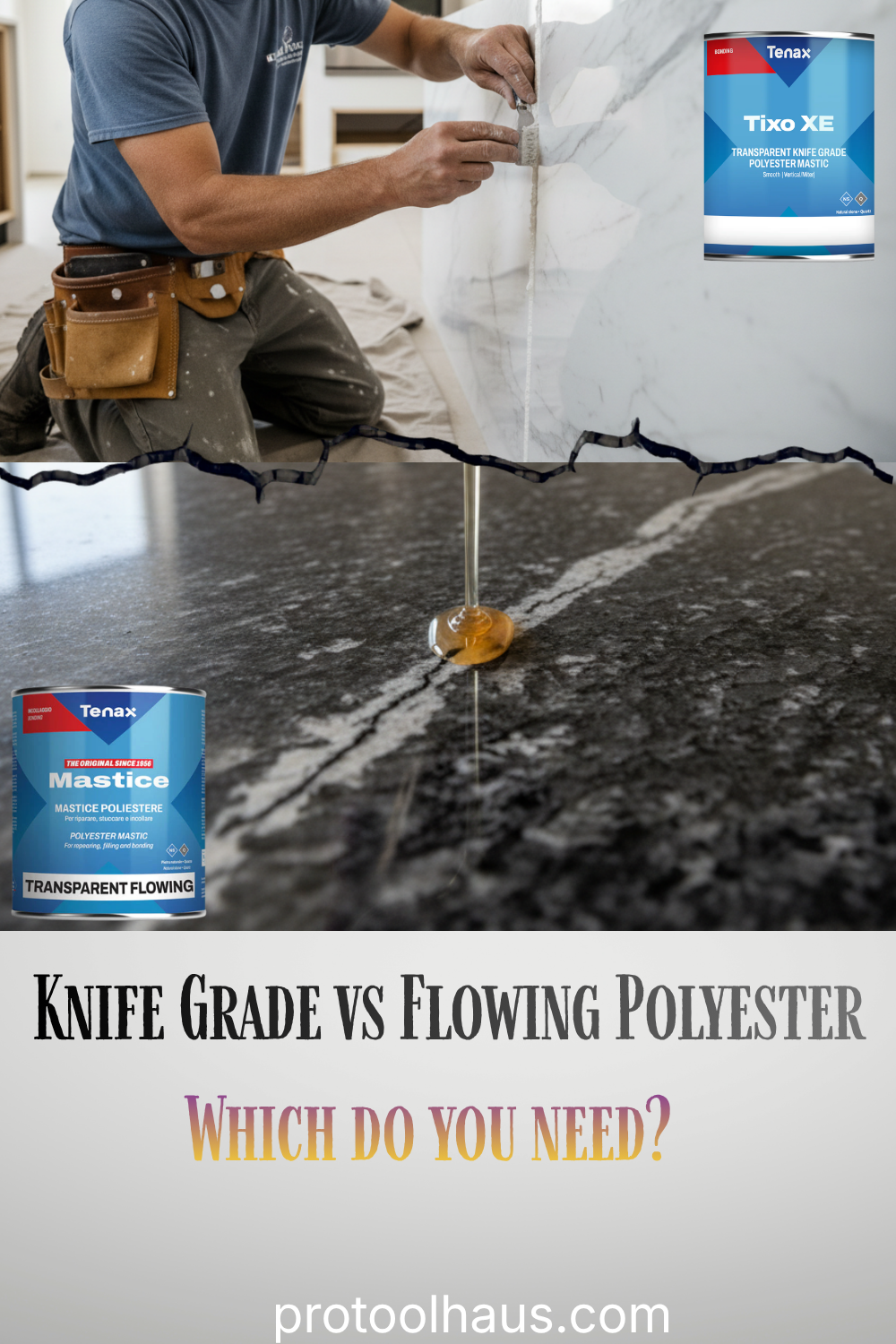
Knife grade or flowing polyester? It's one of the most common questions in a stone fabrication shop — and the answer isn't about preference. It's about the application. Use the wrong one and you'll either have adhesive running out of a seam before it cures, or a mastic too stiff to flow into a tight joint.
Here's how to choose correctly every time.
The Core Difference: Viscosity
The only meaningful difference between knife grade and flowing polyester is viscosity — how thick or thin the adhesive is.
- Knife grade — thick, paste-like consistency. Holds its shape when applied. Does not sag or run on vertical surfaces, edges, or overhangs. You apply it with a putty knife or spatula.
- Flowing — liquid consistency. Self-levels and flows into joints under gravity. Cannot hold a shape on vertical surfaces. You pour or spread it into horizontal seams and channels.
The resin chemistry, cure time, bond strength, and polishability are essentially the same. The viscosity is what changes — and viscosity determines which applications each type can handle.
When to Use Knife Grade
Use knife grade polyester any time the adhesive needs to stay where you put it:
- Vertical seams — backsplash seams, wall cladding, vertical joints
- Edge repairs — chips, breaks, and rebuilds on countertop edges
- 45° miter joints — the adhesive must hold on the angled face during cure
- Surface chips and pits — filling voids on horizontal or vertical surfaces where flowing adhesive would run out
- Bonding overhangs or cantilevered sections — anywhere gravity works against you
Knife grade is also the right choice when you need to build up a repair — adding material in layers to rebuild a broken edge or fill a deep void.
When to Use Flowing Polyester
Use flowing polyester any time you need the adhesive to self-level into a joint:
- Horizontal seams — countertop seams where the slab is flat and level
- Rodding channels — flowing polyester fills around carbon fiber, fiberglass, or steel rods completely and without voids
- Crack repair — thin cracks that a knife grade can't penetrate
- Lamination — bonding a buildup strip or laminated edge where the joint is horizontal
- Tight joints — anywhere the gap is too narrow for a knife grade to be worked in
Flowing polyester relies on gravity to do the work. If the surface isn't level, it will run to the low side. Always ensure the slab is shimmed level before applying.
The Special Case: Travertine
Travertine holes and voids are a unique situation — they're too large for flowing polyester (which runs through) and too irregular for knife grade (which is too stiff to fill completely). Tenax Travertine Filler is a semi-solid polyester developed specifically for this application. It flows into voids without running out and holds its fill level until cured.
Choosing the Right Tenax Formula
Knife Grade Options
Once you've determined you need knife grade, the next decision is color and formula:
- Tixo Xe Transparent Knife Grade — the industry standard transparent knife grade with a 50+ year track record. Clear base, 4–5 minute working time, 12–15 minute cure. Best for white, light-veined, and translucent stone. Available in quart, gallon, and 5-gallon.
- H-Knife Transparent Knife Grade — transparent knife grade for high-volume shops. Available in quart, gallon, and 5-gallon. Compare working characteristics with Tixo Xe and choose based on your preference.
- Prism Premium Knife Grade — ultra-clear, no-shadow formula for fabricators who demand the clearest seam possible. 5–7 minute gel time. Preferred for high-visibility seams on quartz and marble.
- Colored Knife Grade — White & Buff — pre-colored in White and Buff for the most common stone tones. Use when a transparent base would read as a visible line against a solid-colored stone.
- Thassos T Knife Grade — formulated specifically for Thassos marble and pure bright white stone where standard white reads as off-white or cream.
Flowing Options
- Transparent Flowing Polyester — the industry standard flowing polyester with a 50+ year track record. Clear base, 8–10 minute working time, 15–20 minute cure. Best for mixed-tone, light-veined, and translucent stone. True 1-liter volume.
- Colored Flowing Polyester — White & Buff — pre-colored in White and Buff. Use when a transparent base would show as a visible line against a solid-colored stone seam.
Quick Reference Chart
| Application | Use Knife Grade | Use Flowing |
|---|---|---|
| Vertical seams | ✓ | ✗ |
| Horizontal seams | ✓ (works) | ✓ (preferred) |
| 45° miter joints | ✓ | ✗ |
| Edge chips & rebuilds | ✓ | ✗ |
| Rodding channels | ✗ | ✓ |
| Crack repair (tight) | ✗ | ✓ |
| Lamination (horizontal) | ✓ (works) | ✓ (preferred) |
| Travertine voids | ✗ | ✗ (use Travertine Filler) |
Color Selection: Transparent vs. Colored
Both knife grade and flowing polyester come in transparent and pre-colored versions. The rule is the same for both:
- Transparent — use for white, light-veined, mixed-tone, and translucent stone. The clear base disappears into the joint and can be tinted with Universal Color Paste for precise matching.
- Colored (White or Buff) — use for solid-toned stone where a transparent base would read as a visible line. White for light gray and white stone; Buff for beige, cream, and warm-toned stone.
What You'll Need
For any polyester adhesive application:
- Tenax Hardener — catalyst; available in 45ml, 118ml, and 180ml sizes
- Universal Color Paste — for tinting transparent adhesive to match the stone
- Tenax Mixing Cups — disposable cups for measuring and mixing
- Tenax #9 Razor Blade — for trimming cured adhesive flush before polishing
Further Reading
- Stone Repair Adhesive Guide — Cyanoacrylate vs. Polyester vs. Epoxy: Which Do You Need? →
- How to Choose and Use Knife Grade Polyester for Stone Repair →
Questions about which formula is right for your job? Contact the ProToolHaus team — we're here to help.