
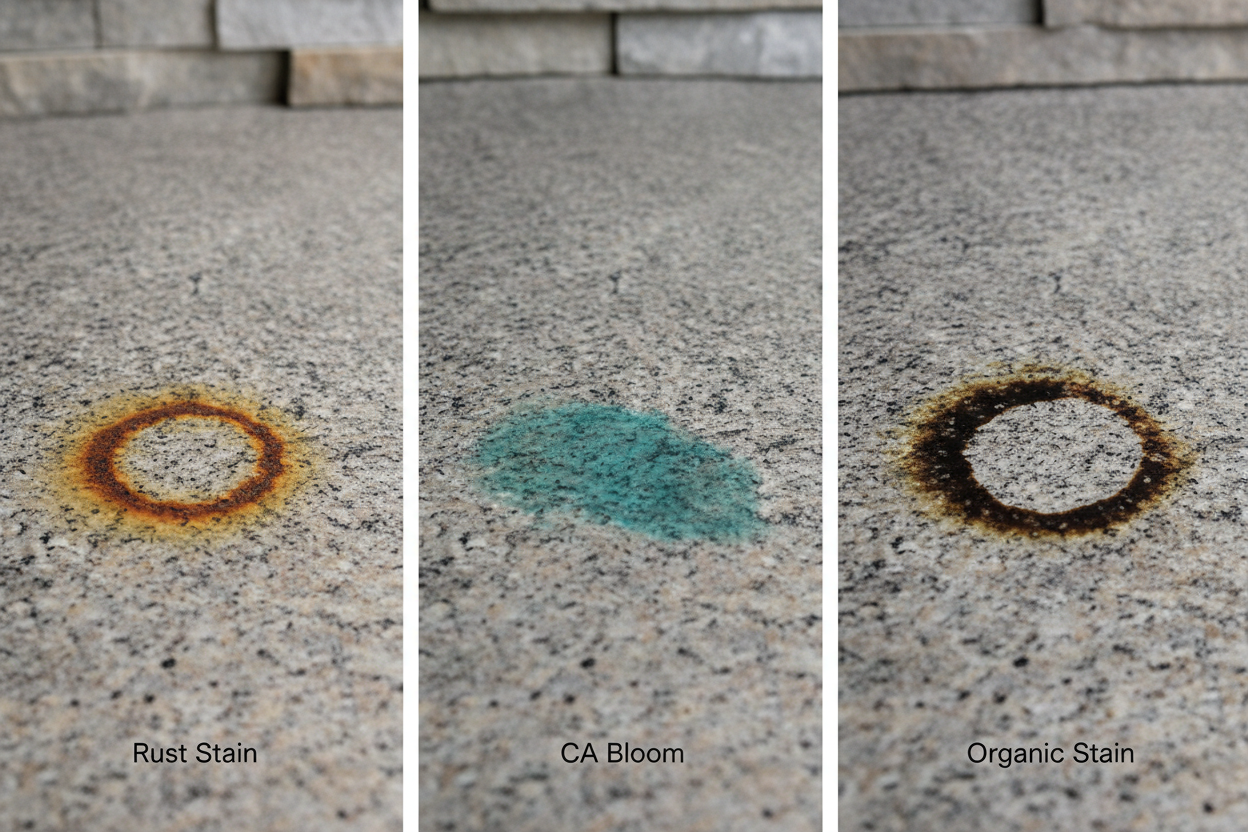
Not all stone stains are the same — and using the wrong product can make things worse. The first step to successful stain removal is identifying what you're dealing with. This guide walks you through the most common stone stain types, how to recognize them, and exactly which product to reach for.
Step 1: Identify Your Stain
Before reaching for any product, look closely at the stain:
- Orange or brown discoloration — likely rust from metal contact, rebar, or iron minerals in the stone
- Blue or green discoloration — almost certainly CA adhesive bloom from cyanoacrylate chip repair adhesives and activators
- Dark spot or ring — likely an organic stain (oil, grease, food, wine, coffee)
- Dull, hazy, or rough patch — likely an etch mark from acid contact (citrus, vinegar, cleaning products)
- White haze or mineral deposits — likely efflorescence or hard water deposits
- General grime, soiling, or surface buildup — deep cleaning needed
Rust Stains — Orange or Brown Discoloration
Cause: Metal contact (tools, rebar, brackets, iron minerals in the stone itself), water runoff from metal fixtures, or iron-rich groundwater.
What to use:
- Tenax TeRust Rust Remover Poultice Powder (8 oz) — mix with water to a toothpaste consistency and apply as a poultice directly over the stain. Cover, wait 24–48 hours, remove. The chelating agents draw the rust up and out of the stone.
- Tenax Rust Remover Liquid (1 Liter) — for deep-set or stubborn rust stains, substitute Rust Remover Liquid for water when mixing the TeRust poultice for enhanced extraction. Also effective as a direct application on unpolished stone surfaces. ⚠️ Acid product — do NOT use on polished marble or calcium-based stone.
After treatment: Seal the surface with Tenax Proseal to prevent future staining.
CA Adhesive Bloom — Blue or Green Discoloration
Cause: Cyanoacrylate (CA) adhesive activators — like those used in chip repair kits — can react with stone or surrounding material and leave a blue or green stain called "bloom." A common frustration after chip repairs on granite, quartz, and marble.
What to use:
- Tenax TeBlossom Bloom Remover Kit — a 2-part chemical poultice specifically formulated to lift and neutralize CA bloom without etching the stone. Mix, apply, cover, wait 24–48 hours, remove.
- Tenax TeBlossom & TeClean Kit — if you also have organic staining alongside the bloom, this bundle adds TeClean Poultice Powder for complete coverage.
Prevention tip: When using TeFill chip repair kits, apply activator sparingly and avoid overspray onto surrounding stone surfaces.
After treatment: Calcium-based stones (marble, travertine, limestone) may etch during treatment — re-polish with Tenax Marble Polishing Powder if needed.
Organic Stains — Oil, Grease, Food, Wine, Coffee
Cause: Cooking oil, grease, food, wine, coffee, tea, or other organic materials absorbed into porous stone.
What to use:
- Tenax TeClean Organic Stain Remover Poultice Powder — a stone-safe surfactant and diatomaceous earth poultice that draws organic stains out of porous stone. Mix with water, apply, cover, wait 24–48 hours, remove. Available as part of the TeBlossom & TeClean Kit.
- Tenax BrioAction 3 Professional Stain Remover — for deep cleaning and restoration of heavily soiled stone and masonry surfaces.
After treatment: Seal with Tenax Proseal or Tenax Ager to close the pores and prevent re-staining.
Etch Marks — Dull, Hazy, or Rough Patches
Cause: Acid contact — citrus juice, vinegar, wine, cleaning products, or even some foods — reacts with calcium-based stone (marble, travertine, limestone) and dissolves the polished surface, leaving a dull or rough patch. Etch marks are surface damage, not stains — they cannot be removed with a cleaner.
What to use:
- Tenax TeEtch Etch Remover (8 oz) — specifically formulated to remove etch marks and water marks from marble, limestone, and travertine. Restores the polished surface without re-polishing equipment.
- Tenax Marble Polishing Powder — for deeper etch damage requiring mechanical re-polishing.
Prevention tip: Seal calcium-based stone with Tenax Proseal and use pH-neutral cleaners only.
General Soiling & Deep Cleaning
Cause: Accumulated grime, surface buildup, construction residue, or general soiling on stone and masonry.
What to use:
- Tenax BrioAction 3 Professional Stain Remover — a professional-grade deep cleaner and restoration product for stone and masonry. Removes surface buildup, construction residue, and general soiling without damaging the stone.
After Any Stain Removal — Seal the Surface
Stain removal opens the pores of the stone. Always seal after treatment to protect against future staining:
- Tenax Proseal Premium Stone Sealer — impregnating sealer for natural and engineered stone, indoor and outdoor
- Tenax Proseal Nano — solvent-based impregnating sealer for quartzite and dense stone
- Tenax Ager Stone Enhancing Sealer — color-enhancing impregnating sealer that deepens the natural color of the stone while sealing
Quick Reference: Stain Type → Product
- Rust (orange/brown) → TeRust Poultice + Rust Remover Liquid (for deep stains)
- CA bloom (blue/green) → TeBlossom Kit
- Organic stains (oil, food, wine) → TeClean (in TeBlossom & TeClean Kit)
- Etch marks (dull patches) → TeEtch Etch Remover or Marble Polishing Powder
- General soiling → BrioAction 3
- After any treatment → Proseal or Ager