
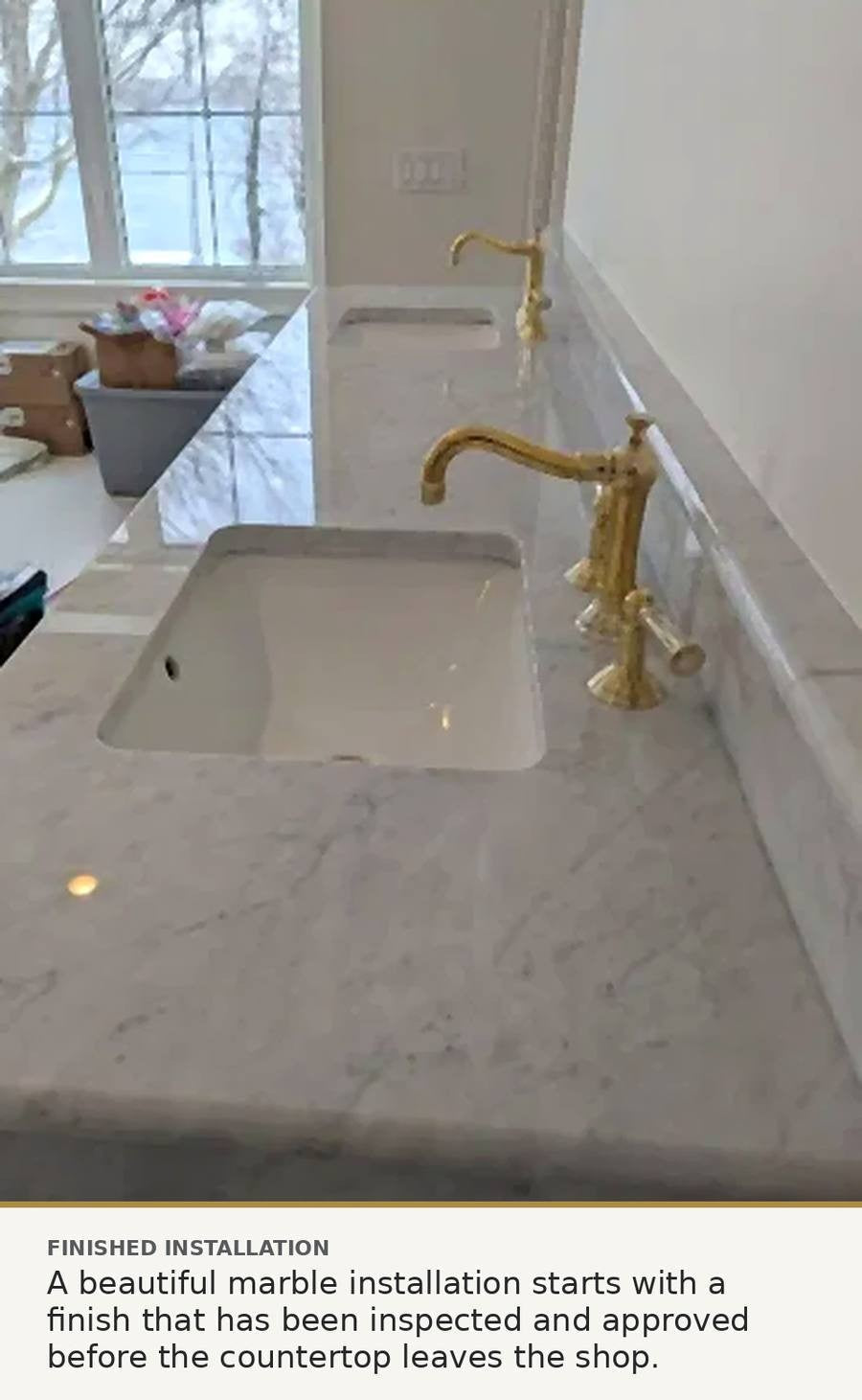
Marble is showing up in more and more shops that never used to touch it — kitchens, vanities, waterfalls, feature walls. Designers are specifying it, homeowners are asking for it, and fabricators who built their business on granite and quartz are suddenly running polished Carrara through the shop and finding out the hard way that it behaves nothing like the engineered stuff.
A working fabricator recently put the question to the trade directly: "For shops that do a lot of marble — are you resurfacing every piece?" The slabs they receive always have some level of damage, and the argument is that every piece should be re-honed or re-polished before it leaves the shop or on site, with the customer charged accordingly. The catch is that it's slow, tedious work. The follow-up question was just as important: how do you set customer expectations about the realities of these stones as a countertop surface?
The responses from other shops were remarkably consistent. Here's what the trade actually does.
The short answer: yes, basically every piece
The consensus among high-volume marble shops is that resurfacing is not optional if you want to deliver a quality finish. As one fabricator put it, "it just about has to be done in order for it to be a quality finish." The manufacturing process, the delivery chain, and the ordinary handling of the stone through staging, storing, and moving all introduce blemishes. A factory finish — even a factory hone — is rarely perfect out of the crate.
One shop reported that 99% of their marble projects are honed, and they resurface as a standard step because the factory hone isn't consistent. They run three Zambon LC 2000 radial-arm polishing stations specifically to handle it. That's a telling detail: shops doing serious marble volume build their process — and their capital equipment — around the assumption that they will be refinishing surfaces in-house, not around the hope that slabs will arrive perfect.
So if you're a shop taking on more marble and wondering whether the resurfacing step is something you can skip on the good slabs, the answer from the people doing the most of it is no. Price it in as a line item, not as an occasional exception.
Why the damage is unavoidable
It helps to understand why marble shows up compromised so you can explain it — to your crew and to your customer.
Marble is calcium carbonate. It is soft, it is porous, and it reacts chemically with anything acidic. That reactivity is the whole problem. Several shops in the thread described etching — dull, matte marks where acid has eaten microscopically into the polished surface — appearing on slabs before they were ever fabricated. One shop had etched drip marks running down slabs that were specially imported from Italy for a job. The likely culprit: acid rain during transport. As one fabricator flatly noted, "nothing you can do about acidic rain during transport." Another agreed it seems to be fairly common on imported material.
That's the part worth sitting with. Even a flawless slab, hand-picked at the distributor, can pick up etching in transit through no fault of anyone in the fab shop. Layer on top of that the scratches from staging, cutting, and moving — one fabricator admitted, "no matter how careful I am I always end up scratching marble, so I end up polishing them" — and you can see why resurfacing becomes a built-in step rather than a repair.
The tooling: what shops use to resurface
The reason resurfacing feels punishing is usually a tooling problem, not a technique problem. Doing it by hand, or with a basic variable-speed polisher, is exactly as slow and miserable as it sounds. The shops that do a lot of marble have invested in machines that make it manageable.
The heavy option is a radial-arm polisher like the Zambon LC 2000 — a dedicated station that swings a polishing head across the surface. Great for volume, but it's a footprint and a real capital cost.
The more accessible option that came up repeatedly is a planetary polisher. The Weha "Pig" was called out by name: a planetary orbit machine that can hone a badly etched marble surface in about an hour and then bring it back to a full polish in a couple of additional steps. One fabricator described it as "basically a radial arm / single-head polisher without the footprint or the extra money." On a waterfall, the same machine can hone or polish the return as well. For shops running marble-only work, the Stone Ray three-head surface grinder/polisher was mentioned as another option.
The workflow detail underneath all of this matters: shape first, then surface, then profile. As one shop described their sequence, they do any shaping first, then polish the surface, then finish the profile. And if you're going to hone rather than polish, remember that most marble countertop work is honed anyway — around 99% of it, per the shops in this discussion — so a planetary machine that gets you to a clean, even hone is often all the job actually requires.
Reject the bad slabs — but know when you can't
The single most-repeated piece of advice was blunt: don't accept damaged material in the first place. As one fabricator laid out the whole philosophy in four steps: first, a marble waiver. Second, if the slabs show up on the delivery truck already damaged, don't accept them. Third, they shouldn't be getting damaged during staging, cutting, fab, transport, or install — that's on your process. Fourth, take copious photos at install, and after that, refer back to step one.
The logic on rejection is important beyond the individual slab: "if we accept damaged products, they will keep sending it." Accepting bad material trains your supplier to keep shipping it.
But every shop also acknowledged the real-world friction. Rejecting slabs "becomes a big hassle when the slabs are hand-picked at a distributor that's hours away." And there's the sunk-cost trap — one fabricator described getting so far into a 25-slab job that rejection was no longer realistic, so they brought the customer in to view the slabs and sign off before proceeding. That's the pragmatic middle ground: when you can't send it back, get the customer's eyes and signature on the actual material before you cut it.
Setting customer expectations before the job starts
This is where shops that are new to marble get burned, and it has nothing to do with fabrication skill.
Start with a marble waiver, in writing, signed before work begins. It should spell out the realities of natural marble as a countertop: it will etch from everyday acids — lemon, wine, vinegar, coffee, many cleaners — and etching is not a defect or a fabrication failure. It's the nature of calcium carbonate. Explain the difference between a stain (something absorbed into the stone) and an etch (a chemical burn to the surface finish), because customers conflate the two constantly.
Set the finish expectation honestly. A honed finish hides etching and everyday wear far better than a polished one, which is a large part of why the trade defaults to honed for marble countertops. A polished finish is beautiful and it is high-maintenance; every etch will show as a dull spot against the shine. If a customer insists on polished marble in a kitchen, that's their call to make — but it should be an informed one, documented.
Then photograph everything at install. Copious, timestamped photos of the finished surfaces protect you when a customer calls three months later about a mark they created. Combined with a signed waiver, that documentation is the difference between a warranty argument and a closed file.
One encouraging note from the trade: expectation-setting is starting earlier in the chain. One fabricator mentioned a distributor salesperson who actually pointed out to the customer, up front, the natural defects that the fabricator wouldn't be able to remove — a rare case of the supply side backing the shop instead of leaving it holding the bag.
The takeaway for shops getting into marble
If marble is becoming a bigger part of your mix, the experience of high-volume shops points to a few clear moves. Treat resurfacing as a standard, priced-in step rather than an exception, because the factory finish and the delivery chain almost guarantee you'll be refinishing. Invest in the right tool — a planetary polisher like the Weha Pig or a radial-arm station — so that resurfacing is a one-hour task instead of an all-day ordeal. Reject damaged material when you can, and when you can't, get the customer to sign off on the actual slabs. And protect yourself on the front end with a written marble waiver, an honest conversation about honed versus polished, and a camera at install.
Marble rewards shops that respect what it is: a soft, reactive, gorgeous natural stone that was never going to behave like quartz. The shops doing well with it aren't the ones who found a way to make it bulletproof. They're the ones who built resurfacing into the process and set expectations before the first cut.
Have a marble workflow that works for your shop? We'd like to hear how you're handling resurfacing, tooling, and customer waivers