
Shop Equipment Guide
Wet vs. Dry Dust Collection Booths: How Stone Fabricators Choose the Right Silica Control
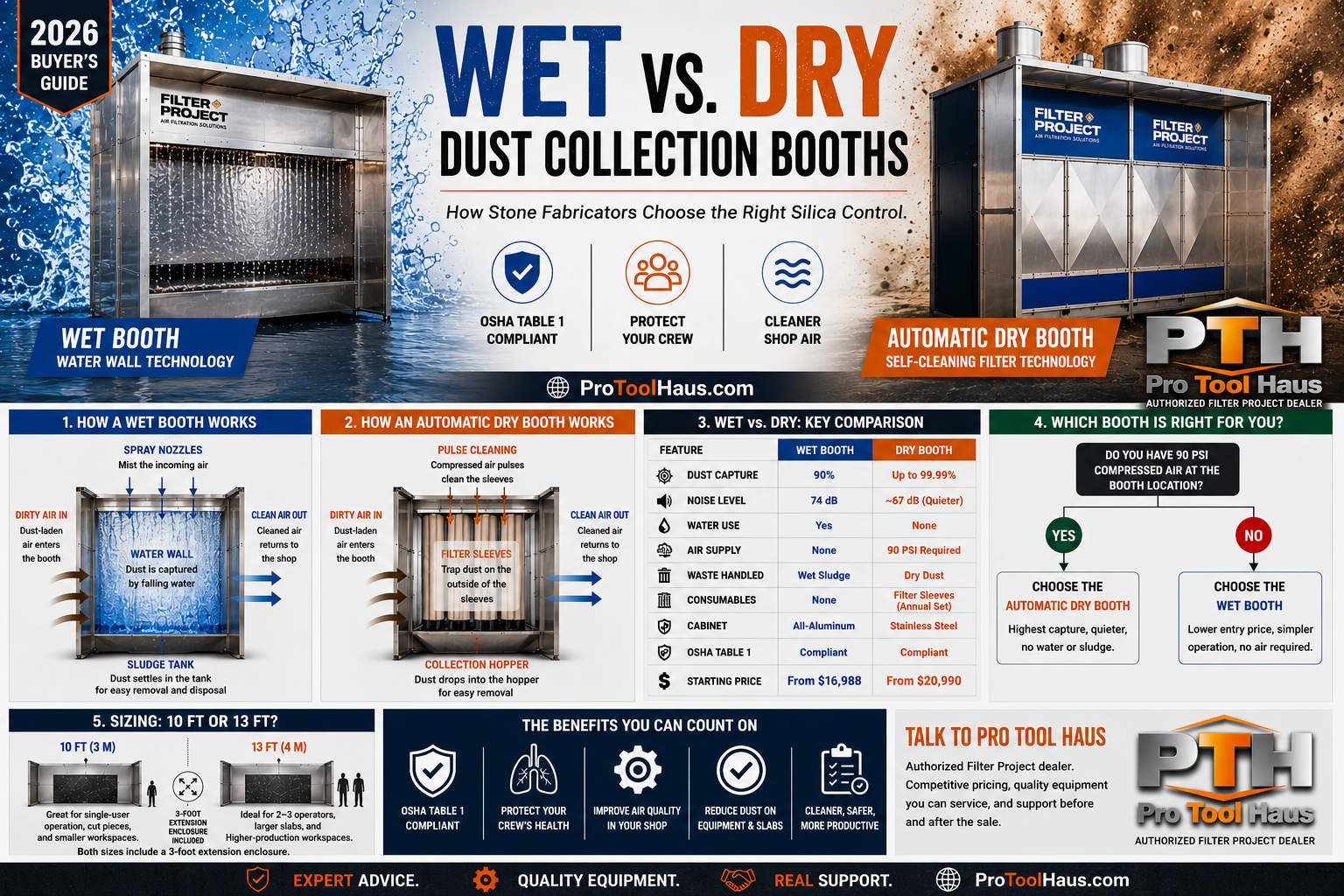
Both booths keep silica dust out of your crew's lungs and your shop OSHA-compliant. The difference is how they capture the dust — and that changes what your shop needs to run one.
By Pro Tool Haus · Authorized Filter Project Dealer · Dust Collection & Water Recycling for Stone Shops
If you cut, grind, or polish engineered stone, granite, or quartz, respirable crystalline silica is the single biggest health hazard in your building — and the one OSHA watches most closely. A dedicated dust collection booth is the cleanest way to pull that dust out of the air at the source, protect your fabricators, and stay on the right side of the OSHA Table 1 silica standard.
Filter Project builds two proven types of booth, and Pro Tool Haus stocks both: wet (water wall) booths and automatic dry booths. They do the same job in fundamentally different ways. Here's how each works, how they compare head-to-head, and how to pick the one that fits your shop.
How a Wet (Water Wall) Booth Works
A wet booth captures dust with water. A sheet of water — the "wall" — runs down the face of the booth, and spray nozzles mist the incoming air. Dust gets heavy, drops out, and settles into a bottom tank as sludge. Cleaned air is recycled back into the shop. Maintenance is simple: empty and rinse the tank, and change the water periodically.
|
SKU TEC711 10 Ft (3 M) Wet Dust Collection Booth $16,988 4.5 HP · 12,000 m³/h airflow · 90% capture · 74 dB · ~400 gal water · all-aluminum |
SKU TEC712 13 Ft (4 M) Wet Dust Collection Booth $18,900 8 HP · 25,000 m³/h airflow · 90% capture · 74 dB · ~400 gal water · all-aluminum |
| Best fit: shops without a compressed-air line at the booth, operations that want the lighter, simpler unit, and crews that would rather never deal with filter bags. The trade-off is that you're managing water and sludge. |
How an Automatic Dry Booth Works
A dry booth skips water entirely. Air is pulled through a bank of filtering sleeves that trap the dust; a compressed-air self-cleaning system automatically pulses the sleeves so the dust drops dry into the collection tank. You get the highest capture rate, a quieter shop, and no water to change — in exchange for a compressed-air supply and periodic filter-sleeve replacement.
|
SKU TEC714 10 Ft (3 M) Automatic Dry Dust Collection Booth $20,990 Single motor · 220V 3-phase · up to 99.99% capture · self-cleaning sleeves · 90 PSI air · stainless cabinet |
SKU TEC715 13 Ft (4 M) Automatic Dry Dust Collection Booth $24,900 220V 3-phase, 30A · up to 99.99% capture · self-cleaning sleeves · 90 PSI air · stainless cabinet |
| Best fit: shops that want the highest capture and cleanest air, a quieter floor, and zero water use. You'll need a compressed-air line and should budget for replacement sleeves (Filter Project recommends a fresh set of 72 sleeves annually). |
Wet vs. Dry: Head-to-Head
| Feature | Wet Booth (TEC711 / TEC712) | Dry Booth (TEC714 / TEC715) |
|---|---|---|
| Capture method | Water wall + spray nozzles | Self-cleaning filter sleeves |
| Dust capture | 90% | Up to 99.99% ✓ |
| Noise | 74 dB | ~67 dB ✓ (quieter) |
| Utility needed | Water supply (~400 gal) | Compressed air (90 PSI) |
| Water use | Yes — refill & change periodically | None ✓ |
| Waste handled | Wet sludge in tank | Dry dust in tank |
| Consumables | None (no filters) | Filter sleeves (annual set) |
| Cabinet | All-aluminum | Stainless steel |
| OSHA Table 1 | Compliant | Compliant |
| Starting price | From $16,988 ✓ | From $20,990 |
Which One Is Right for Your Shop?
Start with two questions: Do you have compressed air at the booth location, and how clean do you need the air to be?
If you don't have a compressed-air line — or you want the lowest entry price and the simplest machine to run — the wet booth is the practical choice. If you want the highest capture rate, a noticeably quieter floor, and no water or sludge to manage, the automatic dry booth earns its higher price, provided you can supply 90 PSI air and keep sleeves on hand.
Sizing: 10 ft or 13 ft?
Both types come in a 10 ft (3 m) and a 13 ft (4 m) width, and both include a 3-foot extension enclosure. Match the width to the size of the pieces you fabricate and the airflow your booth face needs. Bigger slabs and higher throughput point to the 13 ft; a single-station or smaller shop is usually well served by the 10 ft.
| Not sure which size or type fits your floor plan, power, and air setup? That's exactly the call Pro Tool Haus helps stone shops make every week. Send us your layout and we'll size it for you. |
|
Talk to Pro Tool Haus Authorized Filter Project dealer. Competitive pricing, quality equipment you can service, and support before and after the sale. 704-704-5125 · sales@protoolhaus.com |
Tags: dust collection, silica control, OSHA Table 1, stone fabrication, granite, quartz, wet dust collector, dry dust collector, Filter Project, water wall booth