
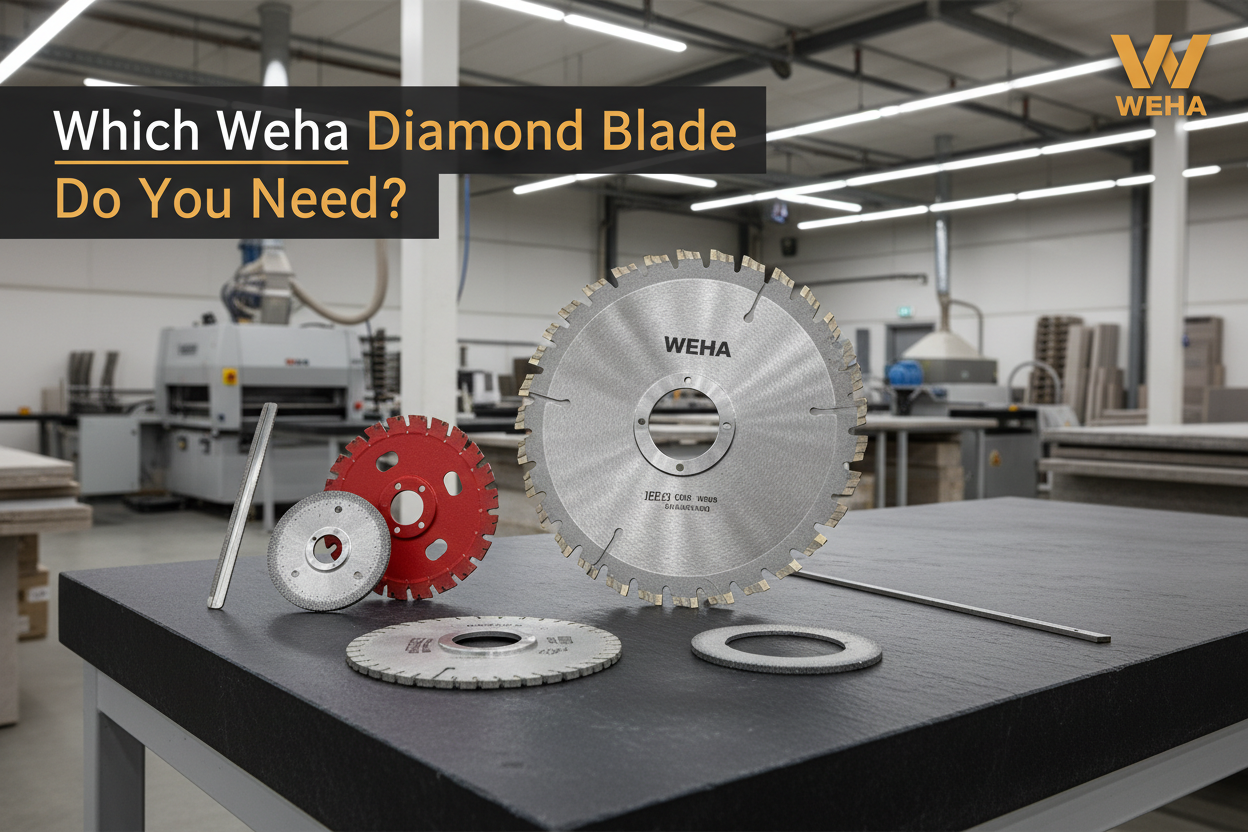
The right diamond blade makes the difference between a clean, fast cut and a chipped, overheated mess. Weha makes blades for a wide range of stone fabrication applications — from ultra-thin sintered stone cutting to vanity bowl contour work to reinforcement channel rodding. This guide breaks down every blade in the Weha lineup so you can match the right tool to the job.
The Key Questions Before You Choose
- What material are you cutting? — Sintered stone (Dekton, Lapitec, Neolith), granite, marble, quartz, or ceramic/porcelain each have different blade requirements
- What tool are you using? — Angle grinder, rail saw, track saw, or table saw
- What is the application? — Straight cuts, contour cuts, rodding channels, or grinding/shaping
- What is your motor HP? — Low HP rail and track saws require a specific blade; standard blades will underperform or stall
Full Blade Comparison
| Blade | Size | Best For | Tool | Wet/Dry |
|---|---|---|---|---|
| Ceramica R-Mesh Turbo | 4", 5", 6" | Ceramic, porcelain, Dekton, Lapitec, Neolith, engineered stone | Angle grinder | Dry (wet optional) |
| Red Cat Diamond Turbo | 6" | Granite, quartz, engineered stone — general cutting | Angle grinder | Wet or dry |
| WX2 Multi Blade | 5" | Granite, marble, quartz — cup wheel, cutting & rodding in one | Angle grinder | Wet or dry |
| Duo Diamond Blade | 5" | Marble, limestone, travertine — cutting, grinding & shaping | Angle grinder | Wet or dry |
| Matrix Turbo Contour | 5" | Vanity bowl cutouts — granite, marble, quartz | Angle grinder | Wet or dry |
| 5" Turbo Rodding | 5" x 1/4" | Reinforcement channels — granite, marble, quartz, concrete | Angle grinder | Wet or dry |
| Matrix 4" Rodding | 4" x 1/4" | Reinforcement channels — compact format for smaller grinders | Angle grinder | Wet or dry |
| 14" x 10mm Low HP | 14" (13-7/8" OD) | Full slab cuts — rail saws & track saws ≤3 HP | Rail saw, track saw | Wet |
| 10" x 5mm Rodding | 10" (250mm) | Saw-mounted rodding channels — GMM and similar saws | GMM & rodding saws | Wet |
By Material — Which Blade Do You Need?
Sintered Stone: Dekton, Lapitec, Neolith
Sintered and ultra-compact surfaces are among the hardest, most brittle materials in stone fabrication. They require an extra-thin blade with a turbo segment design that removes material fast while keeping the blade cool. Standard turbo blades will chip the surface and overheat.
Recommended: Ceramica R-Mesh Turbo Blade — 1.2mm extra-thin kerf, R-Mesh turbo design, developed specifically for Dekton, Lapitec, and Neolith.
Ceramic & Porcelain Tile
Large-format ceramic and porcelain requires a thin, fast blade that minimizes chipping on brittle glazed surfaces.
Recommended: Ceramica R-Mesh Turbo Blade — 1.2mm kerf, dry or wet use, available in 4", 5", 6".
Granite & Quartz — General Cutting
Recommended: Red Cat Diamond Turbo Blade — 8mm diamond rim, narrow turbo segments, quad core holes for flush cutting, wet or dry.
Marble, Limestone & Travertine
Recommended: Duo Diamond Blade — diamonds on both sides and rim; cutting, grinding, and shaping in one blade.
Vanity Bowl Cutouts
Recommended: Matrix Diamond Turbo Contour Blade — side diamonds extend 1-3/8" for full 3cm stone cutouts.
Full Slab Cuts on Rail Saws & Track Saws (≤3 HP)
Recommended: 14" x 10mm Low HP Blade — optimized for ≤3 HP motors including the Achilli TSA.
By Application — Rodding Blades
Grinder-Mounted Rodding
- 5" Turbo Rodding Blade — dual-blade construction; 1/4" groove; preferred for high-volume production rodding
- Matrix 4" Rodding Blade — compact 4" format for smaller grinders or tighter conditions
- WX2 Multi Blade — 3/16" thickness for occasional rodding alongside cup wheel and cutting functions
Saw-Mounted Rodding
- 10" x 5mm Rodding Blade — mounts to GMM and similar saws; 5mm kerf; preferred for high-volume production shops
Quick Decision Guide
- Cutting Dekton, Lapitec, or Neolith → Ceramica R-Mesh Turbo
- Cutting ceramic or porcelain tile → Ceramica R-Mesh Turbo
- Cutting granite or quartz with a grinder → Red Cat Diamond Turbo
- Cutting & shaping marble, limestone, or travertine → Duo Diamond Blade
- Vanity bowl cutouts → Matrix Turbo Contour Blade
- Rail saw or track saw ≤3 HP → 14" x 10mm Low HP Blade
- Rodding channels with a grinder — high volume → 5" Turbo Rodding Blade
- Rodding channels on a GMM or rodding saw → 10" x 5mm Saw-Mounted Rodding Blade
- One blade for grinding, cutting & occasional rodding → WX2 Multi Blade
Pro Tool Haus is a certified distributor of Weha products. Questions about which blade is right for your application? Contact us directly.