
How long does stone sealer last?
Stone sealer typically lasts 1 to 5 years, depending on the type of sealer, the stone's porosity, the surface's use, and how well it was applied. Here's a general breakdown by stone type:
| Stone | Typical Resealing Frequency |
|---|---|
| Granite (kitchen countertop) | Every 1–3 years |
| Marble (kitchen countertop) | Every 6–12 months |
| Quartzite | Every 1–2 years |
| Travertine / Limestone | Every 1–2 years |
| Slate | Every 3–5 years |
| Engineered quartz | Rarely or never — factory sealed |
| Porcelain | Rarely or never — vitrified surface |
What affects how long stone sealer lasts?
Several factors determine how quickly a sealer breaks down:
- Stone porosity — more porous stones (marble, travertine, limestone) absorb sealer faster and require more frequent reapplication. Dense stones (quartzite, slate) hold sealer longer.
- Traffic and use — kitchen countertops see daily acid exposure (citrus, coffee, wine) and cleaning chemicals that degrade sealer faster than a bathroom vanity or floor.
- Cleaning products — harsh alkaline or acidic cleaners strip sealer over time. pH-neutral stone cleaners extend sealer life significantly.
- Sealer type — penetrating (impregnating) sealers last longer than topical sealers because they bond within the stone's pores rather than sitting on the surface.
- Application quality — properly applied sealer (clean, dry surface; correct dwell time; excess wiped off) lasts significantly longer than a rushed application.
- Sun exposure — outdoor stone exposed to UV degrades sealer faster. Use a UV-stable sealer for exterior applications.
How do I know if my stone needs resealing?
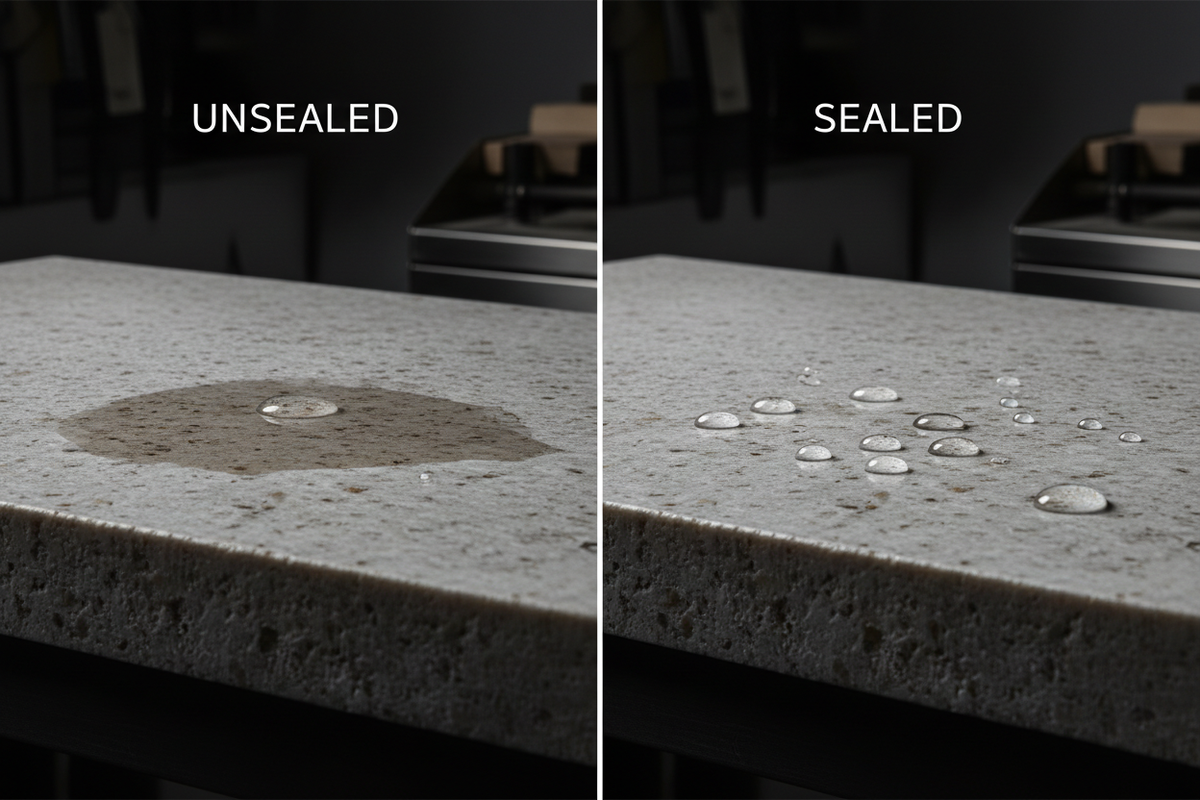
The water bead test is the standard field check:
- Place a few drops of water on the stone surface.
- Wait 10–15 minutes.
- If the water beads up — sealer is still active. No resealing needed yet.
- If the water soaks in and darkens the stone — sealer has degraded. Time to reseal.
For oil resistance, repeat the test with a few drops of cooking oil and check after 5 minutes. If the stone darkens, the sealer is no longer protecting against oil-based stains.
What's the difference between a sealer and an enhancer-sealer?
- Clear impregnating sealers (like Tenax Proseal) protect against staining without changing the stone's appearance. Best for light-colored stones or when you want to preserve the natural look.
- Enhancer-sealers (like Tenax Ager) deepen and enrich the stone's color while sealing. The color enhancement is permanent — the sealing protection needs periodic reapplication, but the color change stays.
- Color-specific sealers (like Quartz Enhancer Stone Sealer) are formulated for specific stone types and deliver both protection and optimized finish for that material.
Which sealers last the longest?
Penetrating (impregnating) sealers consistently outperform topical sealers for longevity. Among penetrating sealers, nano-technology formulations penetrate deeper into the stone's pore structure and bond more durably:
- Tenax Proseal Nano — nano-technology sealer for dense, low-porosity stone like quartzite; one of the longest-lasting options for hard stone
- Tenax Proseal — premium penetrating sealer for granite, marble, and natural stone; 1–3 year lifespan depending on use
- Tenax Ager — color-enhancing impregnating sealer; sealing protection lasts 1–2 years on countertops
- Skudo Stone Sealer — broad-spectrum penetrating sealer for natural stone
How do I apply stone sealer correctly to maximize lifespan?
Proper application is the single biggest factor in sealer longevity:
- Clean the surface thoroughly — remove all grease, residue, and old sealer. Use a stone-safe degreaser like BrioAction 3.
- Ensure the stone is completely dry — moisture trapped under sealer prevents proper bonding. Wait at least 24 hours after cleaning or installation.
- Apply in thin, even coats — do not flood the surface. Thin coats penetrate better and cure more evenly.
- Allow proper dwell time — let the sealer penetrate for the time specified on the product label (typically 5–15 minutes).
- Wipe off all excess — any sealer left on the surface will cure as a sticky, hazy film. Wipe thoroughly before it dries.
- Avoid water contact for 24 hours — allow full cure before exposing to moisture.