
What grit sequence should I use for polishing granite?
The standard grit sequence for polishing granite countertops is:
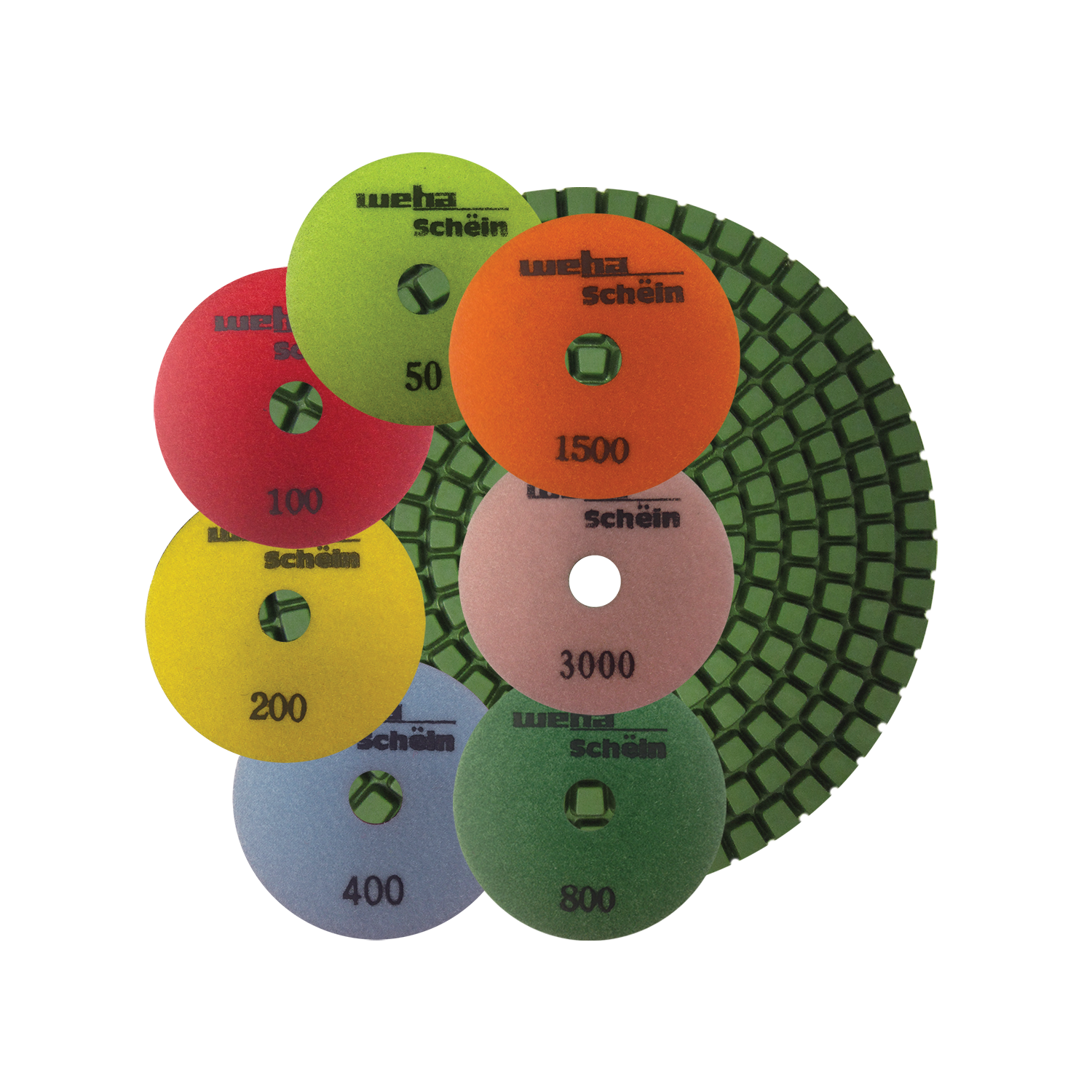
50 → 100 → 200 → 400 → 800 → 1500 → 3000
Each step removes the scratch pattern left by the previous grit before moving to the next. Skipping grits is the most common cause of a dull or hazy final finish — the finer pads cannot remove deep scratches left by coarser ones.
What does each grit stage do?
- 50 grit — aggressive material removal; used after saw cutting, edge profiling, or to remove deep scratches and chips. This is your shaping stage.
- 100 grit — removes the 50-grit scratch pattern; begins to flatten the surface.
- 200 grit — transitions from grinding to polishing; surface starts to show early reflectivity.
- 400 grit — honed finish territory; produces a smooth, matte-to-satin surface with no visible scratches. Many fabricators stop here for a honed countertop spec.
- 800 grit — semi-polished; surface begins to show a clear reflection.
- 1500 grit — high polish; strong reflectivity with minimal haze.
- 3000 grit — mirror finish; maximum clarity and gloss. This is the standard “polished granite” finish delivered to customers.
Do I need all 7 steps every time?
Not always. The starting grit depends on the condition of the surface:
- After saw cutting or edge profiling — start at 50 grit and run the full sequence.
- Repolishing a scratched countertop — assess scratch depth. Light surface scratches may only require starting at 200 or 400 grit.
- Honed finish spec — run through 400 grit and stop. Do not continue to 800+ if a matte finish is specified.
- Spot repair — feather out from the damaged area using the appropriate starting grit, blending into the surrounding finish.
Wet or dry polishing — does it change the sequence?
The grit sequence is the same for both wet and dry polishing, but the pad type must match the method:
- Wet polishing uses water as a coolant and lubricant. It produces less dust, extends pad life, and is required for OSHA silica dust compliance on dry-cut surfaces. Use wet-rated diamond polishing pads.
- Dry polishing uses resin-bond pads designed to generate their own heat for polishing action. Faster setup, but generates respirable silica dust — full PPE and dust extraction are required per OSHA 1926.1153.
Most professional fabrication shops use wet polishing for countertop work and reserve dry polishing for field repairs or situations where water is impractical.
Does the sequence change for different stone types?
Yes — granite is relatively forgiving, but other materials require adjustments:
- Quartz (engineered) — same 7-step sequence, but use pads rated for engineered stone. Quartz is harder and more abrasive on pads than natural granite.
- Marble — softer than granite; you can often start at 100 or 200 grit for repolishing. Marble scratches more easily, so handle with care between steps.
- Quartzite — treat like granite or harder; some quartzite is extremely dense and may require more passes at each grit.
- Porcelain slab — requires specialty porcelain polishing pads. Standard granite pads will not achieve the same result on vitrified porcelain surfaces.
What polishing pads do you recommend?
For a full 7-step sequence on granite and natural stone:
- Weha 5" Schein 7-Step Polishing Pads — complete grit set in one package, wet use
For a faster 3-step process on granite and quartz:
- Weha Trio 3-Step Polishing Pads — 3-step system for production shops
- Chido 4" 3-Step Polishing Pads — compact 4" option for tighter work
For a final buff and maximum gloss:
- Weha Ultra Buff Final Diamond Polishing Pad — used after 3000 grit for showroom-level finish
Common mistakes to avoid
- Skipping grits — the most common error. Each grit must fully remove the previous scratch pattern before advancing.
- Too much pressure — let the pad do the work. Excessive pressure causes uneven wear and heat buildup.
- Not enough water — for wet polishing, keep the surface consistently wet. Dry spots cause pad glazing and uneven finish.
- Switching from wet to dry mid-sequence — pick one method and stick with it for the full sequence.
- Using worn pads — a worn 400-grit pad behaves like a 600-grit pad. Replace pads on schedule for consistent results.
Related guides
- How to Cut a Sink Hole in a Stone Countertop — includes edge finishing and polishing steps for undermount sink cutouts
- OSHA Silica Dust Compliance for Stone Fabricators — required reading for dry polishing operations