
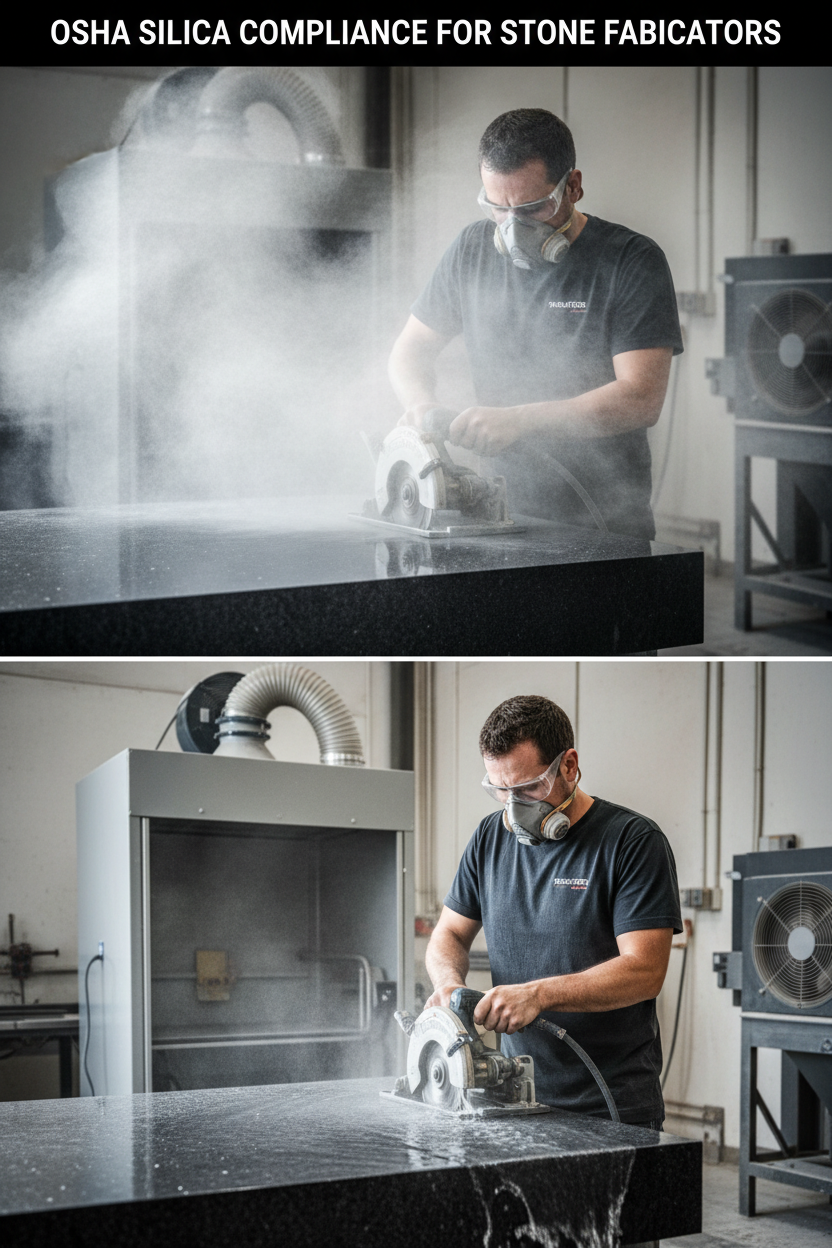
OSHA Silica Dust Compliance for Stone Fabricators: What You Need to Know
If you cut, grind, or polish stone in a fabrication shop, OSHA's respirable crystalline silica standard (29 CFR 1926.1153 for construction; 29 CFR 1910.1053 for general industry) applies to your operation. Non-compliance isn't just a fine risk — it's a serious liability when workers develop silicosis, a progressive and irreversible lung disease caused by inhaling fine silica particles.
This guide breaks down what the standard requires, what it means for your shop floor, and which dust collection systems are built to help you meet it.
What Is Respirable Crystalline Silica?
Crystalline silica is a mineral found in granite, quartz, sandstone, and engineered stone (including quartz slabs). When these materials are cut, ground, or polished, they release fine particles — some small enough to penetrate deep into the lungs. OSHA defines "respirable" silica as particles 10 microns or smaller.
Engineered quartz slabs are particularly high-risk: they can contain 90–95% crystalline silica by weight, compared to 25–45% in natural granite.
What OSHA Requires
OSHA's silica standard establishes two key exposure limits:
- Action Level (AL): 25 µg/m³ (8-hour TWA) — triggers monitoring and medical surveillance requirements
- Permissible Exposure Limit (PEL): 50 µg/m³ (8-hour TWA) — the hard ceiling; exposure above this is a violation
For most stone fabrication tasks — dry cutting, dry grinding, dry polishing — uncontrolled silica exposure can exceed the PEL by 10x or more. OSHA's Table 1 (for construction) specifies engineering controls that, when properly implemented, are presumed to achieve compliance without air monitoring.
Key Table 1 controls for stone fabrication include:
- Wet methods (water suppression at the point of cut)
- Local exhaust ventilation (LEV) — i.e., dust collection booths and extraction arms
- Combination of wet + LEV for high-exposure tasks
Engineering Controls: Your First Line of Defense
OSHA's hierarchy of controls puts engineering controls above PPE. Respirators are a supplement — not a substitute — for proper dust collection.
Wet Dust Collection Booths
Wet booths use water curtains to capture and suppress silica-laden air at the source. The 10 Ft (3M) Wet Dust Collection Booth — Filter Project TEC711 and 13 Ft (4M) Wet Dust Collection Booth — Filter Project TEC712 are designed for stationary fabrication work where wet suppression is the primary control method. Both integrate with water recycling systems to manage slurry discharge.
Dry Dust Collection Booths
For shops running dry processes or working with materials where water contact is not ideal, dry booths with HEPA-rated filtration provide LEV compliance. The 10 Ft (3M) Automatic Dry Dust Collection Booth — Filter Project TEC714 and 13 Ft (4M) Automatic Dry Dust Collection Booth — Filter Project TEC715 feature self-cleaning filter systems designed for continuous operation in high-dust environments.
Mobile Extraction Arms
For tasks performed outside a fixed booth — edge profiling, sink cutouts, field repairs — a mobile extraction arm brings LEV to the point of work. The Mobile Arm Dry Dust Collector — Filter Project TEC740 is designed for exactly this use case, providing flexible positioning without requiring a dedicated booth footprint.
For larger shops running 4-meter booths, the 13 Ft (4M) Dry Dust Collector with Arm Attachment — Filter Project TEC715ARM combines fixed booth extraction with an integrated arm for maximum coverage.
Water Recycling and Slurry Management
Wet dust collection generates slurry — a mixture of water, stone dust, and silica particles. Discharging untreated slurry to a drain is an environmental violation in most jurisdictions and creates a secondary silica exposure risk during cleanup.
A closed-loop water recycling system captures, clarifies, and recirculates process water, eliminating drain discharge and reducing water consumption. Filter Project's clarifier and compact plant lineup covers a wide range of shop throughput:
- 66 GPM Lamellar Stone Water Clarifier — TEC754 — suited for smaller shops or single-saw operations
- 105 GPM Lamellar Stone Water Clarifier — TEC756 — mid-size shops with multiple wet stations
- 198 GPM Compact Water Recycling Plant — TEC772 — high-throughput fabrication environments
- 264 GPM Compact Water Recycling Plant — TEC773 — large-scale operations or multi-saw shops
Slurry dewatering is the final step: the 5-Bag Sludge Dehydrator — Filter Project TEC703 separates solids from water so dried sludge can be disposed of as solid waste rather than liquid effluent.
Written Exposure Control Plan
OSHA requires any employer with silica exposures at or above the Action Level to maintain a written Exposure Control Plan (ECP). The ECP must identify:
- Tasks that involve silica exposure
- Engineering and work practice controls in use
- Housekeeping measures
- Procedures for restricting access to high-exposure areas
- Requirements for respiratory protection when controls alone are insufficient
Your dust collection equipment is a core component of this plan. Documenting the specific systems in use — booth model, filtration rating, maintenance schedule — supports your compliance posture if OSHA conducts an inspection.
Housekeeping: Don't Undo Your Engineering Controls
OSHA explicitly prohibits dry sweeping or dry blowing of silica-containing dust. Housekeeping must use wet methods, HEPA-filtered vacuums, or other methods that don't re-suspend settled dust.
The Pit Clean Out Basket — Filter Project TEC751 is designed for removing settled sludge from water system trenches without disturbing fine particles — a detail that matters for both compliance and system maintenance.
Maintenance: Keep Your Controls Performing
Engineering controls only work if they're maintained. OSHA inspectors look for evidence that dust collection systems are operational and properly serviced. Key maintenance items for Filter Project systems:
- Replacement Filtering Sleeves — TEC733: Replace on schedule to maintain airflow and filtration efficiency in dry booths
- NSF 5-Micron Pleated Replacement Filters — TEC7801: Critical for water system filtration performance
- Replacement Filter Press Bags — TEC750: For lamellar and compact water recycling systems
- Replacement Fuses — Filter Project: Electrical components for booth systems
A documented maintenance log is a strong supporting document for your ECP.
Related Guides
- How to Cut a Sink Hole in a Stone Countertop — Complete Fabricator Guide — includes wet cutting requirements and silica PPE notes for sink cutout work