
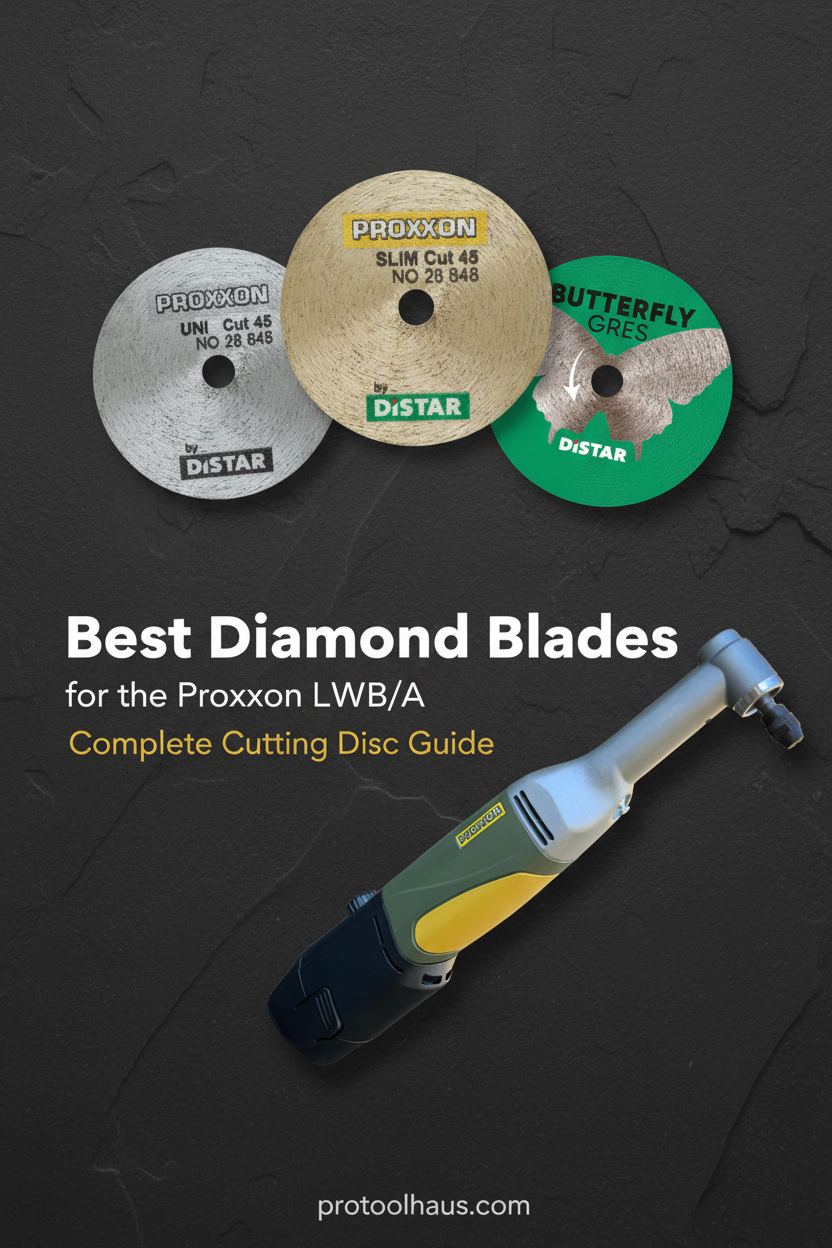
The Proxxon LWB/A is only as good as the blade you put on it. The right diamond disc makes the difference between a clean, chip-free cut and a frustrating, slow grind through hard porcelain. This guide covers every cutting disc compatible with the LWB/A — what each one does, when to use it, and which materials it handles best.
LWB/A Blade Basics — What You Need to Know First
The Proxxon LWB/A uses a collet system (not a center-bore disc mount like the LHW/A). This means blades mount via their arbor shaft into one of the six included MICROMOT collets (1.0–3.2mm). Compatible cutting discs are 45mm in diameter — not 50mm. Using a 50mm disc designed for the LHW/A will not fit the LWB/A.
All blades listed below are 45mm and compatible with the LWB/A collet system.
The Blades — Compared
| Blade | Kerf | Best For | Wet / Dry |
|---|---|---|---|
| Proxxon UNI Cut 45mm | Standard | All-rounder — tile, stone, ceramic, glass | Both |
| Proxxon Slim Cut 45mm | 0.6mm | Ultra-fine detail cuts, minimal chipping | Both |
| DiStar Butterfly 2" | 0.45mm | General tile and stone — fast, clean cuts | Wet preferred |
| DiStar Mastercut 2" | Standard | Hard porcelain, quartzite, sintered stone | Wet preferred |
Proxxon UNI Cut 45mm — The All-Rounder
The Proxxon UNI Cut 45mm (No. 28849) is the default blade for the LWB/A — the one to reach for when you're not sure which disc to use. It handles the widest range of materials cleanly and is the most forgiving blade in the lineup for general tile and stone work.
- Materials: Porcelain stoneware, granite, marble, ceramic, glass
- Kerf: Standard — good balance of speed and edge quality
- Wet or dry: Both — performs well dry for quick cuts, better wet for extended use
- Best use case: General tile cutting, outlet penetrations, inside corners, mixed-material jobs
When to choose it: You're cutting a variety of materials on the same job, or you want one blade that handles everything without switching.
Proxxon Slim Cut 45mm — The Precision Specialist
The Proxxon Slim Cut 45mm is the surgeon's blade in the LWB/A lineup — at just 0.6mm thick, it produces hair-line cuts with virtually zero chipping on the most demanding hard materials. It includes a special 3.2mm arbor engineered specifically for the LWB/E and LWB/A.
- Materials: Porcelain stoneware, granite, marble, ceramic, glass
- Kerf: 0.6mm — ultra-thin, minimal material loss
- Wet or dry: Both — thin kerf generates less heat, but wet cutting still recommended for extended use
- Best use case: Detail cuts, finish work, cutting delicate materials where chipping is unacceptable
When to choose it: Edge quality is the priority — you're doing finish cuts, working with expensive tile, or cutting in a location where chipping would ruin the installation.
DiStar Butterfly 2" — The Fast Cutter
The DiStar Butterfly is a 45mm (2") diamond blade engineered for fast, clean cuts in general tile and stone. At 0.45mm kerf — even thinner than the Proxxon Slim Cut — it's the fastest-cutting blade in the LWB/A lineup and produces excellent edge quality on standard porcelain and ceramic. It's included in the Proxxon LWB/A Tile Pro Kit.
- Materials: Porcelain tile, ceramic, natural stone
- Kerf: 0.45mm — thinnest in the lineup, fastest cutting speed
- Wet or dry: Wet preferred — thin kerf benefits most from water cooling
- Best use case: High-volume tile cutting where speed and edge quality both matter
When to choose it: You're cutting a lot of standard porcelain or ceramic tile and want the fastest, cleanest result. Pair with the DiStar Water Guard Kit for best performance.
DiStar Mastercut 2" — The Hard Material Specialist
The DiStar Mastercut is the blade to reach for when the Butterfly or UNI Cut starts to struggle — engineered specifically for the hardest materials: hard porcelain, quartzite, sintered stone (ultra-compact surfaces), and engineered stone. It's also included in the Proxxon LWB/A Tile Pro Kit.
- Materials: Hard porcelain, quartzite, sintered stone, engineered stone
- Kerf: Standard
- Wet or dry: Wet strongly recommended — hard materials generate significant heat
- Best use case: Large-format hard porcelain, Dekton, Neolith, quartzite, and other ultra-compact surfaces
When to choose it: The material is hard enough that other blades cut slowly, overheat, or produce excessive chipping. If you're regularly cutting Dekton, Neolith, or hard quartzite, the Mastercut is the right tool.
Which Blade Should You Buy First?
If you're new to the LWB/A and want one blade to start with, buy the Proxxon UNI Cut 45mm. It handles the widest range of materials and is the most versatile option for general tile and stone work.
If you're doing professional tile installation and want the best performance across all materials, the Proxxon LWB/A Tile Pro Kit gives you the tool, water guard, Butterfly blade, and Mastercut blade in one box — covering everything from standard ceramic to hard porcelain and sintered stone.
Blade Selection Quick Reference
| Material | Recommended Blade |
|---|---|
| Standard ceramic tile | UNI Cut or Butterfly |
| Standard porcelain tile | UNI Cut or Butterfly |
| Hard porcelain (large format) | Mastercut |
| Quartzite | Mastercut |
| Sintered stone (Dekton, Neolith) | Mastercut |
| Granite | UNI Cut |
| Marble | UNI Cut or Slim Cut |
| Glass | Slim Cut |
| Detail / finish cuts (any material) | Slim Cut |
| High-volume production cutting | Butterfly |
Wet vs. Dry Cutting — Does It Matter for Blade Life?
Yes — significantly. All four blades above can be used dry for short cuts, but wet cutting extends blade life, reduces silica dust, and produces cleaner edges. For extended cutting sessions or hard materials, wet cutting is the right choice. See our full guide: How to Wet Cut Tile with the Proxxon LWB/A.
Frequently Asked Questions
Can I use 50mm blades on the Proxxon LWB/A?
No — the LWB/A uses a collet system for 45mm blades. 50mm center-bore discs are designed for the LHW/E and LHW/A. Using the wrong disc size risks tool damage and is a safety hazard.
What's the difference between the LWB/A and LHW/A blade systems?
The LWB/A uses a collet (45mm discs via arbor shaft). The LHW/A uses a center-bore disc mount (50mm discs). They are not interchangeable. Full comparison here →
How long do diamond blades last on the LWB/A?
Blade life depends heavily on material hardness, cutting technique, and whether you're cutting wet or dry. Wet cutting significantly extends blade life. A blade cutting soft ceramic wet will last far longer than the same blade cutting hard quartzite dry.
Where can I buy these blades?
All blades listed in this guide are available at Pro Tool Haus — an authorized Proxxon dealer priced approximately 5% below proxxontools.com. Browse the full cutting disc range here.