
Dekton is durable, but a clean, durable seam still depends on the right adhesive, accurate color selection, and careful preparation. This guide explains how professional fabricators approach Dekton seaming with a color-matched cartridge adhesive.
What adhesive should you use for Dekton?
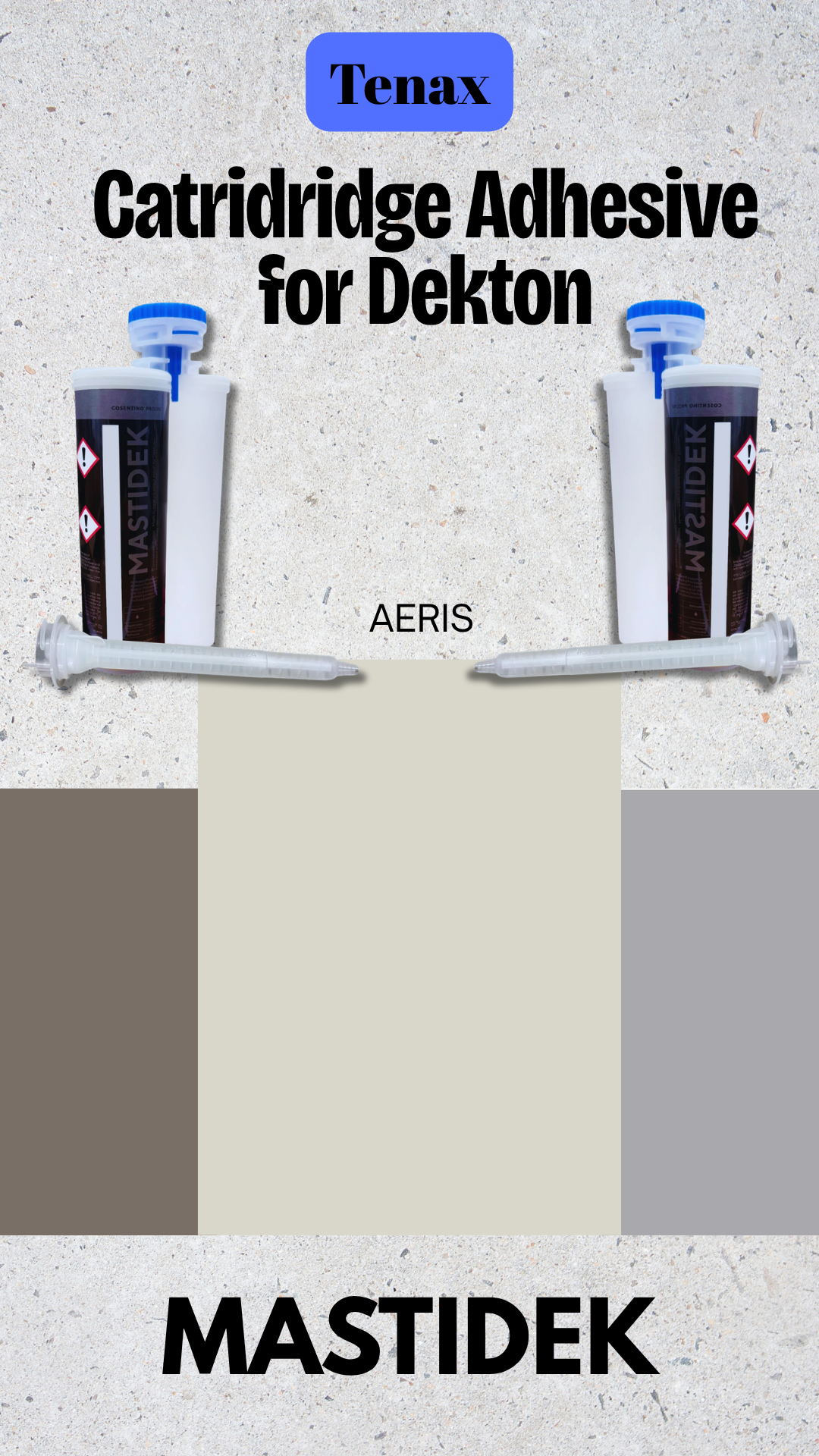
For Dekton seams, laminations, and suitable repairs, use an adhesive formulated for the material rather than a general-purpose construction adhesive. Tenax Mastidek is a two-component methacrylate adhesive engineered specifically for Cosentino Dekton surfaces.
Mastidek is supplied in a 215 ml cartridge with a 2:1 resin-to-hardener ratio. The resin and hardener are pre-dosed inside the cartridge, which helps reduce measuring and mixing errors and keeps the application consistent from one job to the next.
What do you need to seam Dekton?
- Color-matched Tenax Mastidek adhesive
- A compatible 2:1 cartridge gun for 215 ml cartridges
- A static mixing nozzle
- Clean, dry surfaces free of dust and grease
- A suitable abrasive for lightly preparing polished or glossy surfaces
- Scrap Dekton or a test surface for checking the color match
The Tenax 2:1 Cartridge Gun 215 ml is the direct gun match for this cartridge. The Tenax M200XMR Universal Cartridge Gun is another option when you need a flexible gun for multiple cartridge systems.
How do you choose the right Dekton adhesive color?
Choose the Mastidek color that most closely matches the dominant background tone of the slab. For a veined or multi-tone design, do not automatically choose the darkest vein. The background tone is usually the better starting point for making the finished seam less noticeable.
Light slabs may call for a white, warm white, cream, or pearlescent tone. Grey and charcoal slabs may need a standard grey, dark grey, or a light grey option. Black and deep-toned slabs may be better matched with black, deep black, or brown-black options. Veined slabs require extra care, so test the selected adhesive on scrap before applying it to the finished piece.
Because color perception changes with lighting and slab movement, a test is worth the few minutes it takes. A close match on a screen is not a substitute for checking the adhesive beside the actual material.
How to prepare Dekton for seaming
- Make sure the surfaces are clean, dry, and free of dust, grease, and loose material.
- For polished or glossy surfaces, lightly sand as appropriate for the application.
- Dry-fit the pieces and confirm the seam, alignment, and support before dispensing adhesive.
- Prepare the 2:1 cartridge gun and attach the threaded static mixing nozzle.
Good preparation matters. Adhesive cannot compensate for movement, poor support, contamination, or a slab that is cracked or structurally unstable. If the material or substrate has a structural problem, have the installation assessed by a qualified stone professional.
How to apply Mastidek
- Remove the cartridge cap and attach the static mixing nozzle.
- Dispense approximately six inches of adhesive before application so the resin and hardener are properly mixed.
- Apply the adhesive to the prepared surface and assemble the pieces.
- Keep the pieces aligned and supported while the adhesive cures.
- Under suitable conditions, allow approximately 45–60 minutes before cutting and polishing.
- After use, remove and discard the mixing nozzle, clean the cartridge tip, and replace the cap for storage.
How long does Dekton seam adhesive take to cure?
Mastidek can generally be cut and polished in approximately 45–60 minutes under suitable conditions. Actual timing depends on temperature, surface preparation, bead size, and the job environment, so do not treat the time as a guarantee for every installation.
Mastidek is rated for exterior Dekton applications and is designed to cure at temperatures down to approximately +1°C / 33.8°F. It should not be expected to set below 0°C / 32°F. Keep the cartridge away from freezing conditions, direct sunlight, heat, and humidity during storage.
Is Dekton seaming a DIY project?
A homeowner may be able to prepare for a small, non-structural repair, but visible countertop seams, laminations, large repairs, and unstable or cracked slabs are best handled by an experienced fabricator. The right adhesive is only one part of the result. Cutting, alignment, support, polishing, and color selection all affect the finished appearance.
Dekton seaming checklist
- Confirm the material is Cosentino Dekton.
- Select a color that matches the dominant background tone.
- Test the color on scrap material first.
- Use a compatible 2:1 gun and static mixing nozzle.
- Clean and prepare the surfaces carefully.
- Dispense enough material to establish a properly mixed bead.
- Allow suitable cure time before cutting and polishing.
- Store unused adhesive correctly and follow the product documentation.
For a Dekton-specific cartridge adhesive and matching application tools, view Tenax Mastidek at ProToolHaus.