
Introduction
Whether you're a seasoned stone fabricator or a dedicated DIYer tackling your first countertop project, edge profiling is one of the most visible — and most satisfying — finishing steps in stone work. The right tool makes all the difference. In this guide, we'll walk through how to profile stone edges using the Achilli ProEdge Portable Router, covering everything from setup to technique for both professional shops and home workshops. For a complete overview of the full fabrication process, see our How to Fabricate a Granite Countertop: Complete Shop Workflow.
What Is Edge Profiling?
Edge profiling is the process of shaping the exposed edge of a stone slab — granite, marble, quartz, quartzite, or other natural stone — into a finished profile. Common profiles include bullnose, bevel, ogee, and pencil edge. The profile you choose affects both the aesthetics and the safety of the finished surface. For a deep dive into every profile type, tooling requirements, and material compatibility, see our Stone Countertop Edge Profiles: Complete Fabricator's Guide.
Why the Achilli ProEdge?
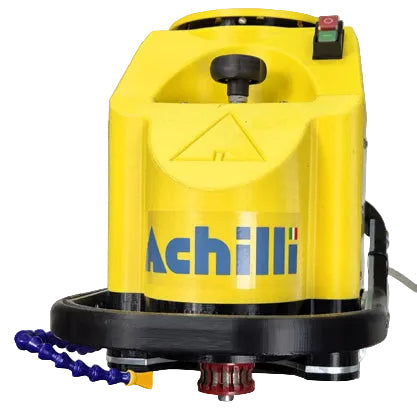
The Achilli ProEdge is a compact, portable router built specifically for stone fabrication. Here's why it stands out:
- Versatility: Works on granite, marble, quartz, quartzite, and natural stones up to 6 cm (2.4") thick
- Portability: Lightweight enough to move around the shop or bring to a job site
- Precision: Aquaplaning base glides smoothly across the slab surface for consistent results
- Power: 2.2 kW (3 HP) motor at 9,000 RPM handles demanding materials with ease
- Adjustability: 20 mm vertical stroke for precise depth control on any profile
Getting Started: Setup for DIYers
If you're new to stone routing, here's how to get set up safely and efficiently:
- Choose your profile wheel: Select a shaped diamond wheel that matches your desired edge profile. The ProEdge is compatible with a wide range of profile wheels.
- Secure your slab: Clamp the stone firmly to a stable work surface. Movement during routing can cause chipping or uneven profiles.
- Connect water supply: The ProEdge uses water cooling to protect both the wheel and the stone. Ensure a steady water flow before starting.
- Set your depth: Use the vertical adjustment to set the correct depth for your profile. Make a test pass on a scrap piece first.
- Start slow: Begin at a steady, controlled pace. Let the machine do the work — don't force it.
Professional Tips for Fabrication Shops
For pros running high-volume fabrication, the ProEdge fits seamlessly into your workflow:
- Batch profiling: Set your depth once and run multiple slabs at the same setting for consistent results across a job.
- Quick wheel changes: Swap profile wheels between jobs to handle custom orders without downtime.
- Aquaplaning advantage: The aquaplaning base reduces friction and operator fatigue during long runs — a real benefit in a busy shop.
- Portability on the job site: Take the ProEdge directly to installation sites for on-the-spot edge adjustments or repairs.
Common Edge Profiles and When to Use Them
Not sure which profile to specify? Our Stone Countertop Edge Profiles: Complete Fabricator's Guide covers every major profile with tooling specs, material compatibility, and production tips.
- Bullnose: Fully rounded edge — great for family kitchens and high-traffic areas
- Bevel: Angled flat edge — modern, clean look for contemporary designs
- Ogee: S-shaped profile — classic and decorative, popular for traditional kitchens
- Pencil Edge: Slightly rounded — subtle and versatile, works with almost any style
Safety Reminders
Stone routing involves high-speed rotation and water. Always wear appropriate PPE — safety glasses, hearing protection, and waterproof gloves. Ensure your electrical connections are rated for wet environments, and never operate the machine without water flow active.