
When shopping for a vacuum cup, most buyers focus on capacity and battery life. But the single most important spec for job site performance is one that often gets overlooked: the pad type.
Choose the wrong pad for your surface and you'll lose suction mid-lift — no matter how powerful the motor. This guide explains the difference between rubber pads and foam ring pads, and helps you match the right technology to your surfaces.
The Two Pad Types: How They Work
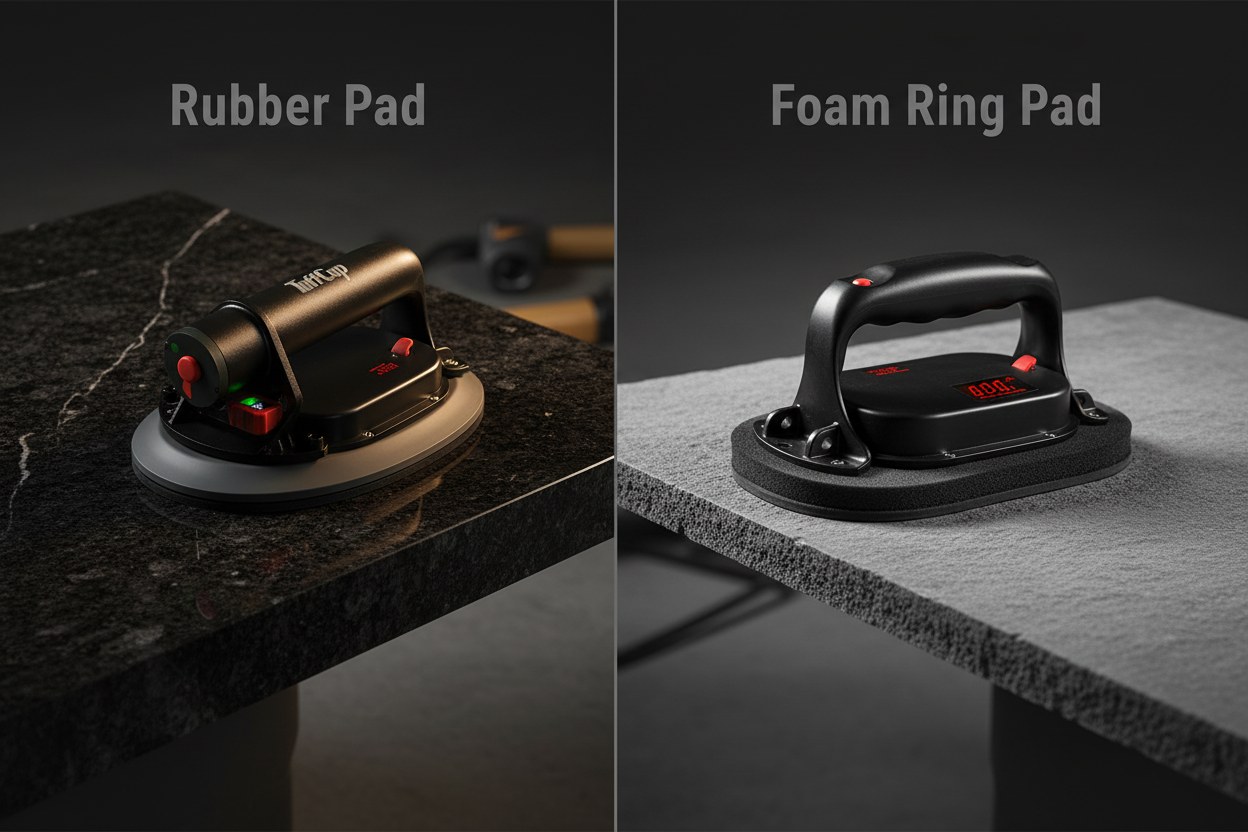
Non-Bleeding Rubber Pads
Rubber pads create suction by forming an airtight seal against a smooth, non-porous surface. The rubber conforms slightly to the material and holds a consistent seal as long as the surface is flat and clean.
Best for: Polished granite, honed marble, glass, glazed ceramic, porcelain, metal, and any smooth non-porous surface.
Limitation: On rough, matte, or textured surfaces, the rubber can't bridge the micro-gaps in the material — suction leaks and the cup loses hold.
High-Grip Foam Ring Pads
Foam ring pads use a compressible foam gasket that physically deforms to fill surface irregularities, creating a seal even on rough or textured materials. The ring design concentrates suction pressure at the perimeter while the foam bridges texture variation.
Best for: Rough-cut granite, textured porcelain, matte tile, sandblasted stone, and any surface with texture variation up to 3/8".
Limitation: On highly polished surfaces, foam ring pads can sometimes leave a faint ring impression — rubber pads are safer for finished polished stone.
Surface Compatibility at a Glance
- Polished granite — Rubber pad ✅ | Foam ring pad ✅ (use rubber to avoid ring marks)
- Honed marble — Rubber pad ✅ | Foam ring pad ✅
- Glazed ceramic / porcelain — Rubber pad ✅ | Foam ring pad ✅
- Textured / matte porcelain — Rubber pad ❌ | Foam ring pad ✅
- Rough-cut granite — Rubber pad ❌ | Foam ring pad ✅
- Sandblasted stone — Rubber pad ❌ | Foam ring pad ✅
- Glass panels — Rubber pad ✅ | Foam ring pad ✅
- Metal — Rubber pad ✅ | Foam ring pad ✅
- Wood — Rubber pad ✅ | Foam ring pad ✅
TuffCup Rubber Pad Models
All rubber pad models use a non-bleeding formulation that won't leave marks or stains on finished surfaces.
- TuffCup Hermes Mini — 132 lb, 1.1 lbs, IP54, 24+ hr runtime. Compact precision work on smaller panels.
- TuffCup Poseidon 8" — 220 lb, 1.9 lbs, 48+ hr runtime. Lightweight daily driver for smooth surfaces.
- TuffCup Titan 8" LED — 264 lb, metal body, LED display, 48+ hr runtime. Mid-range workhorse with real-time monitoring.
- TuffCup Eos 9" LED — 330 lb, metal body, LED display, 48+ hr runtime. Heavy-duty smooth surface lifting.
- TuffCup Apollo 8" Manual — 264 lb, no battery, 24+ hr hold. Battery-free option for job sites without power.
- TuffCup Gemini Double Manual — 176 lb, dual 5" plates. Even load distribution for glass and thin stone.
TuffCup Foam Ring Pad Models
Foam ring pad models are purpose-built for surfaces where rubber pads fail. Each uses a high-grip foam ring that compresses to seal on texture variation.
- TuffCup Ares 9" x 5.5" LED — 308 lb, seals on surfaces up to 1/8" texture variation. 24+ hr runtime, USB-C.
- TuffCup Athena 11" LED — 440 lb, seals on surfaces up to 3/8" texture variation. Waterproof, Handle Frame compatible, 24+ hr runtime.
- TuffCup Hades 13.3" x 8.7" LED — Largest pad in the lineup, dual 21V batteries, 200W motor, Handle Frame compatible. Maximum coverage for oversized panels.
What If You Work Both Surface Types?
Many fabrication shops and tile installation crews work with both smooth and rough surfaces on the same job. The most practical setup is to carry one of each:
- Smooth surface jobs: Eos 9" LED or Titan 8" LED
- Rough surface jobs: Ares 9" x 5.5" LED or Athena 11" LED
- Mixed jobs: Pair the Eos (rubber, smooth) with the Ares (foam ring, rough) — same 9" form factor, complementary pad technologies.
How to Identify Your Surface Type
Not sure which category your material falls into? A quick field test:
- Run your fingernail across the surface. If it catches or drags noticeably, it's textured — use a foam ring pad.
- Try a rubber pad cup on a small area first. If suction drops within 30 seconds, the surface is too rough for rubber — switch to foam ring.
- Check the tile spec sheet. Any surface finish described as "matte", "textured", "anti-slip", or "structured" will typically require a foam ring pad.
The Bottom Line
Rubber pads are the right choice for smooth, polished, and non-porous surfaces — they're lighter, mark-free, and available across the full TuffCup capacity range. Foam ring pads are essential for rough, matte, and textured surfaces where rubber simply can't hold a seal.
When in doubt, the TuffCup Ares is the most versatile starting point for mixed-surface shops — its foam ring pad handles both smooth and rough surfaces, and its 308 lb capacity covers most professional lifting scenarios.
Browse the full TuffCup vacuum cup lineup at Pro Tool Haus to find the right pad type for your workflow.