
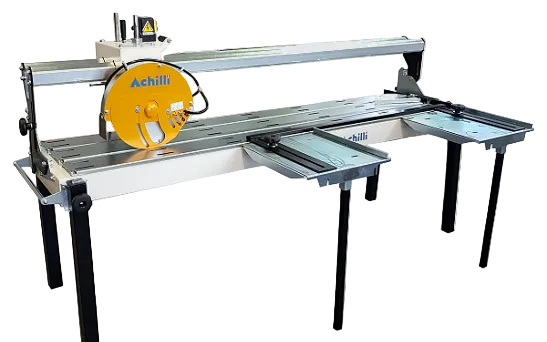
Models and Solutions for Every Application
Sawing machines are essential tools across construction, fabrication, and industrial environments. Their primary function is to cut high-density materials with precision, including marble, granite, quartz, ceramic, and natural stone.
Among the most widely used and effective options are diamond blade saws, designed specifically to handle extremely hard materials while delivering clean, accurate cuts with minimal chipping.
However, not all stone saws are the same. Choosing the right machine depends on your workflow, production volume, and jobsite needs. This guide breaks down the key features and types of stone saws to help you make the best decision.
What Makes Diamond Blade Stone Saws So Effective?
Diamond blade saws are engineered for high-performance cutting of hard materials. Their design allows for both durability and precision, making them a staple in stone fabrication shops and construction projects.
Key Advantages
High Cutting Precision
Diamond blades produce clean, accurate cuts—even on dense materials like granite and quartz—reducing waste and rework.
Durability for Heavy Use
These machines are built to withstand continuous operation, resisting mechanical stress and maintaining performance over time.
Water Cooling Systems
Most stone saws include integrated water cooling, which:
- Prevents blade overheating
- Extends blade life
- Reduces dust for safer operation
Versatility
Stone saws can perform:
- Straight cuts
- Angle cuts
- Plunge cuts
This makes them suitable for everything from industrial production to custom fabrication.
Main Types of Stone Saws
Stone saws generally fall into three categories based on automation level and use case:
1. Automatic (CNC) Saws

CNC (Computer Numerical Control) saws are fully automated systems designed for high-volume production.
Best for:
- Industrial operations
- Large-scale fabrication
- Repetitive, high-precision work
Key Features:
- Multi-axis cutting capability
- Fully programmed cutting cycles
- Minimal operator involvement
- High repeatability and accuracy
- Faster production speeds
These machines are ideal when efficiency and consistency are critical.
2. Semi-Automatic Saws
Semi-automatic saws offer a balance between automation and manual control.
Best for:
- Custom fabrication
- Small-to-medium production runs
- Workshops requiring flexibility
Key Benefits:
- Operator control over positioning and adjustments
- Greater adaptability for custom jobs
- Reliable precision without full automation
While not as fast as CNC systems, they excel in custom, detail-oriented work.
3. Portable Saws

Portable saws are designed for jobsite use, offering flexibility and convenience.
Best for:
- On-site installations
- Renovation work
- Cutting materials in place
Key Advantages:
- Lightweight and easy to transport
- Quick setup in tight or remote spaces
- Suitable for multiple materials (stone, tile, brick)
- Cost-effective solution
These saws are commonly used by contractors who need mobility and fast turnaround on-site.
How to Choose the Right Stone Saw
Selecting the right saw depends on several key factors:
- Material type (granite, marble, tile, etc.)
- Production volume (custom vs. mass production)
- Level of automation required
- Work environment (shop vs. jobsite)
Quick Guide:
- High-volume production → CNC saw
- Custom fabrication → Semi-automatic saw
- On-site work → Portable saw
Investing in the right equipment will help you:
- Improve cutting accuracy
- Reduce material waste
- Increase productivity
- Deliver consistent, high-quality results
Final Thoughts
Stone saws with diamond blades are essential for modern construction and fabrication. Whether you're running a high-output production line or handling custom installations, there's a machine designed to fit your needs.
Choosing the right saw isn’t just about equipment—it’s about improving efficiency, reducing costs, and delivering professional results every time.