
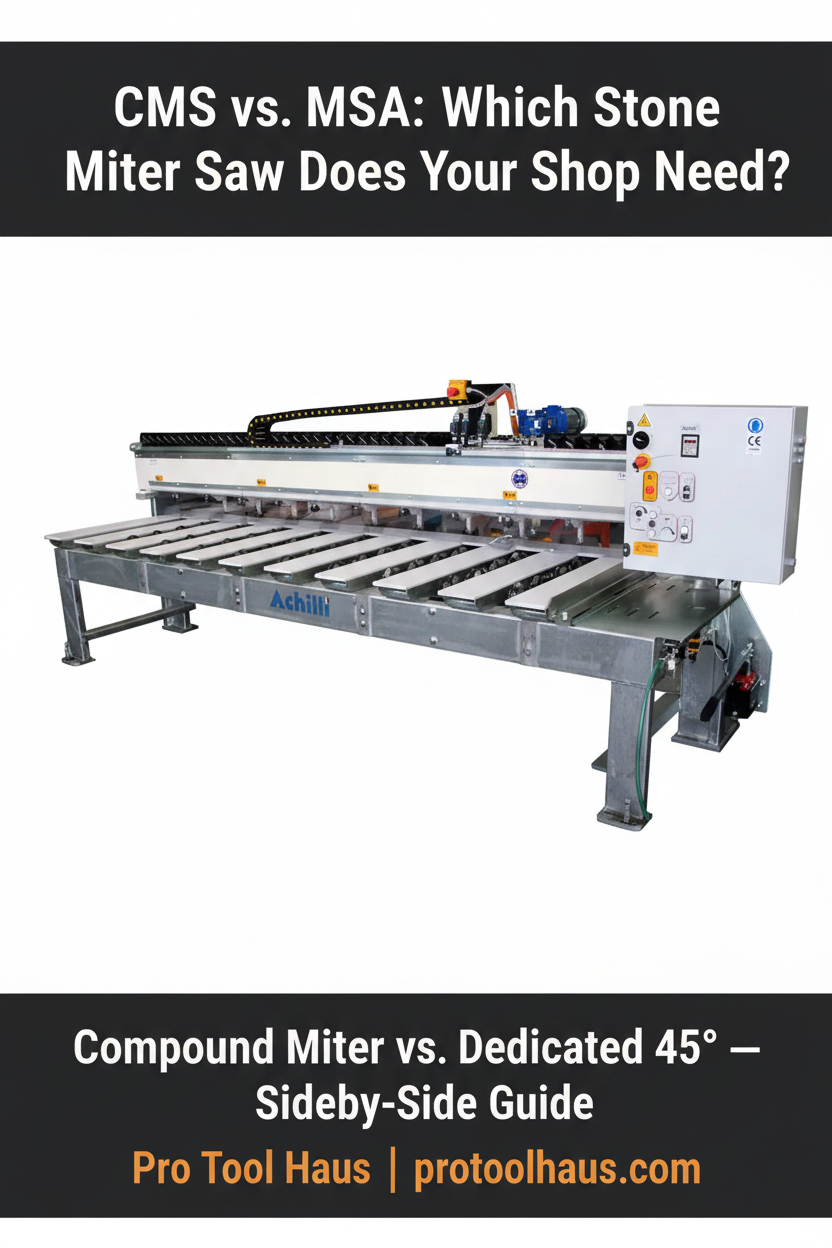
Every fabricator who does miter work hits the same decision point eventually: do I need a dedicated miter saw, or can my compound saw handle it?
The short answer is that it depends on three things — how much miter work you're doing, what material you're cutting, and whether you need compound angles or straight 45° production cuts. This guide walks through the Achilli CMS and MSA side by side so you can make the call for your shop.
What Is a Compound Miter Saw for Stone?
A compound miter saw combines two independent cutting axes: a swivel (left/right head rotation) and a tilt (blade lean). Together, they allow the blade to cut a compound angle — mitered and beveled simultaneously — in a single pass.
The Achilli CMS Portable Wet Cut Sliding Compound Miter Saw is a bench-style wet cutting machine that brings this geometry to stone fabrication. The swivelling head rotates ±45° with positive detent locks at ±45°, ±22.5°, and 0° — set the angle, lock it, and cut repeatedly without re-measuring. Head tilt runs from 90° to 45° for bevel cuts. Combine both axes for true compound miter work on marble, limestone, travertine, and soft stone.
Useful cut is 280 mm (11"). Available in 230V (3 HP) and 115V (1.5 HP) configurations. The removable ABS water tray with built-in recycling pump handles blade cooling without an external water supply. Folding legs and a long-side handle make it practical to move between shop and job site.
The CMS is the right choice when:
- You need compound angles — both swivel and tilt — in a single cut
- Your material is primarily marble, soft stone, limestone, or travertine
- Portability matters — on-site installs, multi-location work, or limited floor space
- You're working from 115V site power without a 230V supply
- Volume is moderate — occasional to regular miter work, not continuous production
What Is a Dedicated Bridge-Style Miter Saw?
A dedicated miter saw is built for one job: high-volume 45° production miter cuts. Where the CMS is a versatile compound machine, the MSA is a purpose-built production tool — larger, more powerful, and optimized for throughput on the shop floor.
The Achilli MSA Professional Miter Saw is a bridge-style machine with a 3700 mm X-axis, a 5.5 kW motor, face-down cutting geometry, and pneumatic slab positioning. The face-down approach puts the finished face of the stone against the table during the cut — minimizing edge chipping on the face that will show in the installation. Pneumatic positioning controls slab placement repeatably across production runs without manual repositioning between cuts.
The MSA is the right choice when:
- You're cutting 45° miters at production volume — countertops, cladding joints, high-quantity runs
- Material is hard granite, quartzite, sintered, or any stone where motor power matters
- You need face-down cutting geometry for cleaner face-edge results on hard stone
- Repeatability and throughput matter more than portability or compound angle capability
- Your shop has 3-phase power and dedicated floor space for a fixed machine
The 4 Questions That Decide It
1. How much miter work are you cutting?
The CMS is built for moderate volume — regular miter cuts in a shop or on-site, up to whatever your throughput needs are at the 280 mm useful cut and 3 HP motor level. If you're running continuous production miters — full countertop runs, large cladding orders, high-volume fabrication — the MSA's 5.5 kW motor, 3700 mm X-axis, and pneumatic positioning are purpose-built for that throughput.
2. What material are you cutting?
The CMS excels on marble, soft stone, limestone, travertine, and onyx — the softer end of the material spectrum where its motor capacity and blade geometry are well matched. It can handle softer granite and engineered stone. For hard granite, quartzite, sintered panels, and ceramic at production volume, the MSA's power and cutting geometry are better suited.
3. Do you need compound angles or straight 45°?
This is the clearest differentiator. The CMS produces compound angles — simultaneous swivel and tilt — that the MSA cannot. If your work includes decorative edges, architectural stone detailing, or angled cladding joints that require both axes, the CMS is the only option between the two. If your miter work is straight 45° production cuts for countertop edges and cladding miters, the MSA is faster and more capable at volume.
4. Does portability matter?
The CMS folds down, moves in a van, and sets up on-site. It runs on 115V if needed. The MSA is a fixed shop machine — 3-phase power, permanent installation, not designed to travel. If any of your miter work happens outside the shop, the CMS is the answer. If all miter work happens in a fixed production environment, portability is irrelevant.
What the CMS Does That the MSA Can't
- Compound angles — both swivel and tilt axes simultaneously
- 115V operation — runs on site power without a 230V or 3-phase supply
- Portable — job sites, installs, multi-location shops
- Plunge cuts — manual plunge mechanism for openings and cut-ins
- Soft stone versatility — optimized for marble, limestone, travertine, onyx
What the MSA Does That the CMS Can't
- Production throughput — 5.5 kW motor and 3700 mm X-axis built for continuous miter runs
- Face-down cutting geometry — cleaner face edge on hard stone production miters
- Pneumatic slab positioning — repeatable, fast positioning across production volumes
- Full countertop-length X-axis — 3700 mm handles full-length countertop miters in position
- Hard stone and sintered at scale — power and geometry suited for demanding materials at volume
Can You Run Both?
Yes — and it's a natural pairing rather than a redundant one.
A common shop setup: MSA as the primary production miter machine for 45° countertop and cladding work, CMS for on-site compound miter cuts, soft stone decorative work, and job-site installs where the MSA can't travel. The machines have different geometry and different use cases — running both means you have the right tool for every miter situation rather than compromising with one machine across all of them.
Side-by-Side Comparison
| CMS | MSA | |
|---|---|---|
| Cut type | Compound (swivel + tilt) | Dedicated 45° |
| X-axis travel | 280 mm (11") | 3700 mm |
| Motor | 2.2 kW (3 HP) | 5.5 kW (7.5 HP) |
| Power | 230V or 115V single-phase | 3-phase |
| Location | Portable | Fixed shop |
| Best material | Marble, soft stone | All stone, hard granite, sintered |
| Volume | Occasional–moderate | Production |
| Starting price | $3,124 | From $1,210 (configuration-dependent) |
The Bottom Line
Choose the CMS if: your miter work requires compound angles, involves marble and soft stone, benefits from portability or 115V site power, or volume is moderate rather than continuous production.
Choose the MSA if: you're running high-volume 45° production miters on hard stone, need face-down cutting geometry and pneumatic slab positioning, and have a fixed shop with 3-phase power.
Run both if: your shop handles production countertop miters and on-site or compound angle work — the machines serve different roles and don't compete.
Shop Achilli Miter Saws
- Achilli CMS Portable Compound Miter Saw — ±45° swivel, 90°–45° tilt, 115V or 230V. Starting at $3,124.
- Achilli MSA Professional Miter Saw — 5.5 kW, 3700 mm X-axis, face-down geometry, pneumatic positioning.
- Achilli AFR-A Motorized Bridge Saw — production bridge saw for straight cuts and 45° miters. Financing available.
- Equipment Financing — $0 down, terms up to 84 months.