
Why Brushed Stone Finishes Are Having a Moment
Polished stone is timeless — but it's not the only option. Over the past decade, brushed, leathered, and antique stone finishes have moved from niche design requests to mainstream specification. Designers and architects love them because they deliver something the standard high-gloss polish can't: warmth, texture, and a lived-in character that feels both classic and current.
These finishes — often called river wash, antique, leather, or caress — were originally developed for softer stones like marble and travertine, where carborundum brushes could work the surface relatively easily. Getting that same effect on hard granite was a different story entirely.
The Challenge with Granite
Granite is tough. Early attempts to brush-finish granite required a brutal multi-step process — sanding, flaming, bush hammering, water blasting — just to open the surface enough for a brush to have any effect. Even then, results were inconsistent, costs were high, and the finish at the edges was often mismatched and unattractive. It never scaled into a practical production workflow.
The core problem was that standard carborundum brushes simply couldn't bite into dense granite without that aggressive surface prep. Fabricators were stuck.
The Solution: Diamond-Embedded Brushes
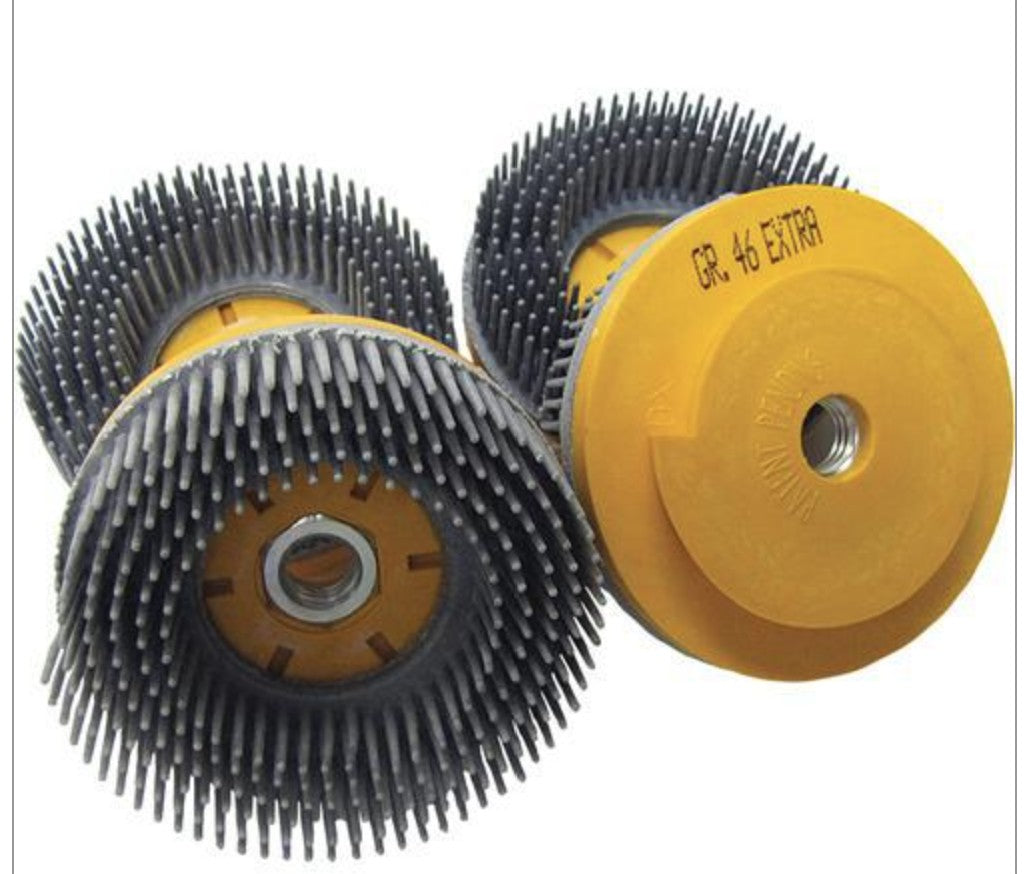
Tenax cracked this problem with a patented brush technology that embeds diamonds directly into both soft and hard plastic bristles. The result — the Airflex and Filiflex brush systems — can work directly into the surface of hard granite without any pre-treatment, progressively pulling out texture and color until the desired finish is achieved.
These tools are available in multiple attachment formats, making them compatible with:
- Angle grinders
- Edge polishers
- CNC machines
- Floor polishing machines
That versatility is a big deal for fabricators — the same system works across your existing equipment lineup.
Surface Prep: Start with a 60–80 Grit Hone
Before running any brush sequence, bring the surface to a consistent 60–80 grit honed finish. This levels out any rough spots and opens the material slightly, giving the brushes better grip and ensuring an even result across the slab. Skipping this step leads to inconsistent texture — don't shortcut it.
The Brush Sequence: Step by Step
Follow this sequence in order. Each step builds on the last, and skipping grits will show in the final finish.
Phase 1 — Filiflex Texturing
- Filiflextra 36
- Filiflextra 46
- Filiflextra 60
These coarser grits do the heavy lifting — cutting into the stone surface and establishing the base texture.
Phase 2 — Airflex Refining
- Airflex 120
- Airflex 220
- Airflex 300
At the end of this phase, you'll have a clean, warm antique brushed finish. This is the stopping point for a classic leathered or river wash look.
Want to Take It Further? The Caress Finish
If you want to push beyond the brushed finish into a caress finish — which retains the texture but adds a polished sheen — continue with the following steps:
Phase 3 — Airflex LUX Polishing
- Airflex LUX 400
- Airflex LUX 600
- Airflex LUX 800
Phase 4 — Fusion G Diamond Abrasives
Finish with Fusion G fine-grain diamond abrasives to bring the surface up to a full polish while preserving the underlying texture. The result is a surface that reads as polished from a distance but has the tactile warmth of a brushed finish up close.
A Note on Diamond Filament Brushes
A newer category of brushes has appeared on the market — they look similar to carborundum brushes but have diamonds woven into the filament. These can be useful for very hard granite at the start of the texturing process (typically just the 36 and 46 grit equivalent passes), but they should not be used to complete the full sequence.
Finishing with diamond filament brushes alone tends to produce a harsh, deeply scratched surface — the opposite of the smooth, warm result you're after. Always finish with the Airflex/Filiflex sequence for a clean, professional result.
Finish Comparison at a Glance
| Finish Name | Sequence Endpoint | Texture | Sheen |
|---|---|---|---|
| Antique / River Wash | Airflex 300 | Pronounced | Matte/Satin |
| Leather | Airflex 300 | Moderate | Low sheen |
| Caress | Fusion G | Subtle | High polish |
Which Stones Can Be Brushed?
The Airflex/Filiflex system works across a wide range of natural stone:
- Granite — the primary use case for this technology
- Marble — excellent results, often with fewer passes needed
- Travertine — produces a beautifully warm antique character
- Engineered stone — check with your material supplier for compatibility
Bottom Line
Brushed and leathered finishes are no longer a specialty fabrication challenge — with the right diamond brush system and the correct grit sequence, they're a repeatable, scalable part of any stone shop's workflow. Start with a clean honed surface, follow the Filiflex-to-Airflex sequence, and you'll have a finish that stands out in any kitchen, bath, or commercial application.
Shop Related Products
Have questions about tooling for a specific stone or application? Contact our team — we're happy to help you spec the right setup.