
What Is the Best Way to Cut Porcelain Tile?
A Complete Guide to Tools and Equipment for Clean, Professional Results
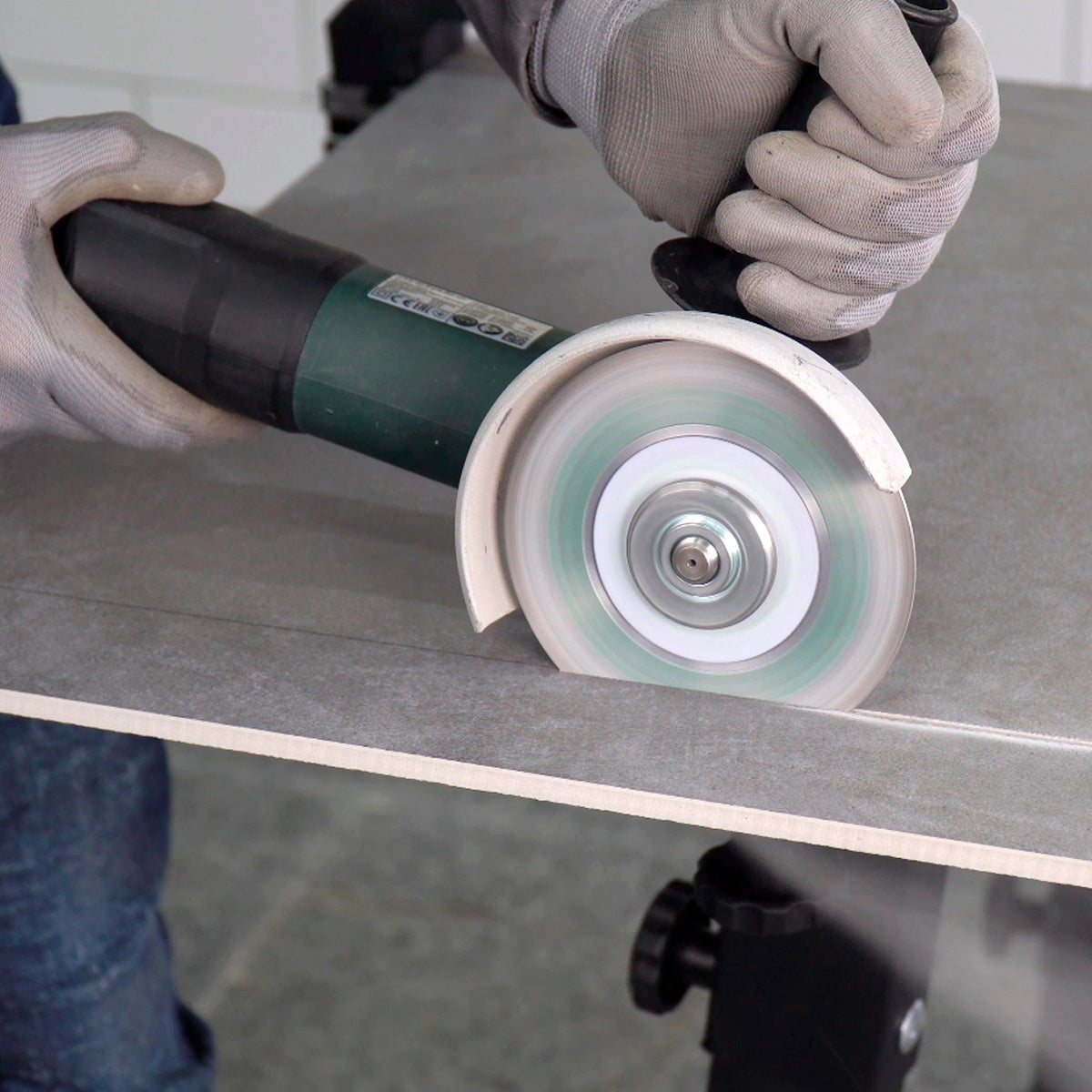
Porcelain tile can be cut using a 5" angle grinder with the proper diamond blade, an electric wet tile saw, or a guide rail system for large-format tile.
The right method depends on:
- Tile thickness
- Tile size (format)
- Surface finish (matte, polished, textured)
- Required edge quality
- Jobsite conditions
For detailed openings and precision cut-outs, a rotary tool (engraver/mini grinder) with a small diamond blade is often used.
There is no single universal tool — the key is matching the equipment to the application.
Why Is Choosing the Right Cutting Method So Important?
Porcelain tile is one of the most widely used finishing materials in residential and commercial construction. It’s valued for:
- Durability
- Design flexibility
- Low water absorption (<0.5%)
- Resistance to wear and chemicals
Porcelain is commonly used for:
- Floors and walls
- Countertops and window sills
- Shower pans and benches
- Built-in shelves and niches
- Decorative wall panels
- Flush plates and access panels
- Electrical box openings
Each of these applications may require a different cutting approach.
Understanding Porcelain Tile Properties
Porcelain tile is manufactured from:
- Clay
- Feldspar
- Quartz
- Mineral additives
It is pressed under high pressure and fired at temperatures exceeding 1,800°F (1,000°C).
The result:
- Extremely dense structure
- High hardness (Mohs 7–8)
- Low porosity
- High resistance to impact and abrasion
From a fabrication standpoint, porcelain is strong — but also unforgiving. Poor technique or unstable tools result in chipping immediately.
Best Tools for Cutting Porcelain Tile
Below are the most common cutting methods used in the U.S. market.
1. Manual Tile Cutter — When Does It Work?
A manual tile cutter scores the surface with a tungsten carbide wheel and then snaps the tile along the line.
Best For:
- Thin porcelain (1/8"–3/8" / 3–10 mm)
- Straight cuts only
- Smooth, non-textured surfaces
Limitations:
- Risk of break deviation
- Not ideal for thick porcelain
- Not suitable for textured or structured tile
- No curved cuts
- Cutting wheel cannot be resharpened
A manual cutter is useful as a secondary tool — not a universal solution.
2. Electric Wet Tile Saw — Maximum Precision
An electric tile saw uses a water-cooled diamond blade to minimize heat and chipping.
Advantages:
- Clean, chip-free edges
- High repeatability
- 45° bevel capability
- Minimal dust
Limitations:
- Requires water supply
- Less portable
- Setup time
Best For:
- High-end finishing work
- Visible edges
- Large volumes
- Professional tile shops
For aesthetic edge quality, wet cutting remains one of the most reliable methods.
3. 5" Angle Grinder — The Most Versatile Tool
A 125 mm (5") angle grinder with the correct porcelain blade is the most common solution on U.S. jobsites.
Why Contractors Prefer It:
- Affordable
- Portable
- Works dry
- Handles straight, curved, and bevel cuts
- Ideal for on-site adjustments
Applications:
- Straight cuts
- Curved cuts
- 45° miters (jolly cuts)
- Edge corrections
- Small cut-outs
Cordless grinders are increasingly popular for mobility.
For best results, use thin porcelain-specific diamond blades (typically 1.0–1.2 mm thickness).
4. Guide Rail Systems — Large-Format Tile
For tiles longer than 48" (1200 mm), standard tools become difficult to control.
Guide rail systems allow:
- Long, straight cuts
- Stable blade control
- Reduced chipping
- Safe slab handling
They can be used with:
- Manual scoring units
- Electric cutting motors
- Angle grinders
This is the preferred solution for large-format porcelain panels.
5. Rotary Tool (Engraver / Mini Grinder) — Precision Work
A rotary tool with a small diamond blade (typically 45 mm / 1.75") is used for:
- Flush plate openings
- Access panels
- Electrical boxes
- Decorative cut-outs
These tools are not for cutting full tile length. They are detail tools for precision fabrication.
Frequently Asked Questions (FAQ)
Can porcelain tile be cut dry?
Yes. Porcelain can be cut dry using a 5" angle grinder with the proper blade. However, dry cutting produces dust and requires controlled feed pressure to prevent overheating.
What is the best blade for cutting porcelain?
Thin, continuous-rim diamond blades specifically designed for porcelain provide the cleanest cuts and minimal chipping.
Is a manual cutter enough for porcelain?
It works for thin, smooth porcelain, but it is not suitable for thick, textured, or large-format tiles.
What is best for large-format porcelain slabs?
Guide rail systems provide the most accurate and stable solution for long, straight cuts.
How do you avoid chipping?
- Use a porcelain-specific blade
- Ensure grinder stability (no spindle wobble)
- Avoid excessive pressure
- Maintain steady feed speed
- Use wet cutting for highest edge quality
Summary
There is no single “best” way to cut porcelain tile.
The best method depends on:
- Tile size
- Thickness
- Surface finish
- Required edge quality
- Work environment
For most U.S. installers:
- Wet saws provide the cleanest finish
- 5" angle grinders offer maximum versatility
- Guide rails handle large-format tile
- Rotary tools handle detailed openings
Successful porcelain cutting is not about one tool — it’s about choosing the right system for the job.