
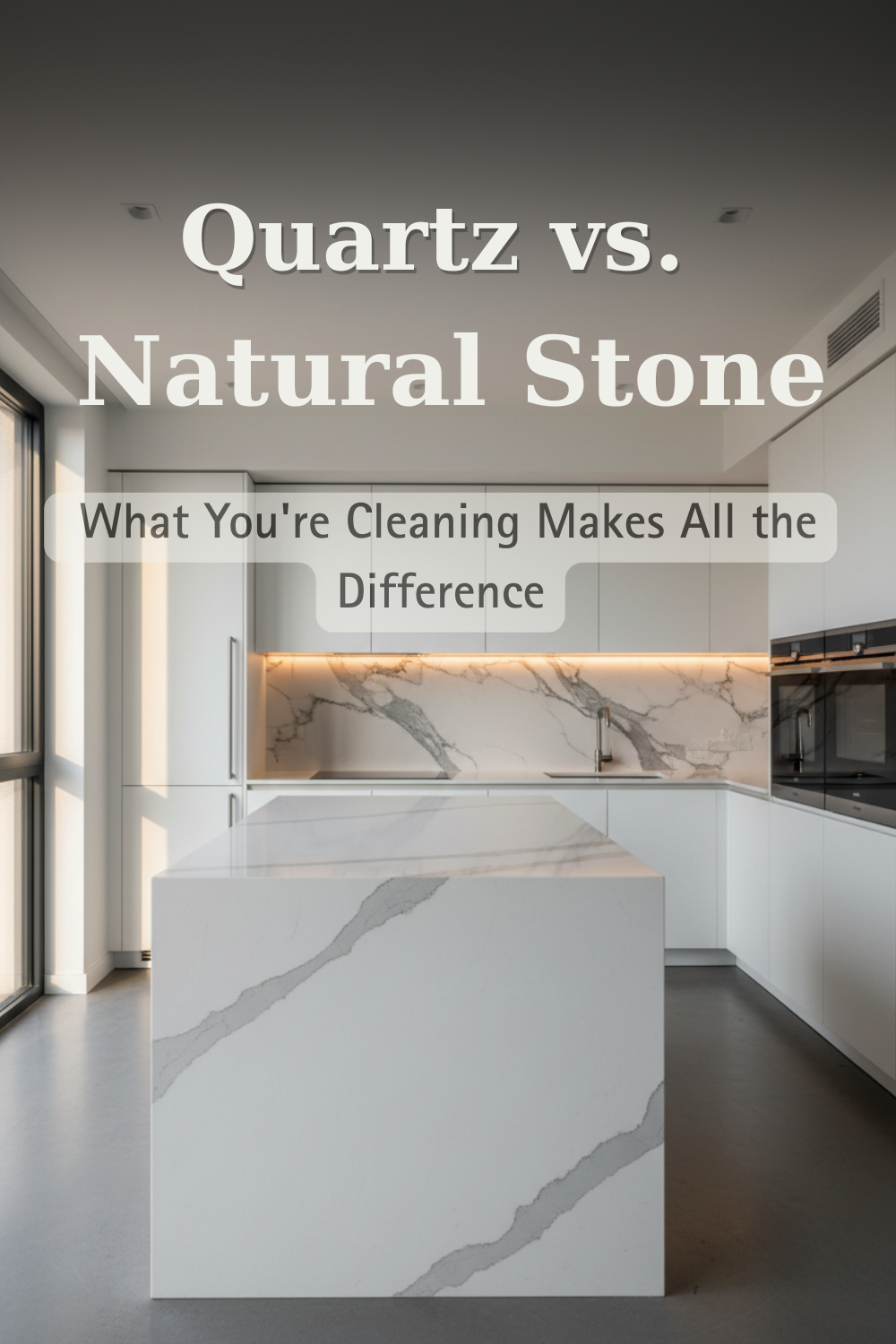
Quartz and natural stone countertops are often grouped together in home improvement conversations — and they do look similar. But they are fundamentally different materials that require completely different care routines, different cleaning products, and different approaches to stain prevention and restoration.
Using the wrong product on either surface can cause permanent damage. This guide explains exactly what makes quartz and natural stone different, how to care for each correctly, and which Lustro Italiano products are designed for each surface.
What's the Difference Between Quartz and Natural Stone?
Natural Stone (Granite, Marble, Travertine, Limestone)
Natural stone is quarried directly from the earth. Each slab is unique — the color, veining, and pattern are determined by the mineral composition of the specific stone. Natural stone is porous, meaning it has microscopic pores that can absorb liquids and staining substances. It requires sealing to protect against staining, and marble and limestone are acid-sensitive and will etch when contacted by acidic substances.
Quartz (Engineered Stone)
Quartz countertops are engineered — they're manufactured from approximately 90–95% ground quartz crystals bound together with polymer resins and pigments. The resin binder makes quartz non-porous, which means it does not absorb liquids and does not require sealing. However, the resin binder is sensitive to certain chemicals, heat, and UV exposure in ways that natural stone is not.
| Property | Natural Stone | Quartz |
|---|---|---|
| Composition | 100% natural mineral | ~93% quartz + resin binder |
| Porosity | Porous — requires sealing | Non-porous — no sealing needed |
| Acid sensitivity | Marble/limestone etch; granite more resistant | Resin can be damaged by strong acids/alkalis |
| Heat resistance | High — stone handles heat well | Moderate — resin can discolor from heat |
| UV resistance | High — color stable outdoors | Low — resin yellows in direct sunlight |
| Unique appearance | Yes — every slab is different | No — consistent, manufactured pattern |
| Requires sealing | Yes — periodically | No |
Daily Cleaning: Quartz vs. Natural Stone
Natural Stone
Natural stone requires a pH-neutral cleaner specifically formulated for stone. Acidic cleaners (vinegar, citrus-based products, many all-purpose sprays) will etch marble, limestone, and travertine. Alkaline cleaners can degrade the sealer over time, leaving the stone vulnerable to staining. Never use bleach, ammonia, or abrasive scrubbers on natural stone.
Use the Lustro Italiano Natural Stone Cleaner for daily cleaning of granite, marble, travertine, and limestone. It's pH-neutral, sealer-safe, and won't etch or degrade the stone surface.
Quartz
Quartz is more forgiving for daily cleaning — mild dish soap and water works for routine cleaning. However, harsh chemicals, bleach, oven cleaners, paint removers, and highly acidic or alkaline products can damage the resin binder and cause discoloration or surface degradation. Abrasive scrubbers can dull the surface finish.
Use the Lustro Italiano Quartz Stone Cleaner for daily cleaning — formulated specifically for quartz and engineered stone surfaces, safe for the resin binder, and won't cause the discoloration that harsh cleaners can produce.
Sealing: Quartz vs. Natural Stone
Natural Stone — Sealing Required
Natural stone is porous and must be sealed to protect against staining. Without a sealer, liquids like oil, wine, and coffee can penetrate the stone's pores and cause permanent staining. The sealing frequency depends on the stone type:
- Granite: every 3–5 years
- Marble: every 1–3 years
- Travertine and limestone: every 1–2 years
Use the Lustro Italiano Stone Sealer for granite, marble, travertine, and limestone. For the complete resealing routine, see our guide: When to Reseal Your Stone Countertops →
Quartz — No Sealing Required
Quartz does not require sealing. The resin binder makes it non-porous — liquids cannot penetrate the surface. However, quartz does benefit from a quartz-specific sealer spray that protects the resin surface from chemical exposure and enhances the appearance.
Use the Lustro Italiano Quartz Stone Sealer — a water-based stain protection spray formulated specifically for quartz and engineered stone. It's not an impregnating sealer (quartz doesn't need that) but a surface protectant that guards the resin binder against staining agents and chemical exposure.
Stain Removal: Quartz vs. Natural Stone
Natural Stone
Because natural stone is porous, stains can penetrate below the surface and require a poultice to draw them out. Surface cleaning alone won't remove deep stains. For oil, grease, wine, coffee, and organic stains, use the poultice method with Lustro Italiano Stain Remover Poultice Powder. For rust stains, use Lustro Italiano Rust Remover Powder.
Full guides: How to Remove Deep Stains Using a Poultice → | How to Remove Rust Stains →
Quartz
Because quartz is non-porous, most stains sit on the surface and can be removed with the right cleaner. For stubborn stains on quartz, use a non-abrasive cleaner and a soft cloth — do not use poultice products designed for natural stone, as they are formulated for porous surfaces and are not appropriate for quartz. The Lustro Italiano Quartz Stone Cleaner handles most surface staining on quartz effectively.
Etch Marks: Quartz vs. Natural Stone
Natural Stone (Marble, Limestone, Travertine)
Marble, limestone, and travertine are calcium-based stones that etch when contacted by acidic substances — wine, citrus, vinegar, coffee, tomato sauce. Etching is chemical damage to the polished surface, not a stain, and requires mechanical re-polishing to fix. Granite is much more resistant to etching.
For etch mark removal on marble, see our guide: How to Remove Etch Marks from Marble →
Quartz
Quartz does not etch the same way marble does — the quartz crystals themselves are acid-resistant. However, strong acids or alkalis can damage the resin binder, causing discoloration or surface dulling that looks similar to etching. Avoid leaving acidic substances on quartz for extended periods and never use harsh chemical cleaners.
Polish and Shine: Quartz vs. Natural Stone
Natural Stone
Natural stone polish products restore shine and replenish the sealer layer between full resealing treatments. Use the Lustro Italiano Stone Polish & Sealer Spray 1–2 times per month on granite, marble, and natural stone surfaces.
Quartz
Quartz has its own polish and enhancer formulated for the resin surface. Use the Lustro Italiano Quartz Stone Polish & Enhancer to restore shine, intensify color, and protect the quartz surface. Do not use natural stone polish products on quartz — they are formulated differently and may leave residue on the non-porous resin surface.
The Most Common Mistakes on Each Surface
Natural Stone Mistakes
- Using vinegar, lemon juice, or acidic cleaners — etches marble and limestone instantly
- Using bleach or ammonia — degrades the sealer over time
- Skipping sealing — leaves the stone vulnerable to deep staining
- Using abrasive scrubbers — scratches the polished surface
- Not resealing after stain or etch removal treatments
Quartz Mistakes
- Using harsh chemical cleaners, bleach, or oven cleaner — damages the resin binder
- Placing hot pots or pans directly on the surface — resin can discolor from heat
- Using natural stone poultice products — not formulated for non-porous surfaces
- Exposing to direct sunlight long-term — resin yellows with UV exposure
- Using abrasive scrubbers — dulls the surface finish
Quick Reference: Which Lustro Italiano Product for Which Surface?
| Product | Natural Stone | Quartz |
|---|---|---|
| Natural Stone Cleaner | ✅ Yes | ❌ No — use Quartz Cleaner |
| Quartz Stone Cleaner | ❌ No | ✅ Yes |
| Stone Sealer (impregnating) | ✅ Yes — required | ❌ No — not needed |
| Quartz Stone Sealer | ❌ No | ✅ Yes — surface protectant |
| Stone Polish & Sealer Spray | ✅ Yes | ❌ No — use Quartz Polish |
| Quartz Polish & Enhancer | ❌ No | ✅ Yes |
| Stain Remover Poultice Powder | ✅ Yes | ❌ No — quartz is non-porous |
| Rust Remover Powder | ✅ Yes | ❌ No |
Frequently Asked Questions
Does quartz need to be sealed?
No. Quartz is non-porous and does not require an impregnating sealer. However, a quartz-specific surface protectant like the Lustro Italiano Quartz Stone Sealer can help protect the resin surface from staining agents and chemical exposure.
Can I use the same cleaner on quartz and granite?
No. Natural stone cleaners and quartz cleaners are formulated differently. Use the Lustro Italiano Natural Stone Cleaner for granite, marble, and natural stone, and the Lustro Italiano Quartz Stone Cleaner for quartz and engineered stone.
Will vinegar damage quartz?
Vinegar won't etch quartz the way it etches marble, but it can damage the resin binder over time with repeated use. Avoid acidic cleaners on quartz and use a pH-balanced quartz cleaner instead.
Is quartz more stain-resistant than granite?
Yes — because quartz is non-porous, liquids cannot penetrate the surface. Granite is porous and can absorb staining substances if unsealed or under-sealed. However, a properly sealed granite countertop provides excellent stain resistance.
Can I use a poultice on quartz?
No. Poultice products are designed to draw stains out of porous stone. Quartz is non-porous, so a poultice has nothing to draw from. For stains on quartz, use the Lustro Italiano Quartz Stone Cleaner with a soft cloth.
Which is easier to maintain — quartz or natural stone?
Quartz requires less maintenance overall — no sealing, more forgiving for daily cleaning. Natural stone requires periodic sealing and more careful product selection, but is more heat-resistant, UV-stable, and has a unique natural appearance that engineered stone can't replicate.
Shop Lustro Italiano by Surface
For Natural Stone (Granite, Marble, Travertine, Limestone)
- Lustro Italiano Natural Stone Cleaner →
- Lustro Italiano Stone Sealer →
- Lustro Italiano Stone Polish & Sealer Spray →
- Lustro Italiano Professional Counter Top Reseal Kit →
For Quartz & Engineered Stone
- Lustro Italiano Quartz Stone Cleaner →
- Lustro Italiano Quartz Stone Polish & Enhancer →
- Lustro Italiano Quartz Stone Sealer →
- Lustro Italiano Quartz Cleaner & Polish Enhancer Kit →
Pro Tool Haus is an authorized distributor of Lustro Italiano stone care products.