
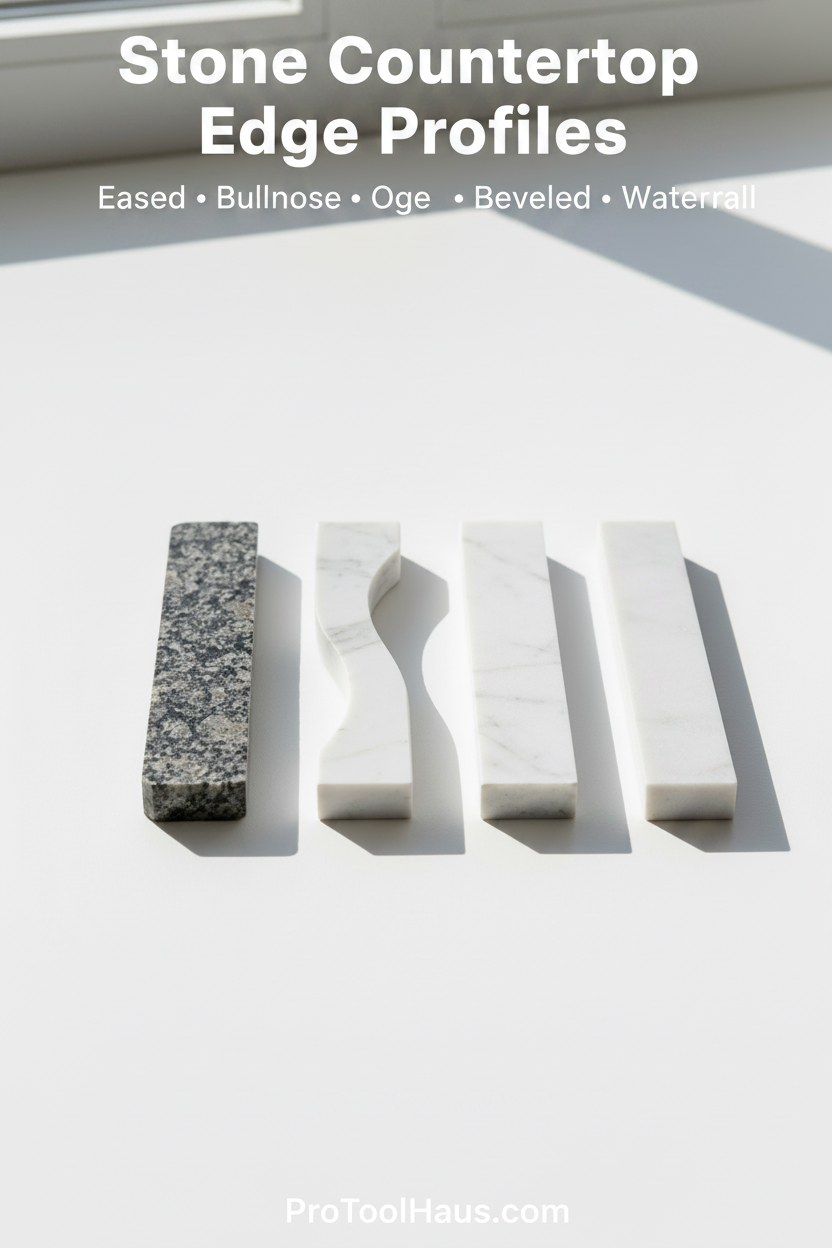
What is a countertop edge profile?
An edge profile is the shape applied to the exposed edges of a stone countertop. It's one of the most visible design decisions in a countertop installation — and one of the most significant labor variables in fabrication. The profile affects the look, feel, durability, and cleaning ease of the finished countertop.
Standard Edge Profiles
Eased Edge
The most common profile in modern fabrication. The top corner is lightly softened (typically a 1/8" break) to remove the sharp 90° corner, while the face remains flat and vertical.
- Look: Clean, contemporary, minimal
- Best for: Modern and transitional kitchens; quartz countertops; commercial applications
- Fabrication: Minimal — a single pass with a flat polishing pad and a light chamfer on the top corner
- Durability: High — no protruding profile to chip
Beveled Edge
A flat angled cut across the top corner, typically at 45°. The bevel width varies — a 1/4" bevel is subtle; a 1" bevel is a design statement.
- Look: Geometric, transitional, slightly formal
- Best for: Granite and quartzite; traditional and transitional kitchens
- Fabrication: Requires a bevel profile wheel or careful angle grinder work with a straight edge; polish the bevel face through the full grit sequence
- Durability: High — the angled face is less prone to chipping than a sharp corner
Bullnose (Full Bullnose)
The entire edge is rounded into a half-circle. The top and bottom corners are both fully rounded, creating a smooth, continuous curve from top to bottom.
- Look: Soft, traditional, classic
- Best for: Traditional kitchens; bathroom vanities; family homes with children
- Fabrication: Requires a bullnose profile wheel; polish the curved face through the full grit sequence; more labor than flat profiles
- Durability: Excellent — no corners to chip; the rounded profile is the most forgiving edge for impact
Half Bullnose (Demi Bullnose)
Only the top corner is rounded; the bottom remains square. A softer look than the eased edge without the full roundover of a bullnose.
- Look: Soft, approachable, versatile
- Best for: Transitional kitchens; quartz and granite; bathroom vanities
- Fabrication: Requires a half-bullnose profile wheel; less material removal than a full bullnose
- Durability: High
Ogee
An S-curve profile — concave at the top, convex at the bottom — creating an elegant, decorative edge. The classic ogee is a traditional high-end profile.
- Look: Formal, ornate, traditional luxury
- Best for: Traditional and formal kitchens; marble and granite; high-end residential
- Fabrication: Requires a dedicated ogee profile wheel; the most complex standard profile to execute cleanly; polishing the concave section requires flexible pads
- Durability: Moderate — the protruding convex section is more vulnerable to chipping than flat profiles; not recommended for high-traffic commercial applications
Dupont (Step Edge / Stacked Edge)
A two-level profile with a flat top surface, a vertical drop, a small horizontal shelf, and a second vertical drop to the bottom. Creates the appearance of a thicker slab.
- Look: Bold, architectural, contemporary
- Best for: Modern kitchens; thick-look countertops on standard 3/4" or 1-1/4" slabs; quartz and granite
- Fabrication: Requires precise router or CNC work; the horizontal shelf must be polished separately; seams at the shelf are a potential weak point
- Durability: Moderate — the horizontal shelf can collect debris and is vulnerable to impact at the outer corner
Waterfall Edge (Mitered)
The countertop surface continues vertically down the side of the cabinet to the floor, creating a seamless waterfall of stone. Requires a precise 45° miter cut at the corner joint.
- Look: Ultra-modern, architectural, dramatic
- Best for: Kitchen islands; contemporary and luxury residential; dark stones (black granite, nero marquina marble) where the continuous grain is most impactful
- Fabrication: Requires precise 45° miter cuts on the bridge saw; grain matching across the miter joint is critical and time-consuming; epoxy seam must be color-matched and clamped under pressure
- Durability: High once installed — the miter joint is the only vulnerability
Chiseled / Leathered Edge
A rough, hand-worked edge that mimics the natural fracture of stone. Often paired with a leathered or brushed top surface finish.
- Look: Rustic, natural, artisan
- Best for: Outdoor kitchens; rustic and farmhouse interiors; quartzite and granite with strong natural character
- Fabrication: Achieved with a chiseling tool or angle grinder; no polishing — the rough texture is the finish
- Durability: High — no polished surface to scratch or chip
How does edge profile affect fabrication time and cost?
| Profile | Relative Labor | Tooling Required |
|---|---|---|
| Eased | Low | Flat pad + chamfer |
| Beveled | Low–Medium | Bevel wheel |
| Half Bullnose | Medium | Half-bullnose wheel |
| Full Bullnose | Medium | Bullnose wheel |
| Ogee | High | Ogee profile wheel |
| Dupont / Step | High | Router or CNC |
| Waterfall (Mitered) | Very High | Bridge saw + epoxy |
| Chiseled | Low–Medium | Chiseling tool |
Does edge profile affect durability?
Yes — significantly:
- Flat profiles (eased, beveled) are the most durable. There's no protruding geometry to catch impacts.
- Rounded profiles (bullnose, half bullnose) are also very durable — the curved surface deflects impacts rather than absorbing them at a sharp point.
- Decorative profiles (ogee, dupont) have protruding sections that are more vulnerable to chipping, especially on harder, more brittle stones like granite and quartzite.
- Marble is softer and chips more easily at complex profiles — simpler edges (eased, beveled, half bullnose) are the practical choice for marble in high-use kitchens.
Does edge profile affect cleaning?
Yes — flat and rounded profiles are easiest to clean. Complex profiles (ogee, dupont shelf) collect debris and require more attention. For kitchen countertops with heavy daily use, simpler profiles are the practical choice regardless of aesthetics.
Polishing edge profiles
All polished edge profiles require the same grit progression as the top surface — 50 through 3000 — applied to the edge face. The challenge is maintaining consistent pad contact on curved and complex profiles:
- Flat edges: Standard polishing pads work directly on the edge face
- Curved profiles (bullnose, ogee): Require flexible polishing pads that conform to the curve — Weha Trio 3-Step Polishing Pads and Chido 4" 3-Step Polishing Pads are well-suited for edge work due to their flexibility
- Final buff: Weha Ultra Buff Final Diamond Polishing Pad for maximum gloss on the finished edge
See: What's the Difference Between Honing and Polishing Stone?