
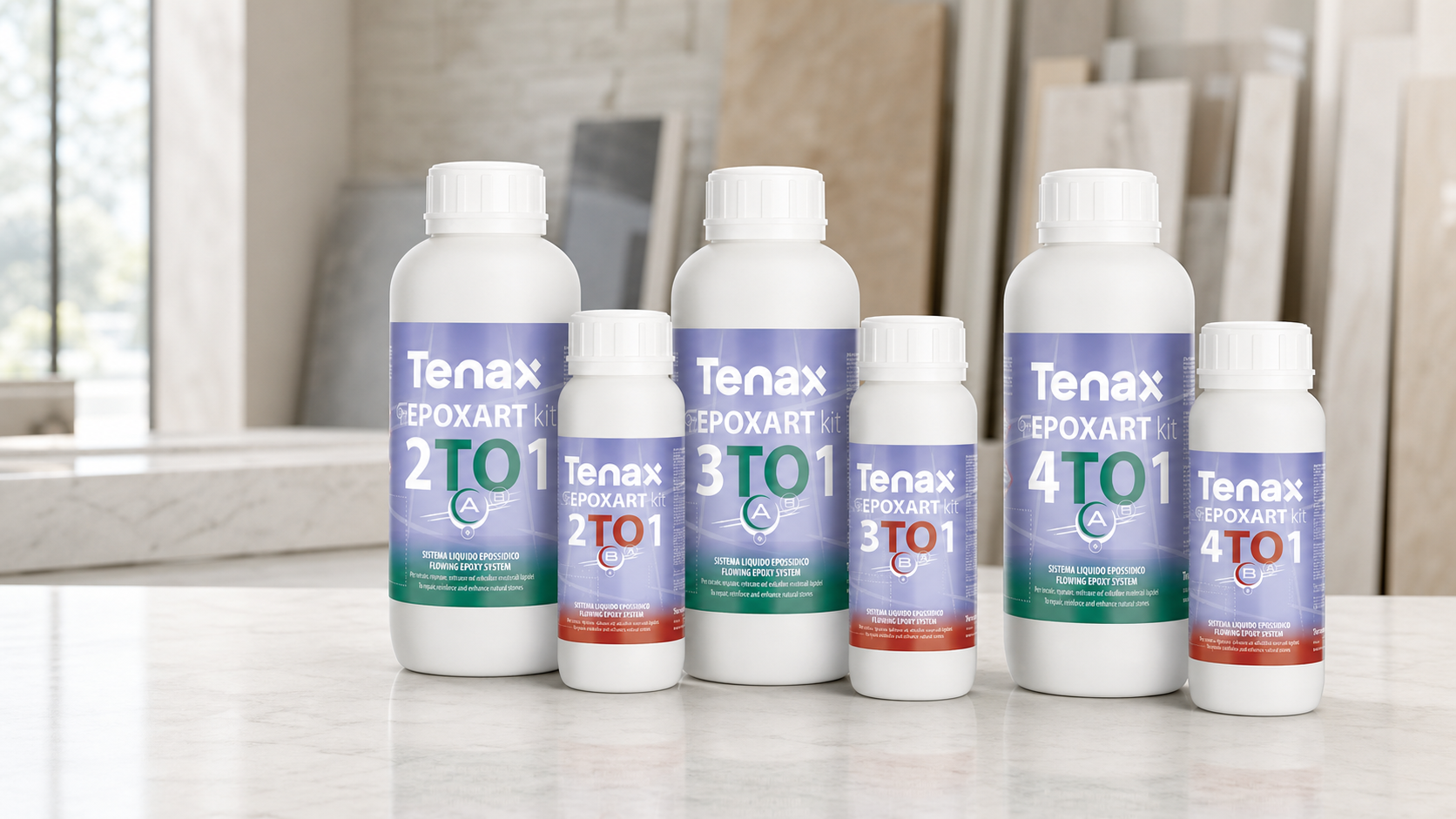
Tenax Epoxart 2:1 vs 3:1 vs 4:1 — Which Stone Epoxy Ratio Do You Actually Need?
The Tenax Epoxart Kit comes in three mix ratios — 2:1, 3:1, and 4:1 — and the numbers on the box tell you how to mix them, not which one to buy. The real differences are cure speed, how the resin flows, and how each one holds up in sunlight.
Here's the breakdown, straight from the latest Tenax technical data sheets (rev 03, September 2025) and confirmed directly with Tenax Italy.
The 30-second answer
- Need the slab back in the line this shift? Epoxart 4:1 — polish or cut in 6–8 hours. Also the pick for white materials sensitive to halos.
- Working porous or fractured stone that needs deep soak-in? Epoxart 3:1 — thinnest flow, longest open time, and the best sunlight stability of the three.
- Laminating edges or working colored materials? Epoxart 2:1 — very fluid, excellent adhesion, built for lamination and fiberglass netting.
All three cure to the same hardness (Shore D 77–80), all three work indoor and outdoor, and every kit includes Part A (resin) and Part B (hardener), always mixed together by weight.
Side-by-side comparison
| Epoxart 2:1 | Epoxart 3:1 | Epoxart 4:1 | |
|---|---|---|---|
| Mix ratio (A:B, by weight) | 2 : 1 | 3 : 1 | 4 : 1 |
| Mixed consistency | Thin syrup — very fluid, flows into cracks | Thin syrup — thinnest of the three, deepest penetration | Runny honey — body to stay where you put it |
| Working time in the cup (gel time @ 77°F / 25°C) | 55–75 min | 150–180 min | 7–8 min |
| Tack-free @ 77°F (25°C) | ~240 min | 300–360 min | 100–110 min |
| Ready to polish/cut @ 77–95°F (25–35°C) | 8-24 hrs | 24–48 hrs | 6–8 hrs |
| Ready to polish/cut @ 59–77°F (15–25°C) | 48 hrs | 48–72 hrs | 24–48 hrs |
| Sunlight stability (3-yr Xenon test, ISO 11341) | Medium-good | Good — best of the three | Good |
| Cured hardness (Shore D) | 77–80 | 78–80 | 78–80 |
| Best for | Crack repair, lamination, fiberglass netting, colored materials | Porous/fractured stone, outdoor work, maximum penetration | Production speed, white materials sensitive to halos |
All kits: minimum shop temperature to cure 59°F (+15°C) · service range after cure -13°F to 140°F (-25°C to +60°C) · never let the resin freeze · shelf life 24 months sealed at 68–77°F (20–25°C).
Epoxart 4:1 — The speed kit
The 4:1 is the accelerated system. Gel time in the cup is 7–8 minutes, and the slab is ready to polish or cut in 6–8 hours at normal shop temperatures. If your bottleneck is turnaround, this is the answer.
Two things to know before you mix:
Batch small. Seven minutes of pot life means you mix what you can spread in about five. Mix a full quart and you'll lose half of it hardening in the cup.
It's the thickest of the three. With the body of runny honey, the 4:1 stays on the surface and in the repair rather than soaking deep into the stone. That's a feature for facework and filling — and it's why Tenax recommends it for white materials sensitive to halos, where you don't want resin migrating into the stone around the repair.
Epoxart 3:1 — The penetration kit
The 3:1 is the thinnest-flowing system in the line and carries the highest penetration rating on Tenax's sheets. It also has the longest open time — 150–180 minutes in the cup — which means you can flood a fractured slab, let the resin find every fissure, and keep working it without racing the clock.
It also posts the best sunlight stability of the three ratios on the 3-year Xenon test. For exterior work, or any application where the resin line will see UV for years, the 3:1 is the conservative choice.
The trade-off is time: plan on 24–48 hours before polishing at normal shop temps, and up to 72 hours in a cool shop.
Epoxart 2:1 — The crack repair kit
The 2:1 is a very fluid, high-adhesion system that Tenax positions specifically for crack repair, lamination, fiberglass netting, and colored materials. It wets out mesh cleanly, flows into laminated buildups without starving the bond line, and cures clear and glossy.
Its sunlight stability is rated medium-good — a step below the 3:1 and 4:1 — which is consistent with its intended use: hair line cracks will absorb the color of the material, laminated edges and colored stone, where the resin line is either buried in the buildup or working under pigment.
Middle-of-the-road timing: about an hour of working time in the cup, polish-ready in 8-24 hours at shop temp.
Rules that apply to every kit
- Mix by weight, not volume. The ratio is in the name — 2, 3, or 4 parts resin to 1 part hardener, on a scale.
- Dry, clean stone only. Moisture under the resin is the most common cause of bond failure and color change.
- Never use PVC containers — use corrosion-resistant plastic, and keep the resin away from copper and brass, which can oxidize on contact.
- Gloves and goggles, every pour. These are professional-grade chemicals; read the SDS.
- Don't let the resin freeze, in the truck or in storage.
Still not sure?
If you're between the 3:1 and the 4:1, ask one question: is the job about soaking in or building up? Penetration and open time → 3:1. Speed and body → 4:1. And if there's mesh or a laminated edge anywhere in the job, start with the 2:1.
Questions about a specific material or application? Reach out — we've been resining stone for 30 years and we're happy to talk through the job before you buy.
Technical data from Tenax S.p.A. technical data sheets rev 03 (03/09/2025). All values are laboratory results and indicative; always test on your specific material.