
DiStar Diamond Blades: The Complete Buying Guide for Tile & Stone Professionals
Not all diamond blades are built the same. Walk into any big-box store and you'll find blades that cut — for a while. What you won't find is a blade engineered specifically for the contact angle of a 45° miter bevel, or a segment bond formulated for the dense, vitrified structure of full-body porcelain gres. That's the difference DiStar makes.
DiStar is a Ukrainian-engineered diamond tooling brand with over 25 years of manufacturing precision behind every blade, cup, and core bit. Their products are designed for professionals who can't afford chipping on a $40/sq ft porcelain slab or a blade that gives out halfway through a granite countertop. Pro Tool Haus is your authorized US source for the full DiStar lineup — blades, grinding cups, polishing pads, core bits, and 45° miter systems.
This guide breaks down every DiStar blade by application so you can match the right tool to your material, your machine, and your cut.
How to Choose the Right DiStar Blade
Match the Blade to the Material
The single biggest mistake installers make is treating diamond blades as interchangeable. DiStar engineers each blade's segment bond hardness and diamond concentration for a specific material density range.
- Porcelain and ceramic tile — dense, hard, and unforgiving of the wrong bond. You need a blade with a softer bond that exposes fresh diamond as the segment wears. DiStar's porcelain-specific blades (Colibri, Butterfly, DECOR SLIM 5D) are formulated for this.
- Granite and hard stone — abrasive materials that wear segments fast. DiStar's Gabbro series uses a harder bond to extend cut life in these demanding applications.
- Quartz — engineered stone with high silica content. The Gabbro Max Turbo 9" handles quartz and black granite where standard blades overheat and glaze.
Wet Saw vs. Angle Grinder
Your tool determines your blade. DiStar's angle grinder blades (4.5"–5") are designed for handheld dry cutting — they have center holes and arbor specs for standard grinders. Wet saw blades (7"–10") require water cooling and are mounted on tile saws. Never run a wet saw blade dry — the segment bond isn't designed for the heat load.
Straight Cuts vs. 45° Miter Cuts
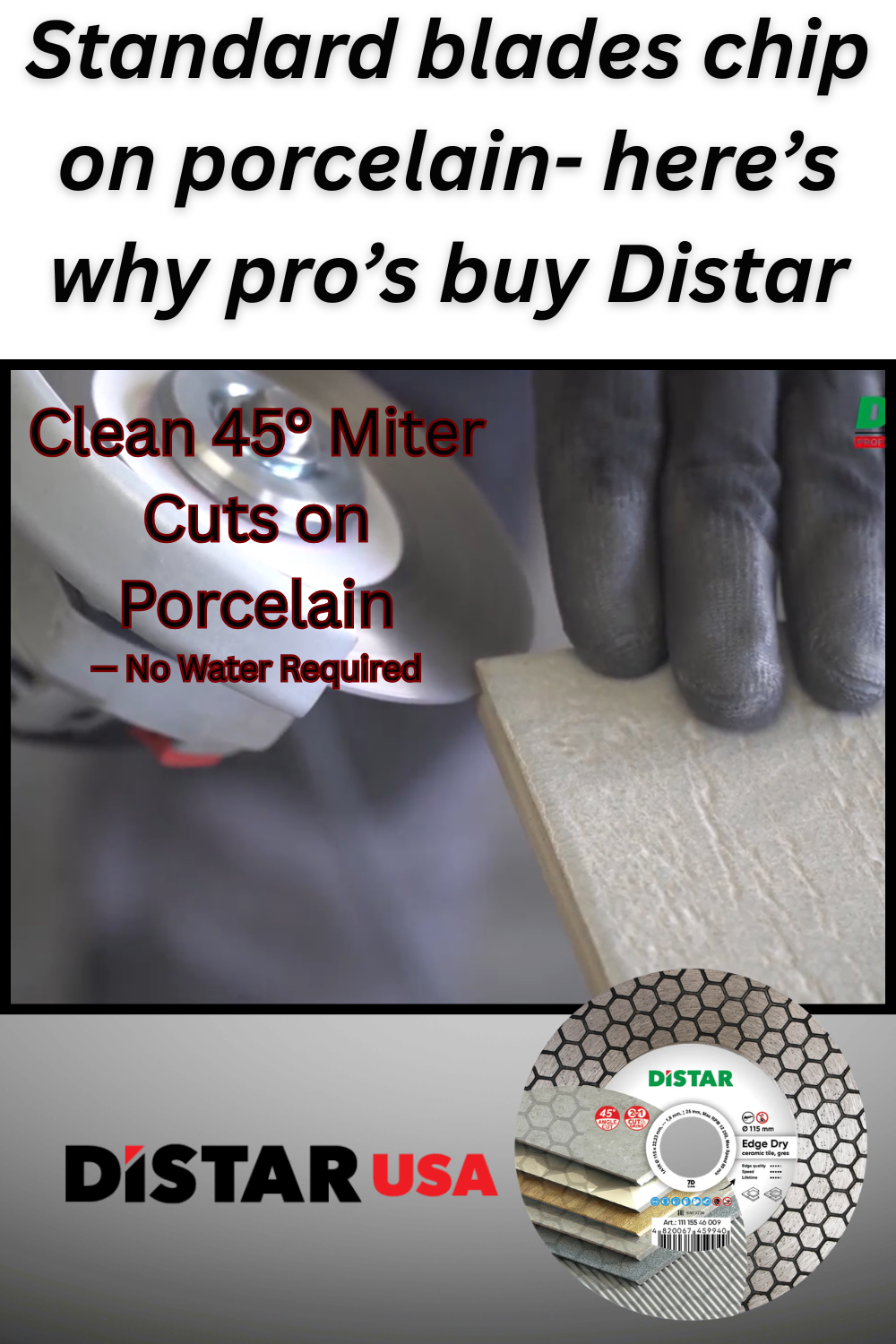
Standard diamond blades cut perpendicular to the tile face. When you tilt a grinder to 45° for a miter joint, the blade contacts the tile at a diagonal — a completely different geometry. Blades not designed for this angle will chip the bevel face and undercut the joint. DiStar's Edge Dry range and Edge Blade series are specifically engineered for 45° miter contact. More on this in the miter section below.
Blade Diameter and Arbor Compatibility
Always confirm your tool's arbor size before ordering. Most DiStar angle grinder blades use a 22.23mm arbor (standard for 4.5"–5" grinders). Wet saw blades vary by saw model — check your saw's manual for the correct arbor and blade diameter range.
DiStar Blades by Application
Porcelain Tile & Gres
Full-body porcelain and large-format gres slabs are among the most demanding cutting applications in tile installation. The material is dense, brittle at the edges, and expensive enough that a chipped cut is a costly mistake.
Colibri — DiStar's precision porcelain blade for angle grinders. Engineered for clean, chip-free cuts on ceramic and porcelain tile. The thin kerf reduces heat buildup and material loss, making it ideal for large-format work where precision matters.
Butterfly 45–50mm — A compact diamond blade for detail cuts, notches, and tight-radius work where a standard 4.5" blade won't fit. Purpose-built for ceramic and porcelain, with a segment geometry optimized for ultra-precise cuts in small format applications.
DECOR SLIM 5D — DiStar's ultra-thin dry cutting blade for decorative ceramic and porcelain. The 5D segment design minimizes chipping on glazed surfaces and decorative tile faces where aesthetics are critical.
Ceramic 4.5"–5" — DiStar's workhorse dry-cut blade for standard ceramic and porcelain tile on angle grinders. High cut volume, consistent performance, and a bond formulated for the full range of ceramic tile densities.
45° Miter Cutting
Curbless shower installations, feature walls, staircase tile work, and any application where a visible corner grout line is replaced by a mitered tile joint — these all require a blade and technique that standard diamond blades simply can't deliver cleanly.
Edge Dry Diamond Blade 4.5"–5" — DiStar's dedicated dry miter blade for angle grinders. The segment geometry and bond formula are engineered for the diagonal contact angle of a 45° bevel cut on ceramic and porcelain. No water required.
Edge Dry Slider 5" — Designed to pair with the SLIDER 45 PRO 2.0 guide system for precision miter work. The blade and guide work as a matched system, holding the grinder at exactly 45° while the blade handles the bevel contact geometry.
45° Miter Diamond Blade 7"–10" — Edge Blade — For wet tile saws where the saw head tilts to the miter angle. Available in 7", 9", and 10" diameters to match your saw. The segment bond is formulated for wet miter cutting on porcelain and ceramic gres.
Galaxy 5" — DiStar's versatile 5" porcelain blade that also supports 45° miter cutting on angle grinders. A strong all-around performer for installers who want one blade that handles both straight and miter cuts.
Granite & Hard Stone Fabrication
Granite, basalt, and hard natural stone require a fundamentally different blade than tile work. The material is abrasive, the cuts are longer, and blade longevity directly affects job profitability.
Gabbro Turbo 7" — DiStar's turbo-rim granite blade for angle grinders and small fabrication saws. The turbo segment design accelerates cutting speed while the bond formula is calibrated for granite's abrasive wear characteristics. Designed for fabricators who need consistent performance across high cut volumes.
Gabbro Max Turbo 9" — The heavy-duty option for black granite, quartz, and hard engineered stone. The larger diameter and reinforced segment bond handle the density and silica content of materials that wear standard blades prematurely. Built for 9" angle grinders and fabrication saws.
Small Format & Detail Work
Not every cut is a full slab run. Notches around outlets, cuts in tight corners, detail work on mosaic installations — these require a blade small enough to maneuver precisely without sacrificing cut quality.
Butterfly 45–50mm — At 45–50mm, this is DiStar's smallest blade — purpose-built for the cuts that a standard grinder blade can't reach. Ideal for notching, outlet cutouts, and precision detail work in ceramic and porcelain.
DiStar Grinding & Finishing Tools
Cutting is only part of the fabrication workflow. Edge prep, surface grinding, and polishing require dedicated tooling — and DiStar's grinding and finishing range is built to the same engineering standard as their blades.
Grinding Cups for Edge Prep
Soft Edge DGM-S 4.5" Grinding Cup — DiStar's soft-bond grinding cup for edge profiling and surface prep on porcelain tile and stone. The soft bond exposes fresh diamond consistently, making it effective on the dense, hard surfaces where harder-bond cups glaze and lose efficiency.
Nectar 2" Diamond Grinding Cup — A compact 45mm grinding cup for tight-radius edge work and detail grinding. At 100 grit, it's suited for material removal and edge shaping in areas where a full-size cup won't fit.
Polishing Pads for Porcelain
CoolPAD 2" Polishing Pad — DiStar's dry-use diamond polishing pad for porcelain tile. The CoolPAD design manages heat during dry polishing, extending pad life and maintaining consistent surface finish quality.
CoolPAD 4" Polishing Pad — The larger format option for polishing broader tile surfaces and countertop edges. Same dry-use diamond technology as the 2", scaled for higher-volume finishing work.
Core Drilling
Rocket Diamond Core Drill Bit — DiStar's dry-use core bit for drilling through porcelain and granite. Rated for 300+ holes per bit, the Rocket is built for the repetitive drilling demands of tile installation — drain holes, fixture cutouts, and penetrations through hard stone.
45° Miter Systems — Blades and Guides Together
A miter blade alone gets you halfway there. The other half is holding the grinder at a consistent 45° angle through the entire cut — something that's nearly impossible to do freehand with the accuracy a clean miter joint requires.
Why the Blade Alone Isn't Enough
Freehand miter cutting with an angle grinder produces inconsistent bevel angles, wandering cuts, and chipped edges — even with the right blade. The guide system is what makes the difference between a professional miter joint and a rework.
SLIDER 45 PRO 2.0 — The Complete Kit
The SLIDER 45 PRO 2.0 combines the Edge Dry Slider blade with a precision guide rail that locks the grinder at exactly 45°. The guide rides along the tile edge, maintaining the angle through the full cut length. It's the professional solution for curbless shower niches, feature wall corners, and staircase tile work where joint consistency is non-negotiable.
DUSTER 45 and SLIDER 1.8" for Tight Spaces
The DUSTER 45 provides the 45° angle geometry with integrated dust extraction — useful for interior work where dry cutting dust is a concern. It works with any compatible tile blade, giving you guide precision without being locked to a specific blade.
The SLIDER 1.8" gives you the narrower guide foot needed for 45° work close to walls and in tight junctions — the situations where the standard SLIDER guide is too wide to position correctly.
Shop the full 45° Miter Blades & Guides collection →
DiStar vs. Standard Diamond Blades — What's the Difference?
The diamond blade market is full of commodity tooling — blades that are priced to move, not engineered to perform. Here's what separates DiStar from the standard options:
Segment bond engineering. DiStar formulates the bond hardness of each blade for a specific material category. A blade with the wrong bond for your material either wears too fast (soft bond on abrasive stone) or glazes over and stops cutting (hard bond on dense porcelain). Commodity blades use a one-size-fits-all bond that compromises on both ends.
Heat management. DiStar's segment geometry — turbo profiles, thin kerfs, 5D designs — is engineered to manage heat at the cut interface. Heat is what kills blades prematurely and causes edge chipping on sensitive materials. Better heat management means longer blade life and cleaner cuts.
Cut life consistency. A DiStar blade doesn't just last longer — it performs consistently through its life. Commodity blades often cut well initially and degrade rapidly. DiStar's diamond concentration and bond formula are calibrated to maintain cut quality from the first cut to the last.
Application specificity. DiStar makes blades for 45° miter cutting, for ultra-thin decorative tile, for black granite, for compact detail work. That level of application specificity doesn't exist in commodity tooling.
Frequently Asked Questions
Can I use a DiStar blade dry?
It depends on the blade. DiStar's angle grinder blades — the Edge Dry range, Colibri, Butterfly, DECOR SLIM 5D, Ceramic, Galaxy, Gabbro series — are designed for dry cutting. DiStar's wet saw blades (Edge Blade 7"–10") require water cooling and should never be run dry. Always check the blade's product page for dry/wet designation before use.
What's the difference between the Edge Dry and the Edge Dry Slider?
Both are 45° miter blades for angle grinders. The Edge Dry is a standalone blade for freehand or guide-assisted miter cutting. The Edge Dry Slider is specifically designed to pair with the SLIDER 45 PRO 2.0 guide system — the blade geometry is matched to the guide's contact mechanics for optimal miter performance as a system.
How many cuts can I expect from a DiStar blade?
Cut life varies by material, blade model, and cutting technique. DiStar's Rocket core bit is rated for 300+ holes. For cutting blades, DiStar publishes cut life data by material on their technical sheets — contact Pro Tool Haus for application-specific guidance.
Where can I buy DiStar blades in the US?
Pro Tool Haus is an authorized US distributor for DiStar diamond tooling. Shop the full DiStar collection →
Ready to Find Your Blade?
Shop DiStar Diamond Blades & Cutting Tools →
Shop DiStar Grinding Cups →
Shop 45° Miter Blades & Guides →
Questions about which blade is right for your application? Contact Pro Tool Haus →