
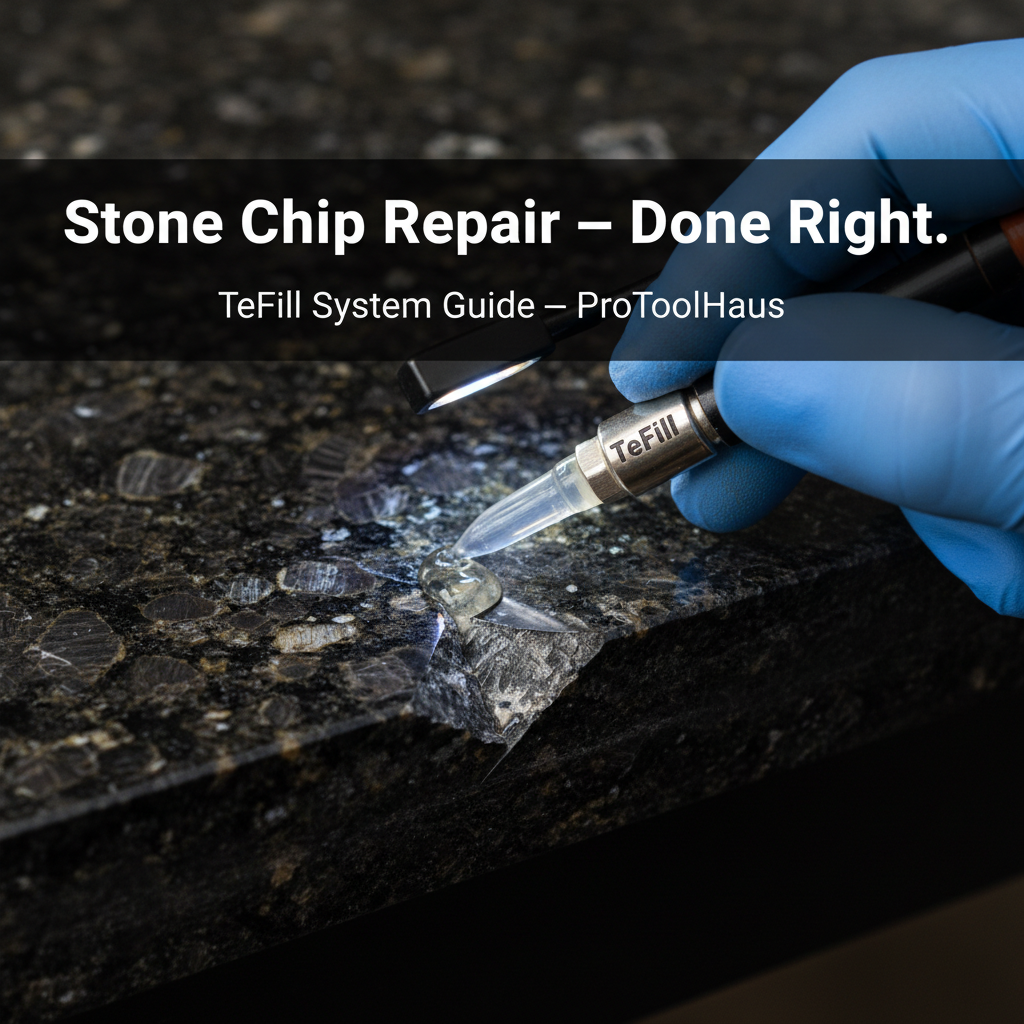
TeFill is Tenax’s cyanoacrylate stone repair system — three products that work together to fill cracks, chips, and voids in natural stone, engineered stone, wood, ceramic, and more. The system is fast, clean, and nearly invisible when done correctly. But the three components have specific roles, and using the wrong one for the job will give you a poor result.
Here’s exactly what each product does and when to use it.
How the TeFill System Works
TeFill is a two-step system: adhesive first, activator second.
- Apply TeFill 1 or TeFill 2 (the cyanoacrylate adhesive) to the repair area
- Spray TeFill 3 (the activator) over the adhesive
- The activator triggers an accelerated chemical reaction — the repair locks in seconds
- Once cured, sand and polish to a seamless, nearly invisible finish
Without TeFill 3, TeFill 1 and TeFill 2 will cure on their own — but slowly, over minutes or hours depending on humidity and temperature. TeFill 3 is what makes the system practical for professional use.
TeFill 1 — Thin Cyanoacrylate
TeFill 1 has a water-thin viscosity — it flows like water and wicks into tight spaces by capillary action. This is what makes it effective for repairs that thicker adhesives simply can’t reach.
Use TeFill 1 for:
- Hairline cracks and fissures in granite, marble, and natural stone
- Porous surfaces where the adhesive needs to penetrate deeply
- Stabilizing crumbling edges before a larger repair
- Thin cracks in wood grain, ceramic, and concrete
- Any repair where the gap is too narrow for a thicker adhesive to enter
Do not use TeFill 1 for: larger chips or voids — it will run out of the repair area before it can cure. Use TeFill 2 instead.
TeFill 2 — Thick Cyanoacrylate
TeFill 2 has a gel-like consistency — it stays where you put it. This makes it the right choice for larger defects where TeFill 1 would simply flow away.
Use TeFill 2 for:
- Larger chips and voids in countertop edges and surfaces
- Deeper pits and spalls in granite, marble, and travertine
- Vertical surface repairs where the adhesive needs to stay in place
- Building up material in layers for a flush, polishable repair
- Large knot holes and grain voids in wood
- Edge chips on porcelain and engineered stone
Pro tip: For complex repairs, use TeFill 1 first to stabilize hairline cracks around the chip, then fill the main void with TeFill 2. Activate each step separately with TeFill 3.
TeFill 3 — Activator (Pump vs. Aerosol)
TeFill 3 is the activator — it’s what cures TeFill 1 and TeFill 2 in seconds. It comes in two formats:
TeFill 3 — Activator Pump (2 oz)
A precision pump applicator that delivers a controlled, targeted spray with minimal overspray. Best for:
- Spot repairs where you need precise application
- Smaller repairs where aerosol coverage would be excessive
- Jobsite use where portability and control matter
- Situations where overspray on surrounding stone would be a problem
TeFill 3 — Aerosol Spray (6 oz)
A spray-can format that delivers faster, hands-free coverage over larger areas. Best for:
- High-volume shops doing multiple repairs per day
- Larger repair areas where pump coverage would be slow
- Situations where speed matters more than precision
Both formats activate TeFill 1 and TeFill 2 identically — the difference is application speed and coverage area, not chemistry.
Quick Reference Chart
| Product | Viscosity | Best For | Not For |
|---|---|---|---|
| TeFill 1 — Thin | Water-thin | Hairline cracks, fissures, porous surfaces | Large chips or voids |
| TeFill 2 — Thick | Gel | Larger chips, voids, vertical surfaces | Hairline cracks too narrow for gel |
| TeFill 3 — Pump | N/A | Precision spot repairs, jobsite use | High-volume or large-area repairs |
| TeFill 3 — Aerosol | N/A | High-volume shops, larger repair areas | Precision work with overspray concerns |
Step-by-Step: How to Use the TeFill System
- Clean the repair area — remove dust, debris, and any loose material. The surface must be dry.
- Choose your adhesive — TeFill 1 for hairline cracks; TeFill 2 for larger chips and voids.
- Apply the adhesive — apply sparingly. For TeFill 1, let capillary action draw it in. For TeFill 2, slightly overfill the void to account for minor shrinkage.
- Spray TeFill 3 — apply the activator over the adhesive. The repair will lock in seconds.
- Allow to fully cure — wait until the repair is completely hard before proceeding.
- Trim flush — use a Tenax #9 Razor Blade to trim any excess cured adhesive flush with the surface.
- Sand and polish — sand progressively through grits and polish to match the surrounding stone finish.
CA Bloom — What It Is and How to Avoid It
CA bloom is a white haze that can appear on the stone surface around a cyanoacrylate repair — caused by cyanoacrylate vapors reacting with moisture in the air during cure. It’s more common in humid conditions and when too much activator is applied.
To minimize bloom:
- Apply TeFill 3 sparingly — a light mist is enough
- Work in a well-ventilated area
- Avoid applying in high-humidity conditions when possible
If bloom occurs, Tenax TeBlossom is specifically formulated to remove CA bloom from stone surfaces without damaging the repair or the surrounding stone.
Best Value: TeFill Chip Repair Kit
New to the TeFill system? The TeFill Chip Repair Kit bundles TeFill 1, TeFill 2, and TeFill 3 Activator Pump in one package — everything you need to handle any repair, at a better price than buying the components separately.
Further Reading
- Stone Repair Adhesive Guide — Cyanoacrylate vs. Polyester vs. Epoxy: Which Do You Need? →
- Knife Grade vs. Flowing Polyester — Which Do You Need? →
Questions about the TeFill system? Contact the ProToolHaus team — we’re here to help.