
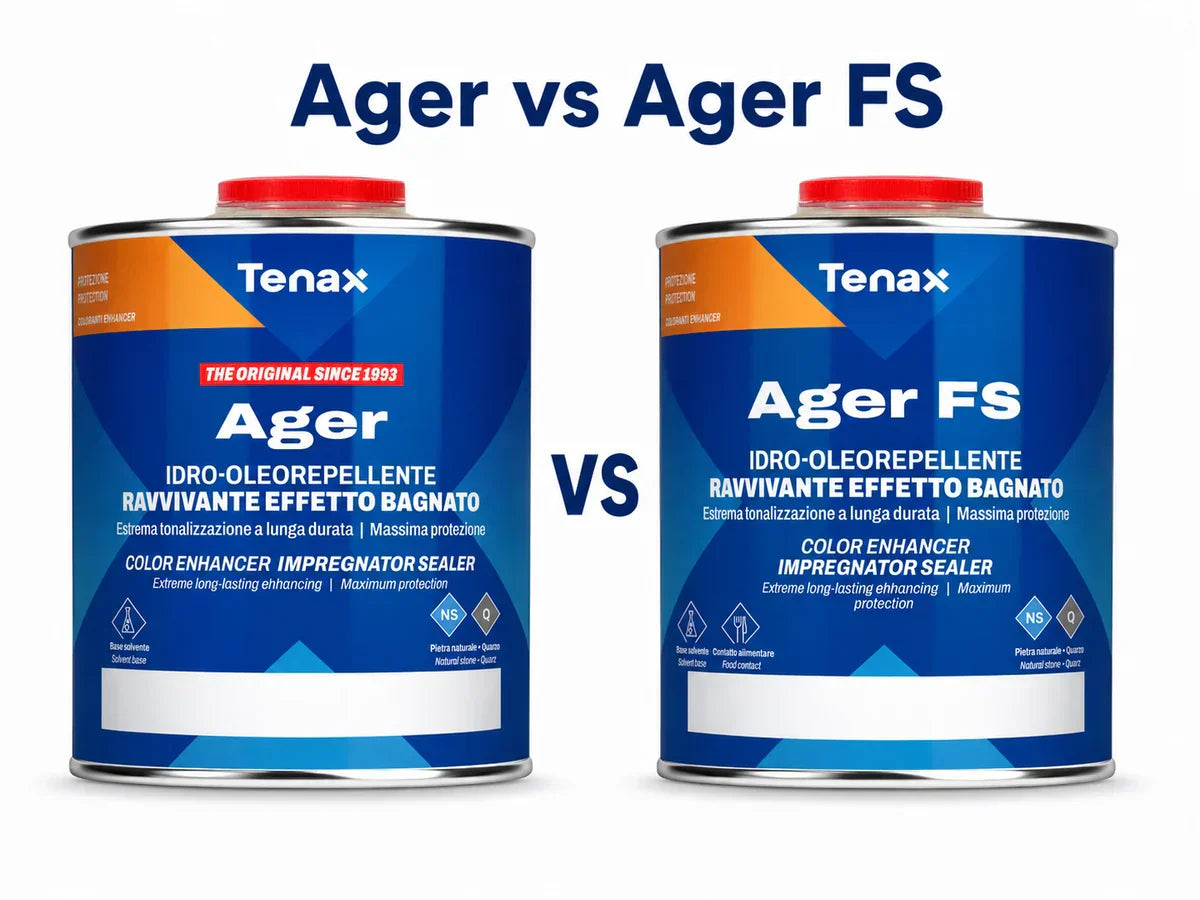
If you've sealed stone for any length of time, you've reached for Tenax Ager. It's been the go-to color-enhancing impregnating sealer in the trade for years. Lately a second version has shown up on the shelf — Ager FS — carrying a "food safe" designation, and it raises a fair question we hear from fabricators and installers all the time:
If Ager FS is the "food safe" one, does that mean regular Ager isn't safe for the kitchen counters I've been sealing all along?
Short answer: that's not what the designation means, and the distinction is more specific — and more useful — than the label suggests. Here's the straight story, drawn from Tenax's own technical and safety documentation.
Two different questions that often get tangled together
When people ask whether a sealer is "safe," they're usually mixing two separate things:
- Is the liquid product safe to handle during application?
- Is the finished, cured surface safe to put food on?
These are governed by different data and answered differently. Keeping them separate is the key to understanding Ager vs. Ager FS.
The liquid product: both require care, and both are professional-use
Both Ager and Ager FS are solvent-based, professional-use products, and both are classified as hazardous in their liquid form. That's normal for this category of impregnating sealer. Per Tenax's Safety Data Sheets:
- Both are flammable liquids and carry California Proposition 65 warnings (from a trace methanol content).
- Regular Ager carries the more cautionary classification — signal word DANGER, including a reproductive-toxicity Category 1B statement — and is built on an ethyl-acetate / hydrocarbon solvent system with a small organotin catalyst.
- Ager FS carries signal word WARNING, a lower-tier reproductive-toxicity Category 2 ("suspected") statement, and is built on a different, siloxane-based chemistry.
The practical takeaway for the applicator is the same for both: work in ventilation, wear the right gloves and eye protection, keep it away from ignition sources, and read the SDS before use. None of this is unusual for a solvent-based stone treatment — it's standard professional practice.
This first question — handling the wet product — is not what the "food safe" label is about.
The cured surface: this is what "food safe" actually refers to
Both Ager and Ager FS are penetrating impregnators. They soak into the microporosity of the stone, the solvent carrier flashes off, and — when applied correctly and buffed — they leave no surface film. What remains is the repellent resin bound inside the stone, not a coating sitting on top of it.
The "food safe" designation is a statement about that cured, treated surface, not about the can. According to Tenax's technical data sheet, a surface treated with Ager FS is suitable for contact with food and complies with EU Regulation 1935/2004 (the European framework regulation for materials intended to contact food) and Italian Ministerial Decree DM 21/03/1973.
That's a real, specific certification — Tenax tested the treated surface against a recognized food-contact standard and it passed.
Regular Ager carries no such food-contact certification on its technical data sheet. That's the honest, documented difference between the two products.
What that does — and doesn't — mean for past projects
Here's where precision matters, because "not certified for food contact" is not the same statement as "unsafe."
- It does not mean regular Ager is a problem on a finished countertop. Ager is a penetrating sealer that cures into the stone and leaves no surface film, and it has an exceptional real-world track record (more on that below). There is no recall or safety advisory on it that we're aware of.
- It does mean Tenax has not tested or certified the treated surface of regular Ager for food contact — and that the properly documented choice for a job that requires food-contact compliance is Ager FS.
In other words, the arrival of Ager FS isn't a correction of a problem with regular Ager. It's a purpose-built, certified option for the specific situations where food-contact compliance is the requirement.
So which one should you use?
First, some perspective on regular Ager. It has been the trade's go-to color-enhancing sealer for two decades, with tens of thousands of cans sold every year. That adds up to hundreds of thousands — realistically millions — of countertops sealed with Ager over twenty years, with no pattern of complaints, warranty claims, or safety issues across that entire history. A track record like that, over that many surfaces and that many years, speaks for itself: once Ager has cured into the stone, it has performed as a reliable, trouble-free sealer in real kitchens for a very long time.
So the choice between the two isn't "safe vs. unsafe." It's about which product carries the specific food-contact certification when a job calls for it:
- When a food-contact spec is explicitly required (commercial kitchens, certain healthcare and hospitality work, or any customer who wants certified documentation): use Ager FS. It's the product that holds the EU food-contact certification, so it satisfies the spec on paper as well as in performance.
- For residential countertops and general stone work, regular Ager remains the proven, trade-standard choice it has always been — and Ager FS is available whenever a certified option is preferred.
One important note on accuracy
If you market or describe a sealing service as "food safe," make sure the product you actually used matches the claim. The EU food-contact certification belongs to Ager FS specifically. Describing a surface sealed with regular Ager as "food safe certified" would be a misstatement — not because the work is bad, but because the certification attaches to one product and not the other.
Get the source documents
Everything above is drawn from Tenax's own Technical Data Sheets and Safety Data Sheets. For any project where the documentation matters — a spec, an inspection, or simply a customer who wants to see it in writing — we recommend keeping the current SDS and TDS for both Ager and Ager FS on file, and relying on those manufacturer documents as the authoritative source on safety and certification.
Pro Tool Haus stocks both Tenax Ager and Ager FS. If you'd like the current Tenax data sheets, help matching the right product to a job spec, or guidance on application, reach out — we're glad to help.
This article is provided for general information by Pro Tool Haus and reflects manufacturer documentation available at the time of writing. It is not a safety determination or legal advice. Always read the product Safety Data Sheet and Technical Data Sheet before use, and verify suitability for your specific application.