
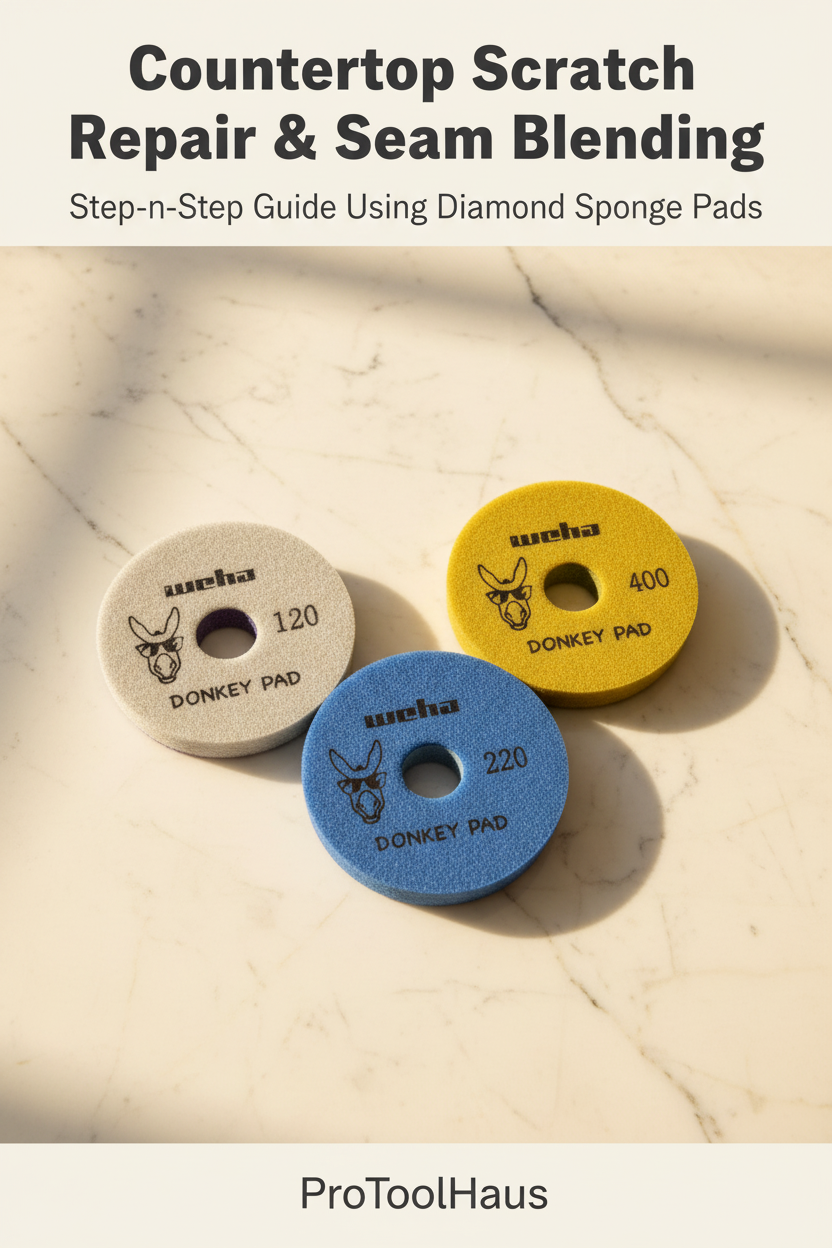
Surface repairs are where reputations are made or lost. A visible scratch on a freshly installed quartz countertop, a seam that doesn't blend, an etch mark on marble that the homeowner notices on day one — these are the jobs that define whether a fabricator or installer gets called back or gets a bad review.
The good news: with the right pad system and the right technique, most countertop surface repairs are fully recoverable. This guide covers scratch removal, seam blending, and etch mark repair on quartz, marble, and granite using the Weha Donkey Face Polish & Inline Polishing Pads — a diamond sponge pad system built specifically for surface repair work.
Why Diamond Sponge Pads for Surface Repair
Standard rigid diamond polishing pads are designed for flat surface polishing on a machine. They cut efficiently in a controlled environment but are too aggressive and too rigid for the nuanced work of surface repair — especially on installed countertops where you're working in tight spaces with limited water access.
The Weha Donkey pad uses a diamond sponge matrix — a flexible, water-retaining pad construction that gives you several advantages in repair situations:
- Water retention — the sponge matrix holds water internally, making it effective for interior repairs where you can't run a hose
- Flexibility — conforms to slight surface variations without creating flat spots or halos
- Full grit range — 120 through 10000 grit in a single product line, so you can start at the right point for the damage and work through to factory finish
- 3 sizes — 4", 5", and 6" for angle grinders, inline polishers, and edge machines
Available grits: 120, 220, 400, 600, 1000, 2000, 3000, 6000, 10000.
Before You Start: Assess the Damage
The grit you start with depends entirely on the severity of the damage. Resist the urge to start too aggressive — you can always drop down, but unnecessary stock removal creates more work.
| Damage Type | Starting Grit |
|---|---|
| Deep scratches, heavy surface damage | 120–220 |
| Moderate scratches, dull surface | 400–600 |
| Light scratches, minor haze | 1000 |
| Seam blending on polished surface | 600–1000 |
| Etch marks on marble (light) | 600 |
| Final gloss matching | 6000–10000 |
Pro tip: Before starting any repair, soak your Donkey pads in water for at least 20 minutes. The sponge matrix needs to be fully saturated to perform correctly — a dry or partially dry pad will cut unevenly and wear faster.
Scratch Removal — Quartz & Engineered Stone
Quartz is harder than natural stone and requires a methodical approach. Don't skip grits.
- Start at the appropriate grit (typically 400–600 for most shop or jobsite scratches). Work in a consistent circular or fanning pattern over the damaged area, extending slightly beyond the repair zone to avoid creating a visible boundary.
- Check your progress under a raking light — hold a flashlight or work light at a low angle to the surface. You should see the previous scratches being replaced by a uniform, finer scratch pattern from the current grit.
- Progress through grits — 600 → 1000 → 2000 → 3000 → 6000 → 10000. At each stage, the goal is to fully remove the scratch pattern from the previous grit before moving up.
- Blend the repair area using a fanning technique — work the pad in overlapping arcs that extend into the surrounding undamaged surface. This prevents a visible halo or repair boundary.
- Final gloss match — at 10000 grit, the repaired area should match the factory polish of the surrounding surface. Check under multiple light sources before signing off.
RPM: 800–1200 RPM. Do not exceed 1200 RPM with Donkey pads.
Seam Blending — Quartz & Engineered Stone
A visible seam is usually a combination of height mismatch, texture difference, and gloss difference. The Donkey pad addresses texture and gloss — height mismatch needs to be addressed mechanically before pad work begins.
- Confirm the seam is flush. If there's a height difference, address it with a diamond cup wheel or hand grinder before starting pad work. Trying to blend a seam that isn't flush with polishing pads will create a dished surface.
- Start at 400–600 grit and work across the seam in a perpendicular fanning motion — crossing the seam line rather than running parallel to it. This blends the texture across the joint rather than polishing each side separately.
- Progress through grits as with scratch removal, always working across the seam.
- At 3000–6000 grit, begin checking the seam under raking light. The texture on both sides of the joint should be indistinguishable.
- Finish at 10000 for factory gloss match.
Etch Mark Removal — Marble
Marble etches when acidic substances (lemon juice, vinegar, wine, cleaning products) contact the calcium carbonate in the stone. The result is a dull, slightly rough patch that looks like a water stain but doesn't wipe off.
- Start at 600 grit for most light to moderate etch marks. For severe etching with visible texture change, start at 400.
- Work at low RPM — 800–1000 RPM on marble. Marble is softer than quartz and responds quickly; too much speed generates heat and can cause uneven polishing.
- Progress through grits — 600 → 1000 → 2000 → 3000 → 6000 → 10000.
- Check gloss frequently from 3000 grit onward. Marble polishes faster than quartz and it's easy to overshoot.
- Finish with a marble polishing powder if needed for final gloss matching after the Donkey pad sequence.
Operating Tips
- Always use a fanning pattern — never polish in tight circles in one spot. The fanning motion blends the repair into the surrounding surface and prevents halos.
- Keep the pad wet — add water frequently during the repair. A dry Donkey pad cuts poorly and wears faster.
- Work in sections — on larger repairs, work in overlapping sections rather than trying to cover the whole area in one pass.
- Check under raking light at every grit — this is the only reliable way to confirm the previous grit's scratches are fully removed before moving up.
- Don't exceed 1200 RPM — the diamond sponge matrix is not designed for high-speed operation. Higher RPM generates heat, reduces water retention, and shortens pad life.
Works Well With
- Weha Pig 350VS Planetary Polisher — ships with a full Donkey pad set; ideal machine for countertop surface repair
- Weha 4" Rubber Diamond Cup Wheel — for surface prep and heavy scratch removal before transitioning to Donkey pads
- Tenax TeEtch Etch Remover — for marble etch removal before or alongside the Donkey pad sequence