
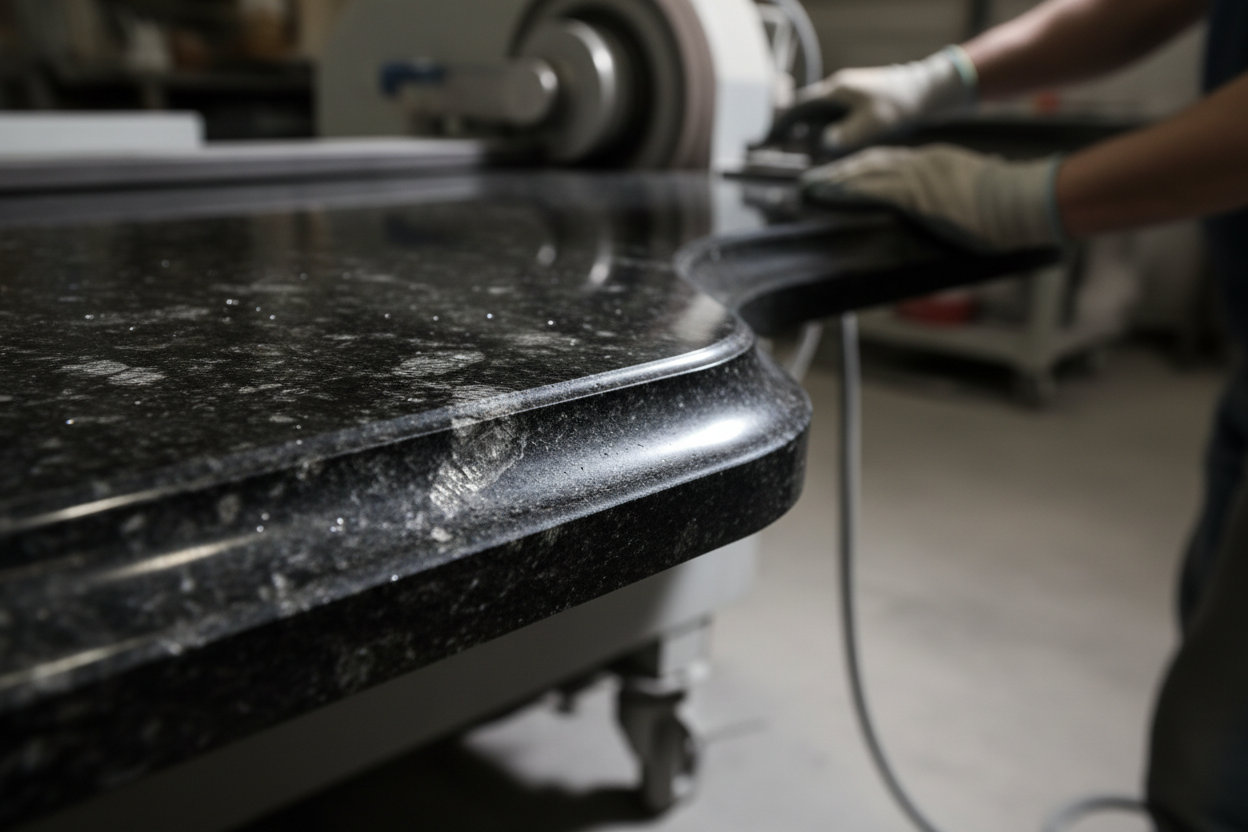
Edge profiling is where fabrication quality becomes visible — to the homeowner, to the designer, and to anyone who runs a hand along the countertop. The profile you cut defines the finished look, affects structural integrity at the edge, and determines how long the job takes. This guide covers every major edge profile, the tooling required to produce it, material-specific considerations, and the production decisions that separate efficient shops from slow ones.
Skill Level: Intermediate–Advanced | Applies To: Granite, Marble, Quartz, Quartzite, Porcelain Slab, Ultra-Compact
Edge Profile Overview
Edge profiles fall into three broad categories based on production complexity:
| Category | Profiles | Relative Production Time |
|---|---|---|
| Simple | Eased, Beveled, Half Bullnose | Low |
| Intermediate | Full Bullnose, DuPont, Chiseled | Medium |
| Complex | Ogee, Double Ogee, Waterfall, Laminated | High |
Profile selection affects not just aesthetics but also edge durability, cleaning ease, and material yield. Thin-edge profiles (eased, beveled) are more prone to chipping on brittle materials like porcelain. Rounded profiles (bullnose) are more forgiving. Complex profiles (ogee, laminated) require more passes, more tooling, and more polishing time.
Eased / Straight Edge
The eased edge is the industry workhorse — a flat vertical face with a slight break (chamfer) on the top corner to remove the sharp 90° arris. It's clean, modern, and fast to produce.
Tooling: A single router pass with a chamfer or easing bit, or a hand pad on the corner. On an edge machine, one wheel handles it.
Production notes:
- Fastest profile to produce — minimal setup, one pass
- The bottom edge also typically gets a small easing to prevent chipping during installation
- Polishing is straightforward: flat face, flat bottom, small chamfer
Best for: Contemporary kitchens, high-volume shops, waterfall islands (where the edge face is the feature), commercial work
Material note: Works on all materials. On porcelain and ultra-compact, the eased profile is often preferred because complex profiles risk edge chipping on these brittle materials.
Pro Tip: The size of the easing matters. A 1/16" break reads as sharp and modern. A 1/8" break reads as softer and more traditional. Standardize your easing size across the shop to keep jobs consistent.
Beveled Edge
A bevel is an angled flat cut on the top edge — typically 45°, though shallower angles (22.5°) are also common. It adds visual interest without the complexity of a curved profile.
Tooling: Chamfer router bit at the specified angle, or a tilting head on an edge machine. The bevel face must be polished separately from the flat top and vertical face.
Production notes:
- Three distinct surfaces to polish: top flat, bevel face, vertical face
- Bevel width is typically 3/16" to 3/8" — wider bevels read as more dramatic
- The inside corner where the bevel meets the top flat is a common polish trap — don't skip it
Best for: Transitional kitchens, bathroom vanities, bar tops
Pro Tip: On dark granites and quartzites, a polished bevel creates a strong light-catching line that highlights the stone's movement. On lighter stones, it's more subtle. Factor this into your client consultation.
Bullnose & Half Bullnose
The bullnose is a fully rounded edge — the top corner curves continuously from the top face to the vertical face, meeting at a tangent. The half bullnose (also called a demi-bullnose or eased bullnose) rounds only the top corner, leaving the lower portion of the edge face flat and vertical.
Tooling: Profile wheel on an edge machine (most efficient) or a bullnose router bit for portable work. Requires careful polishing through the full grit sequence on the curved surface.
Production notes:
- Full bullnose requires the edge machine to be set up for the full radius — typically equal to half the slab thickness
- Half bullnose is faster and more forgiving; the flat lower face is easier to polish than a full curve
- Both profiles are very forgiving of minor chips during installation — the rounded geometry distributes impact
- Polishing the curved surface requires consistent pressure and speed — flat spots show immediately
Best for: Traditional and transitional kitchens, family homes, any application where edge durability matters
Pro Tip: Full bullnose on thick (3cm) slabs is a significant profile — it reads as heavy and substantial. On 2cm material it can look thin and unfinished. Consider laminating 2cm material before bullnosing if the client wants a full rounded look.
Ogee & Double Ogee
The ogee is an S-curve profile — a concave cove transitioning into a convex round. It's the most recognizable "traditional" countertop edge and requires the most tooling passes of any standard profile.
Tooling: Minimum two router bits or profile wheels: one for the cove (concave), one for the round (convex). Many shops use a dedicated ogee bit that cuts both in one pass on softer stones, but granite typically requires separate passes.
Production notes:
- The transition point between the cove and the round is the hardest area to polish cleanly — it's a tight inside corner
- Double ogee adds a second S-curve below the first, requiring additional passes and significantly more polishing time
- Ogee profiles are sensitive to slab thickness variation — a slab that varies 1–2mm in thickness will show in the profile geometry
- Price accordingly: ogee and double ogee should carry a significant upcharge over simple profiles
Best for: Traditional kitchens, formal dining rooms, high-end residential where the client is paying for detail
Material note: Avoid ogee on porcelain, ultra-compact (Dekton, Neolith), and highly fissured quartzites. The tight inside corner of the cove is a stress concentration point and a chipping risk on brittle materials.
Pro Tip: The ogee profile collects water and debris in the cove. Mention this to clients during consultation — it's not a defect, it's a cleaning consideration. Clients who know in advance don't call back.
Waterfall / Mitered Edge
The waterfall edge isn't a profile in the traditional sense — it's a 45° miter joint where the countertop surface continues vertically down the cabinet face, creating the illusion of a continuous slab flowing from horizontal to vertical. It's the most structurally demanding edge treatment in residential fabrication.
Tooling: Bridge saw with a tilting (revolving) head capable of accurate 45° cuts, or a dedicated miter sled. Both pieces must be cut to exactly 45° — any deviation shows as a gap or a proud edge at the joint.
Production notes:
- The miter joint must be cut, dry-fit, adhesive-joined, and clamped — this is a two-person operation
- Veining must be bookmatched or at minimum flow consistently across the miter joint — slab selection is critical
- The joint is structural: use epoxy or a high-strength polyester, not standard knife-grade
- Rodding (fiberglass rod reinforcement) across the back of the miter joint is strongly recommended for spans over 18"
- The vertical panel must be secured to the cabinet substrate — it cannot hang unsupported from the miter joint alone
Best for: Contemporary and minimalist kitchens, islands with visible sides, high-end residential
Material note: Waterfall edges work best on materials with strong, readable veining (marble, quartzite, bookmatched granite). On uniform materials (solid quartz, honed black granite), the joint is visible and the effect is less dramatic.
Pro Tip: Always cut a test miter on scrap from the same slab before cutting the finished pieces. Saw calibration drift is common and a 0.5° error on a 45° miter produces a visible gap. Verify before you cut.
Chiseled / Rough Edge
The chiseled edge (also called a natural, rough, or hand-chiseled edge) replicates the look of stone broken along its natural cleavage plane. It's an intentionally irregular, textured edge that contrasts with the polished top surface.
Tooling: Hand chisel and hammer for true hand work; pneumatic chisel for production volume; some shops use a specialized chiseling attachment on a grinder. The edge is typically left unpolished or lightly brushed.
Production notes:
- True hand chiseling is slow — price accordingly
- The chiseled edge is inherently variable; no two edges are identical. Set client expectations clearly
- Granite chisels cleanly along crystal boundaries. Marble and limestone chisel more predictably. Quartz and ultra-compact do not chisel — they fracture unpredictably
- The top arris where the polished face meets the chiseled edge needs a clean, consistent break — use a router to establish this line before chiseling
Best for: Rustic, farmhouse, and Mediterranean kitchens; outdoor applications; feature islands
Pro Tip: Establish the top break line with a router before chiseling. This gives you a clean, consistent transition between the polished top and the rough edge — without it, the chiseling tends to wander onto the top face.
DuPont Edge
The DuPont edge features a flat top, a small cove (concave curve) transitioning to a flat vertical face. It's a cleaner, more restrained version of the ogee — one curve instead of two — and reads as contemporary rather than traditional.
Tooling: One cove router bit or profile wheel, plus polishing of the flat top, cove, and vertical face. Fewer passes than ogee but more than eased or beveled.
Production notes:
- The inside corner of the cove is the polish challenge — same as ogee but only one transition to manage
- DuPont is often confused with eased by clients — show samples, not just drawings
- Works well on 3cm material; on 2cm it can look shallow and undefined
Best for: Transitional kitchens, bathroom vanities, clients who want detail without the full traditional ogee look
Pro Tip: The DuPont is an underused profile — it photographs well, it's faster than ogee, and it reads as more refined than a simple eased edge. Worth showing clients as an option between eased and ogee.
Laminated & Stacked Edges
Laminated edges add a second piece of stone to the underside of the countertop edge, creating the appearance of a thicker slab. Common on 2cm material to achieve a 4cm or 6cm visual thickness, or on 3cm material to achieve a mitered or built-up look.
Tooling: Straight cuts on the bridge saw, adhesive joining, clamping, and then profiling the combined edge as a unit. The joint line between the two pieces must be tight and color-matched.
Production notes:
- The laminate strip must come from the same slab as the countertop — color and pattern matching is critical
- Joint line placement matters: a centered joint reads as intentional; an off-center joint reads as a mistake
- The laminate adds significant weight — factor this into substrate and support requirements
- Any profile can be applied to a laminated edge; the combined thickness opens up profile options not possible on single-thickness material
Best for: 2cm material that needs visual weight, waterfall islands, any application where slab thickness is a design feature
Pro Tip: Cut laminate strips from the offcut of the same slab immediately after the main cuts, before the slab leaves the shop. Trying to match a laminate strip from a different slab later is a color-matching nightmare.
Tooling & Equipment by Profile
| Profile | Portable Router | Edge Machine | Bridge Saw Required | Relative Cost |
|---|---|---|---|---|
| Eased | Yes | Yes | No | $ |
| Beveled | Yes | Yes | No | $ |
| Half Bullnose | Yes | Yes | No | $$ |
| Full Bullnose | Yes | Yes | No | $$ |
| DuPont | Yes | Yes | No | $$ |
| Ogee | Yes (2 bits) | Yes | No | $$$ |
| Double Ogee | Yes (3+ bits) | Yes | No | $$$$ |
| Chiseled | Partial | No | No | $$$ |
| Waterfall | No | No | Yes (45°) | $$$$ |
| Laminated | Varies | Varies | Yes | $$$–$$$$ |
Material-Specific Considerations
| Material | Best Profiles | Avoid | Notes |
|---|---|---|---|
| Granite | All profiles | — | Most forgiving material for edge work |
| Marble | Eased, Bullnose, Ogee, Waterfall | Chiseled (unpredictable) | Softer — profiles cut faster but scratch more easily during production |
| Quartzite | Eased, Beveled, Bullnose | Ogee, Double Ogee | Highly variable hardness; fissured material chips at tight inside corners |
| Engineered Quartz | Eased, Beveled, Bullnose, DuPont | Chiseled | Consistent hardness; profiles cut predictably but material doesn't chisel |
| Porcelain Slab | Eased, Beveled, Mitered | Ogee, Bullnose, Chiseled | Brittle — complex profiles risk edge chipping; specialized tooling required |
| Ultra-Compact (Dekton, Neolith) | Eased, Beveled, Mitered | Ogee, Chiseled | Extremely hard and brittle; use manufacturer-recommended tooling only |
Common Mistakes to Avoid
- Profiling after final polish. Routing generates heat and micro-scratches. Always profile before your final polish pass — never after.
- Using the wrong profile on brittle materials. Ogee and chiseled profiles on porcelain or ultra-compact will chip at the inside corners. Match the profile to the material.
- Skipping the bottom easing. The bottom edge of the countertop gets chipped during installation more than any other surface. Always ease the bottom arris, even on simple profiles.
- Not establishing a router line before chiseling. Chiseling without a defined top break line causes the rough edge to wander onto the polished top face.
- Cutting waterfall miters without a test piece. Saw calibration drift is common. A 0.5° error on a 45° miter produces a visible gap. Always verify on scrap first.
- Laminating from a different slab. Color and pattern variation between slabs is almost always visible at the laminate joint. Cut laminate strips from the same slab, same day.
- Skipping grits on curved profiles. Curved surfaces (bullnose, ogee cove) are harder to polish evenly than flat faces. Skipping grits leaves scratches that are very difficult to remove after the fact.
- Not pricing complex profiles correctly. Ogee, double ogee, waterfall, and laminated edges take significantly more time than eased or beveled. Flat-rate edge pricing loses money on complex jobs.
Frequently Asked Questions
What is the most popular countertop edge profile?
The eased edge is the most commonly specified profile in contemporary residential work — it's clean, fast to produce, and suits the flat-front cabinet styles that dominate current kitchen design. Bullnose remains popular in traditional and transitional kitchens. Waterfall edges are increasingly requested for islands in high-end residential projects.
What edge profile is easiest to keep clean?
The eased and beveled edges are the easiest to clean — flat surfaces with no coves or inside corners where debris accumulates. The ogee profile is the hardest to keep clean due to the concave cove. Chiseled edges trap debris in the texture but are typically used in applications where that's acceptable.
Can you put an ogee profile on quartz?
Yes — engineered quartz machines predictably and ogee profiles are routinely produced on it. The material is consistent in hardness, so tooling wear is predictable. Avoid ogee on natural quartzite with heavy fissuring, and avoid it entirely on porcelain and ultra-compact surfaces.
How thick does a slab need to be for a waterfall edge?
Waterfall edges are typically done on 3cm (1-1/4") material for structural integrity at the miter joint. 2cm material can be used but should be laminated to 4cm before mitering, or the vertical panel must be fully supported by the substrate. The miter joint alone is not sufficient structural support for an unsupported 2cm vertical panel.
What is the difference between a DuPont and an ogee edge?
Both feature a concave cove, but the ogee adds a convex round below the cove, creating the classic S-curve. The DuPont has only the cove transitioning to a flat vertical face — one curve instead of two. DuPont reads as more contemporary; ogee reads as more traditional. DuPont is also faster to produce and easier to polish.
Can I profile porcelain tile edges?
Porcelain slab edges (large format slabs used as countertops) can be profiled, but the options are limited to simple profiles — eased, beveled, and mitered. Porcelain is brittle and the inside corners of complex profiles (ogee, bullnose) are high-risk chipping zones. Use diamond tooling rated specifically for porcelain and keep water flowing throughout.
Recommended Tools & Supplies
The following products are available at Pro Tool Haus:
Edge Profiling
Cutting (Waterfall & Laminated Edges)
Polishing
- 3-Step Diamond Polishing Pads: Chido vs. EZ3 vs. Trio
- How to Re-Polish, Hone, and Leather Stone Countertops
Diamond Blades (Porcelain & Ultra-Compact)
Full Fabrication Workflow