


Description
The Tenax Epoxart Kit 3:1 is the thinnest-flowing system in the Epoxart line — engineered for applications where maximum penetration, extended working time, and best-in-class UV stability are critical. Its water-thin viscosity flows freely into hairline cracks and micro-fissures, flooding fractured stone and letting the resin find every fissure without racing the clock. With 150–180 minutes of open time and the highest sunlight stability rating of the three Epoxart ratios (3-year Xenon test, ISO 11341), it's the conservative choice for porous stone, outdoor work, and any application where the resin line will see UV for years.
Key Features
- Thinnest flow of the three — deepest penetration into porous, fractured, and micro-fissured stone
- Longest open time — 150–180 min gel time; flood a fractured slab and keep working without rushing
- Best UV stability in the Epoxart line — highest rating on the 3-year Xenon test (ISO 11341); ideal for outdoor and sun-exposed applications
- High transparency — crystal-clear cure that disappears into the crack, preserving the stone's natural look
- Good cold reactivity — performs reliably in cooler shop or jobsite conditions
- Medium hardness — Shore D 78–80; flexes slightly to resist re-cracking under load
Cure Times (from Tenax TDS rev 03, 09/2025)
- Gel time in cup @ 77°F (25°C): 150–180 min
- Tack-free @ 77°F (25°C): 300–360 min
- Ready to polish/cut @ 77–95°F (25–35°C): 24–48 hrs
- Ready to polish/cut @ 59–77°F (15–25°C): 48–72 hrs
- Minimum cure temp: 59°F (15°C)
- Service range after cure: -13°F to 140°F (-25°C to +60°C)
Ideal Applications
- Porous and fractured stone requiring deep resin penetration
- Outdoor stone surfaces and countertops exposed to sunlight for years
- Hairline and micro-crack filling in granite, marble, quartzite, and natural stone
- Fiberglass mesh reinforcement of fragile or brittle stone slabs
- Cold-environment fabrication shops and jobsites
Epoxart Kit A+B — Which Ratio Do You Need?
Same proven Tenax epoxy chemistry, three cure profiles. Every kit includes Part A (resin) and Part B (hardener) — always mixed together by weight. All three cure to the same hardness (Shore D 77–80). The difference is cure speed, flow, and sunlight stability.
| Spec | 2:1 | 3:1 ★ | 4:1 |
|---|---|---|---|
| Mix ratio (A : B, by weight) | 2 : 1 | 3 : 1 | 4 : 1 |
| Mixed consistency | Thin syrup — very fluid, wets out mesh and laminations | Thin syrup — thinnest of the three, deepest soak-in | Runny honey — stays where you put it |
| Working time in the cup — 77°F (25°C) | 55–75 min | 150–180 min | 7–8 minutes |
| Tack-free — 77°F (25°C) | ~240 min | 300–360 min | 100–110 min |
| Ready to polish / cut — shop temp 77–95°F (25–35°C) | 8-24 hrs | 24–48 hrs | 6–8 hrs |
| Ready to polish / cut — cool shop 59–77°F (15–25°C) | 48 hrs | 48–72 hrs | 24–48 hrs |
| Sunlight stability (3-yr Xenon test, ISO 11341) | Medium-good — made for laminated & colored work | Good — best of the three | Good |
| Best for | Crack repair, lamination, fiberglass netting, colored materials | Porous / fractured stone, outdoor work | Production speed, halo-sensitive white materials |
| Cured hardness (Shore D) | 77–80 | 78–80 | 78–80 |
| Minimum shop temp to cure | 59°F (+15°C) — all kits | ||
| Service temp after full cure | -13°F to 140°F (-25°C to +60°C) — all kits | ||
Every kit, every time:
- Mix Part A + Part B by weight, not volume — the ratio is in the kit name.
- Stone must be completely dry and clean before resining.
- 4:1 users: mix only what you can apply in about 5 minutes. Pot life is 7–8 minutes at 77°F (25°C).
- Never use PVC containers; keep resin away from copper and brass.
- Gloves and safety glasses required. See the SDS before use.
- Store sealed in original containers at 68–77°F (20–25°C). Do not let the resin freeze. Shelf life 24 months.
Data: Tenax S.p.A. technical data sheets rev 03 (03/09/2025). Laboratory values, indicative — always test on your specific material.
Kit Contents
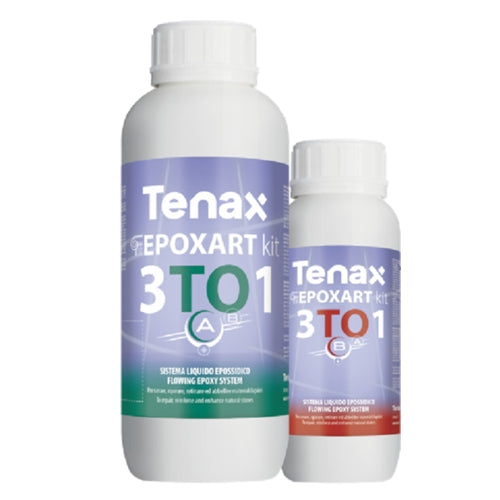
- Epoxart A-5004 — 1 kg (Resin, Part A)
- Epoxart B-BM30 — 0.3 kg (Hardener, Part B)
- Total kit weight: 1.3 kg
- Mix ratio: 3 parts resin : 1 part hardener (by weight)
How to Use
- Clean and thoroughly dry the stone surface — remove all dust, oils, and debris from the crack area.
- Measure by weight: 3 parts resin (Part A) to 1 part hardener (Part B).
- Mix thoroughly using clean corrosion-resistant plastic tools — never PVC, copper, or brass.
- Apply directly into cracks — the water-thin formula self-levels and penetrates by capillary action. Wear safety gloves and glasses.
- Allow full cure before grinding, polishing, or loading the surface.
- Reseal containers immediately; never let the resin freeze.
Storage & Shelf Life
- Store below 35°C (95°F), away from heat, direct sunlight, humidity, and freezing
- Shelf life: 24 months sealed at 68–77°F (20–25°C)
Not sure which Epoxart ratio is right for your job?
Read our full comparison: Tenax Epoxart 2:1 vs 3:1 vs 4:1 — Which Stone Epoxy Ratio Do You Actually Need?
Choosing the Right Epoxart Kit
- Epoxart Kit 2:1 — very fluid, high-adhesion; best for lamination, fiberglass netting, and colored materials
- Epoxart Kit 3:1 (this product) — thinnest flow, longest open time; best for porous/fractured stone and outdoor work
- Epoxart Kit 4:1 — fastest cure, natural effect; best for production speed and white/color-sensitive stone
Works Well With
- Tenax Epoxart Kit 2:1 — use first for lamination and fiberglass netting before crack filling with 3:1
- Tenax Epoxart Kit 4:1 — for fiberglass mesh reinforcement on the back of slabs when speed is needed
- Tenax Fixtop Knife Grade Epoxy — knife-grade 2-part epoxy for bonding and laminating stone
- Tenax Mixing Cups 12oz (50/Sleeve) — disposable cups for measuring and mixing epoxy components
- Tenax Colored Knife Grade Polyester — for surface chip and void repairs after crack consolidation
Technical data from Tenax S.p.A. technical data sheets rev 03 (03/09/2025). All values are laboratory results and indicative; always test on your specific material.